Market Your Book Like a Bestselling Author Without the Overwhelm, Gimmicks, or Massive Budget
Everything you need to get your book discovered and selling, proven marketing strategies, tool comparisons, and insider tactics from authors who’ve launched successfully.
- Used by bestselling authors
- 100% Free resources
- No fluff, just Strategies
Marketing is what separates books that sell from books that sit invisible on digital shelves
But most authors approach it with dread and confusion, throwing money at ads that don’t work, posting on social media that nobody sees, or giving up entirely because “marketing doesn’t work for them.”
Below you’ll find everything you need to market your book effectively how to build your author platform before launch, launch strategies that actually generate sales, honest comparisons of marketing tools and advertising platforms, organic marketing tactics that don’t cost a fortune, how to decide between Amazon Ads and Facebook Ads, and the critical marketing mistakes that tank book sales. Whether you’re launching your first book or your tenth, start with the section that addresses your biggest challenge and begin building a marketing machine that works for you.
Market your book Topics
Click below below to jump straight to the topic.

Your Complete Marketing Roadmap: From Unknown Author to Unforgettable Brand

Writing the book was the first mountain. Publishing it was the second. Now you stand before the third and most challenging peak of all: marketing. More brilliant books die quiet deaths from poor marketing than from any other cause.
In a world where over two million books are published every year, simply writing a great book and putting it on Amazon is not enough. You have to build a system, a machine, that connects your book with the readers who are actively searching for it, and then turns those readers into lifelong fans.
This roadmap is your complete, strategic guide to building that machine. We’re going to move beyond random tactics and into a proven, interconnected system for marketing your book effectively for years to come. This isn’t about spamming social media or throwing money at ads that don’t work. It’s about building a sustainable, long-term marketing ecosystem.
We’ll cover the foundational principles of Building Your Author Platform Before You Launch, the critical role of Email Marketing for Authors, the basics of Paid Advertising, and the power of Organic Marketing Strategies that don’t cost a fortune. Whether you’re a complete beginner or looking to improve your existing results, this roadmap will give you the strategic sequence that successful authors follow.
author marketing ecosystem platform email ads organic strategy
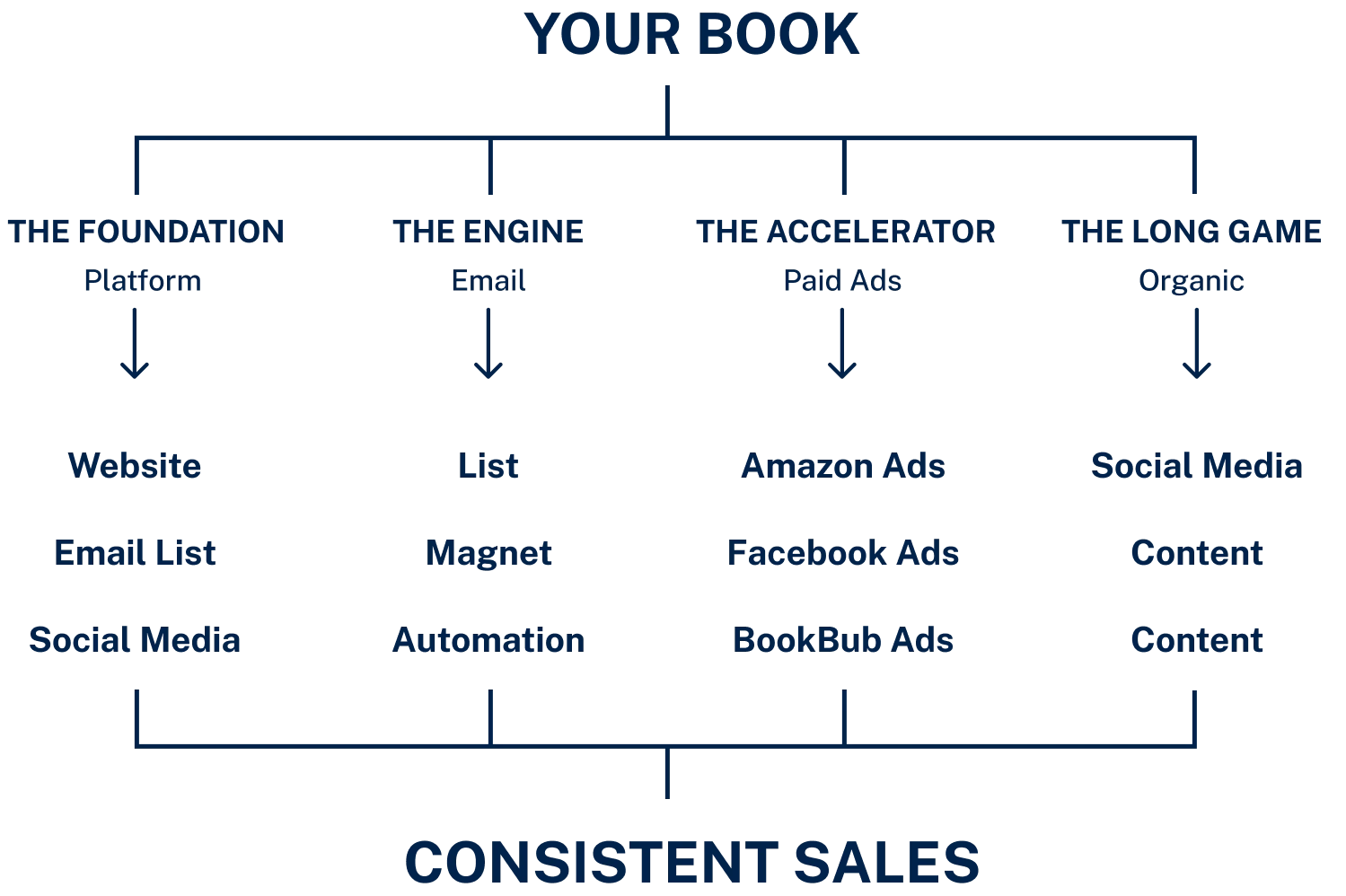
The Foundation
Your Author Platform

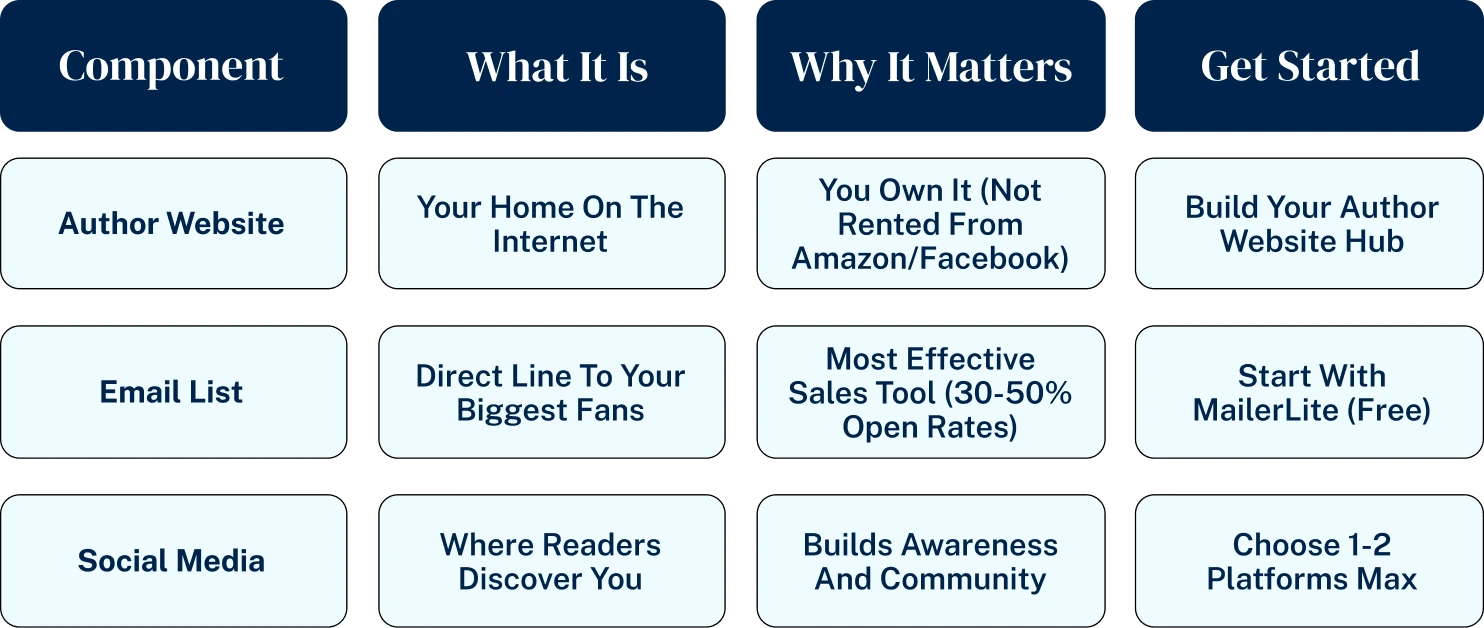
Your author platform is the sum of your direct connections to your readers. It’s your Author Website, your Email List, your social media presence, and your network of author and influencer relationships. It is the single most valuable asset you will ever build. Why? Because you own it.
Amazon can change its algorithm, Facebook can limit your reach, but no one can take away your email list or your website. Your platform is your direct line to your audience, allowing you to launch books, promote sales, and build a real, lasting career.
The Core Components:
- An Author Website: This is your home on the internet. It’s where readers can find your books, sign up for your email list, and learn more about you. Our Build Your Author Website hub is your complete guide to creating a professional site from scratch.
- An Email List: This is the heart of your platform. Your email list is a direct, intimate connection to your most loyal readers. It is, without question, the most effective sales tool you will ever have. Our guides on Building an Author Email List with MailerLite and 5 Essential Email Automations for Authors with GoHighLevel are required reading.
- A Focused Social Media Presence: You don’t need to be everywhere. Choose one or two social media platforms where your target readers hang out and focus on providing value there. Our guide on Choosing the Right Social Platforms for Your Genre can help.
Building your platform is not something you do after you publish; it’s something you start today. Our deep dive on Starting From Zero: The 90-Day Author Platform Plan provides a step-by-step guide.
author platform components website email social media
Pro tip:
Don't wait until your book is published to build your platform. Start building your email list TODAY, even if your book won't be ready for 6-12 months. Offer a free short story, a character guide, or a helpful checklist as a Reader Magnet. By launch day, even a small list of 100 engaged subscribers can generate 20-30 sales in the first week—enough to trigger Amazon's algorithms and get your book noticed. Every successful author wishes they'd started their list sooner.
The Engine
Email Marketing

If your platform is the foundation, your email list is the engine that drives your sales. Email marketing consistently outperforms every other marketing channel for authors, and it’s not even close.
When you have a new book, a special promotion, or exciting news, you can send an email and see sales within minutes. It’s that powerful.
- The Strategy: The goal of your email list is to build a relationship with your readers. You do this by offering a valuable Reader Magnet (like a free short story or a helpful checklist) in exchange for their email address. Then, you nurture that relationship with a welcome sequence of automated emails that introduce you and your work. Our guides on How to Create a High-Converting Reader Magnet and Setting Up Your First Email Automation with MailerLite walk you through the entire process. For authors who want to build a truly powerful, automated marketing machine, our content on GoHighLevel for Authors is the next level.
Pro tip:
our email list is the only marketing channel you truly own. Amazon can change its algorithm tomorrow, Facebook can limit your reach, but no one can take away your email list. Treat it like the most valuable asset in your author business—because it is. Use MailerLite (free up to 1,000 subscribers) or GoHighLevel (for advanced automation) to manage your list professionally. Even a small, engaged list of 500 subscribers is worth more than 10,000 social media followers.
The Accelerator
Paid Advertising
Once you have a book that is proven to sell (meaning it has a professional cover, a great blurb, and good reviews), you can pour gasoline on the fire with paid advertising.
Paid ads on platforms like Amazon Ads, Facebook Ads, and BookBub Ads can get your book in front of hundreds of thousands of your ideal readers, fast.
- The Big Three Ad Platforms for Authors:
- Amazon Ads: The most direct way to reach readers who are already on Amazon with the intent to buy a book. You can target specific keywords, genres, and even the sales pages of other popular authors.
- Facebook Ads: Allows for incredibly detailed audience targeting based on interests, demographics, and behaviors. Great for reaching readers who may not have heard of you yet.
- BookBub Ads: Allows you to advertise to BookBub’s massive list of power readers. Can be very effective, but also very competitive.
Paid advertising has a steep learning curve and can be a quick way to lose money if you don’t know what you’re doing. Our Amazon Ads vs. Facebook Ads hub provides a detailed comparison, and our Beginner’s Guide to Paid Advertising will help you set your budget and your expectations.
The Long Game
Organic & Content Marketing

Organic marketing is the process of attracting readers naturally over time without paying for ads. This includes strategies like Social Media Marketing, Blogging, Podcast Guesting, and Cross-Promotions with Other Authors. While slower than paid ads, these strategies are often more sustainable and build a more loyal, long-term fanbase.
- Key Organic Strategies:
- Content Marketing: Creating valuable content that your target readers will find helpful or entertaining. This could be blog posts about your writing process, YouTube videos about the history behind your novels, or bonus content related to your books. This very hub page is an example of content marketing!
- Social Media Engagement: Don’t just broadcast “buy my book.” Engage in conversations, share other authors’ work, and be a valuable member of the reader community.
- Author Collaborations: Partner with other authors in your genre to do newsletter swaps or social media takeovers. This is one of the fastest ways to grow your audience for free. Services like StoryOrigin make this easy.
Your marketing roadmap is a combination of all these elements working in harmony. You build the platform, you power it with email, you accelerate it with ads, and you sustain it with organic marketing. It’s a system that takes time to build, but once it’s running, it can sell your books for years to come.
author marketing roadmap timeline beginner-to advanced
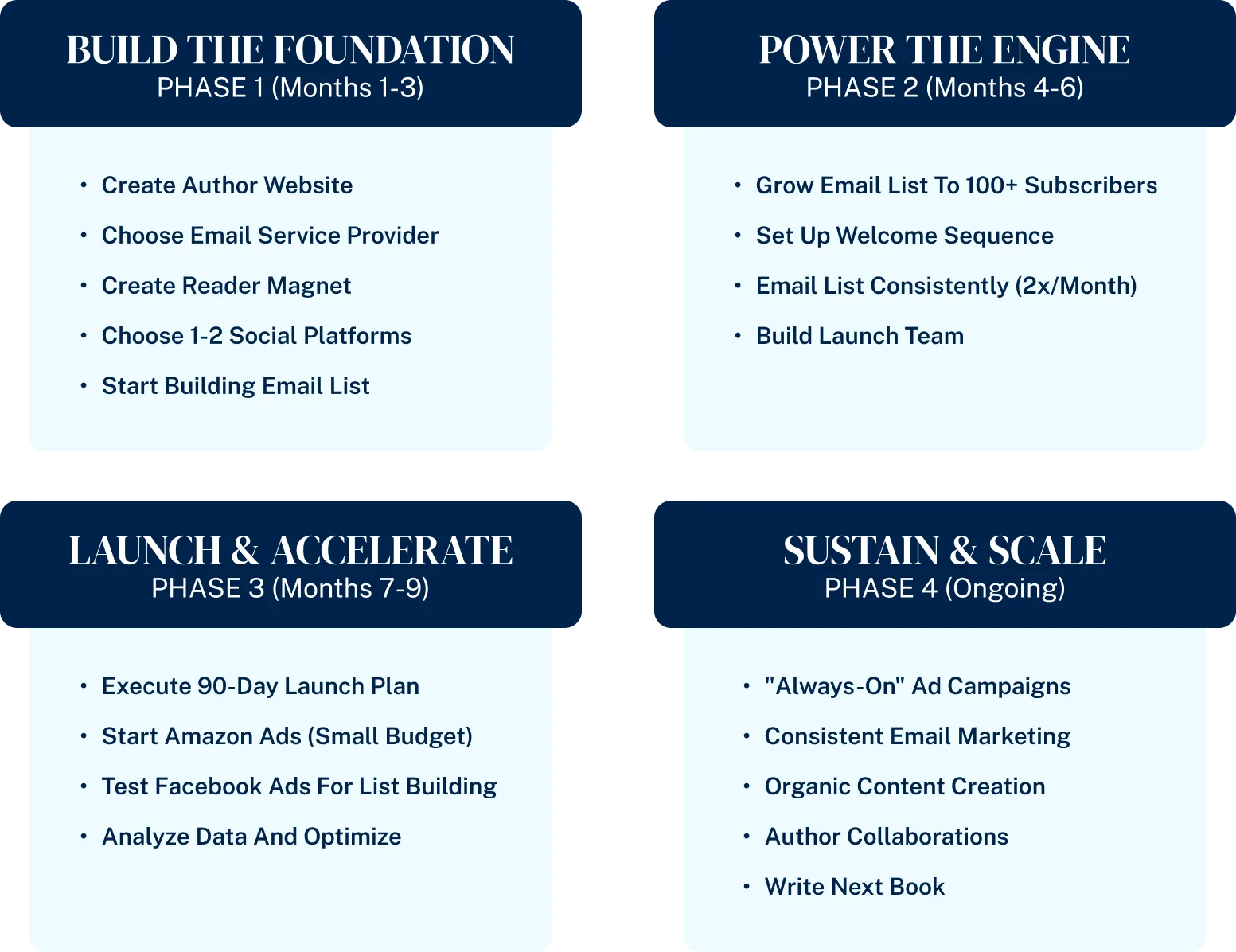

The 90-Day Pre-Launch: Building Your Runway

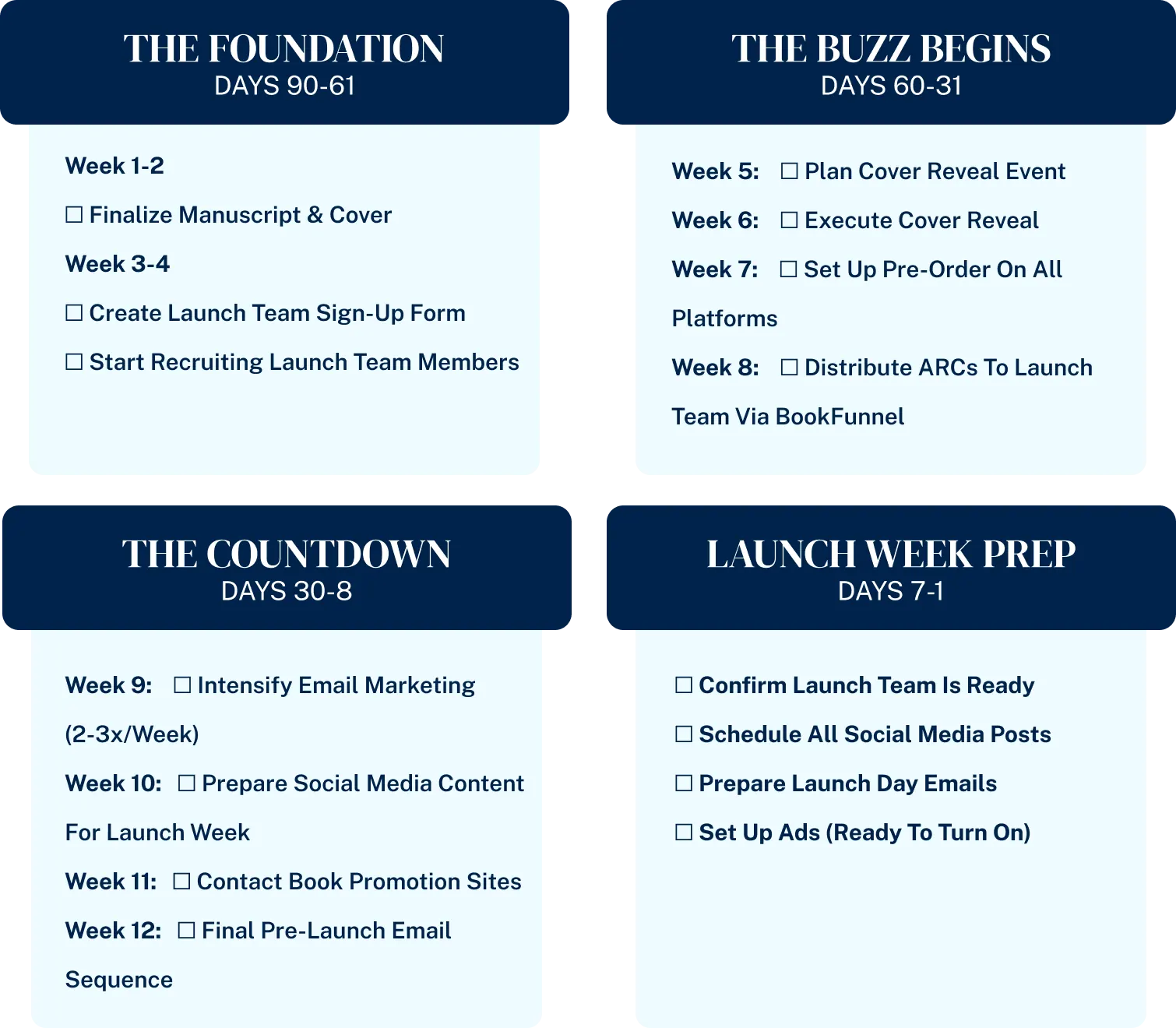
Your launch begins long before your book is available for sale. The 90 days leading up to your launch are dedicated to building the assets and the audience you’ll need for a successful release.
90 day book launch calendar pre launch checklist
90 Days Out
The Foundation
- Finalize Your Manuscript: Your book should be fully edited and formatted.
- Finalize Your Cover: Your cover should be complete and ready to be revealed.
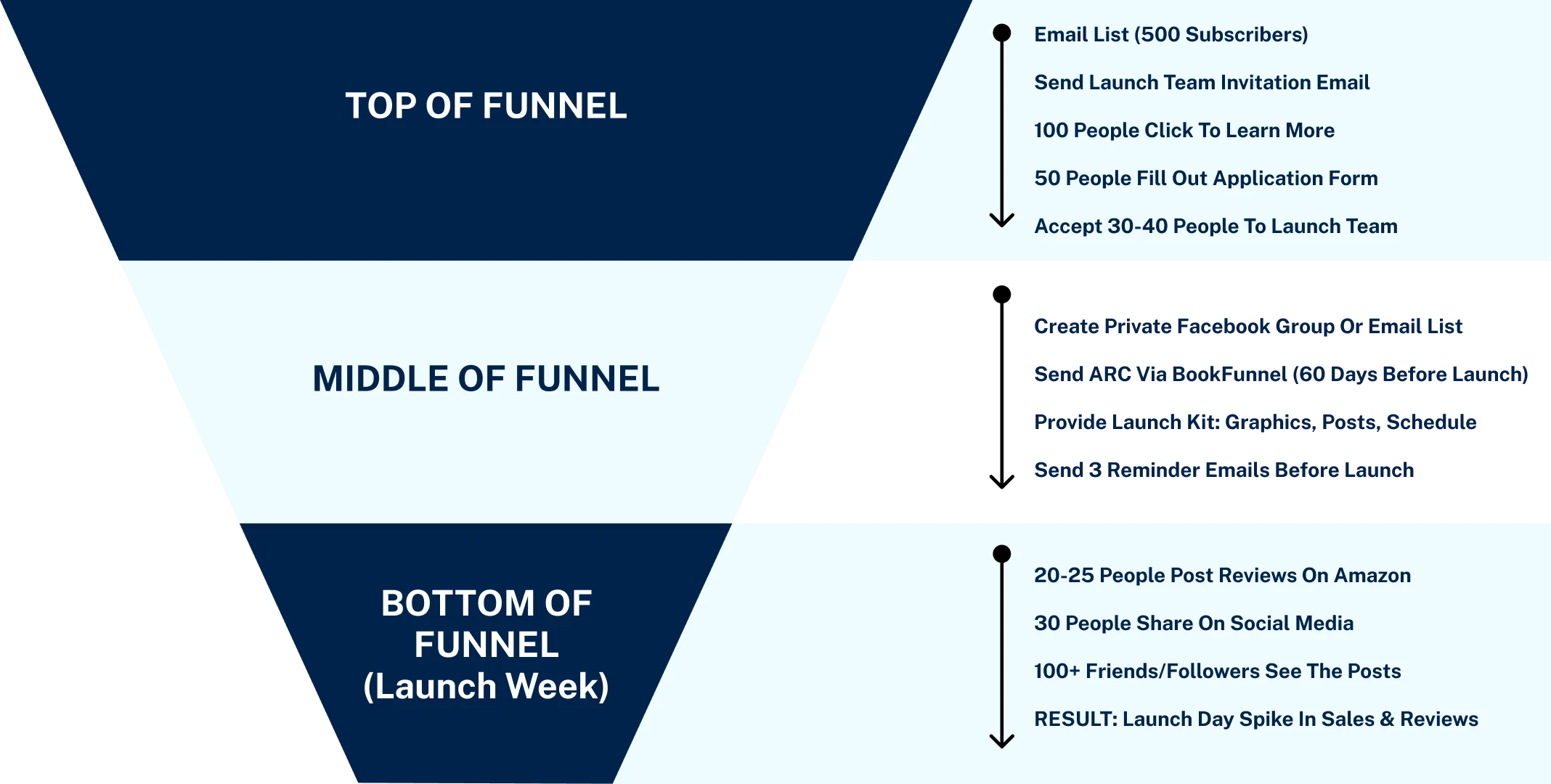
- Start Building Your Launch Team: Create a sign-up form using Google Forms, MailerLite, or GoHighLevel and start recruiting members from your existing email list and social media followers. Our guide “How to Build a Launch Team That Gets Results” provides email templates.
HOW TO BUILD A 30-PERSON LAUNCH TEAM
60 Days Out
The Buzz Begins
- Cover Reveal: This is a major marketing event. Plan a coordinated cover reveal with your launch team and other author friends. Build anticipation for a week beforehand.
- Set Up Your Pre-Order: Make your book available for pre-order on all major platforms. This allows you to start collecting sales that will all count on launch day.
- Distribute Your ARCs: Send the Advance Reader Copy of your book to your launch team using a secure service like BookFunnel. This gives them plenty of time to read the book and prepare their review.
Pro tip:
Use BookFunnel to distribute your ARCs instead of emailing PDF files. BookFunnel costs just $20/year and delivers your book securely to your launch team's e-readers while preventing piracy. It also tracks who has downloaded your ARC, so you can send targeted reminder emails to people who haven't read it yet. This one tool can increase your launch day review count by 30-50% because it makes it easier for your team to actually read the book.
30 Days Out
The Countdown
- Intensify Your Email Marketing: Start emailing your list more frequently. Share excerpts, character art, behind-the-scenes stories, and a countdown to launch day. Our “Pre-Launch Email Sequence Template” can be adapted for MailerLite or GoHighLevel.
- Prepare Your Social Media: Use a scheduler like Buffer or Hootsuite to plan out your entire launch week social media content in advance. This will free you up to engage with readers during launch week.
- Contact Book Promotion Sites: Schedule promotions with sites like Freebooksy, Bargain Booksy, or even a coveted BookBub Featured Deal if you can get one. These paid promotions can drive thousands of sales.
Launch Week: The 7-Day Blitz

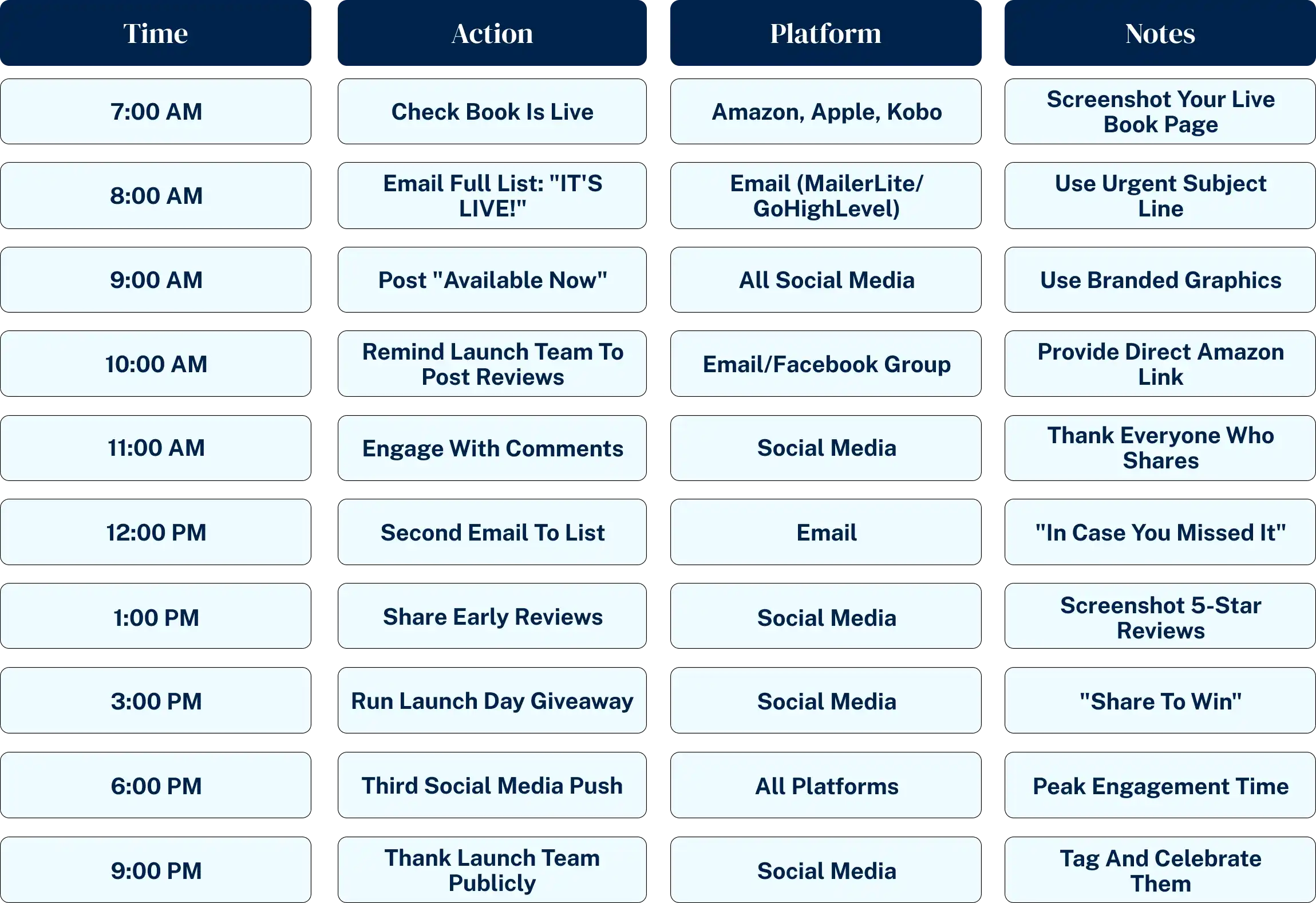
Launch Day
- 7:00 AM: Check that your book is live on all platforms.
- 8:00 AM: Send an email to your full list announcing the book is live.
- 9:00 AM: Post your “Available Now” announcements on all social media channels.
- 10:00 AM: Send a reminder to your launch team to post their reviews.
- Throughout the Day: Be present on social media. Thank people for sharing, answer questions, and share screenshots of your book climbing the charts. Run a launch-day giveaway to encourage sharing.
The 7-Day Push
- Price Pulsing: Many authors launch at a discount ($0.99 or $1.99) for the first 2-3 days, then raise the price. This creates urgency. Email your list to let them know the price is going up.
- Run Your Ads: Turn on your Amazon Ads and Facebook Ads.
- Coordinate Your Promotions: Stagger your paid promotions throughout the week to maintain a steady stream of sales.
- Keep Emailing: Email your list 3-4 times during launch week, reminding them of the book, sharing early reviews, and announcing any chart rankings you hit.
book launch day hour by hour schedule checklist
Post-Launch: Keeping the Momentum

Your launch doesn’t end after week one. The goal now is to transition to a sustainable, long-term marketing plan.
- Analyze Your Data: What worked? What didn’t? Use the data from your KDP dashboard and ad platforms to refine your strategy.
- Apply for More Promotions: Now that your book has a solid base of reviews, apply to more selective promotion sites.
- Focus on Read-Through: If your book is part of a series, your main goal now is to get readers to buy the next book. Optimize the back matter of your book with clear calls to action and links to the rest of the series. Our guide on “Maximizing Series Read-Through with GoHighLevel” shows you how to build automated email sequences that do this for you.
- Start Writing the Next Book: The best marketing you can do for your current book is to release the next one. The release of a new book will create a spike in sales for your entire backlist.
A well-executed launch is a powerful engine for a long-term author career. It takes planning and hard work, but by following this tactical playbook, you can give your book the best possible start in a competitive market.
Pro tip:
The best marketing for your last book is your next book. Readers who love your first book will eagerly buy your second, third, and fourth. This is why successful indie authors publish 2-4 books per year. After launch week, shift 80% of your focus back to writing the next book and only 20% to marketing the current one. A growing backlist is the most powerful long-term marketing strategy you have—and it's the one thing your competitors can't copy.

Compare Book Marketing Tools: The Ultimate Author Tech Stack

In the digital age, marketing your book is as much about technology as it is about creativity. The right set of tools can automate your marketing, expand your reach, and provide you with the data you need to make smarter decisions. But the market is flooded with thousands of tools all promising to be the magic bullet for author success.
From email marketing platforms and social media schedulers to landing page builders and book promotion sites, it’s a confusing and often expensive landscape to navigate. Investing in the wrong tools can waste hundreds of dollars and hours, while the right ones can 10x your results.
This section is your definitive guide to building your author tech stack. We’ve tested and compared dozens of the most popular book marketing tools to help you decide where to invest your time and money. We’ll do a head-to-head comparison of the top Email Marketing Platforms, breaking down the pros and cons of GoHighLevel vs. MailerLite vs. ConvertKit.
We’ll evaluate the ROI of the most popular Book Promotion Sites like BookBub and Freebooksy. We’ll look at Social Media Scheduling Tools that can save you hours every week, and the best platforms for delivering Reader Magnets. This is your practical, no-fluff guide to building a professional marketing toolkit that actually sells books.
The Core of Your Stack
Email Marketing Platforms

Your email list is your most valuable asset, and your Email Service Provider (ESP) is the most important tool in your entire tech stack. This is not a place to skimp. A good ESP will allow you to build automated sequences, tag your subscribers, and track your results.
email marketing platforms comparison authors mailerlite convertkit gohighlevel
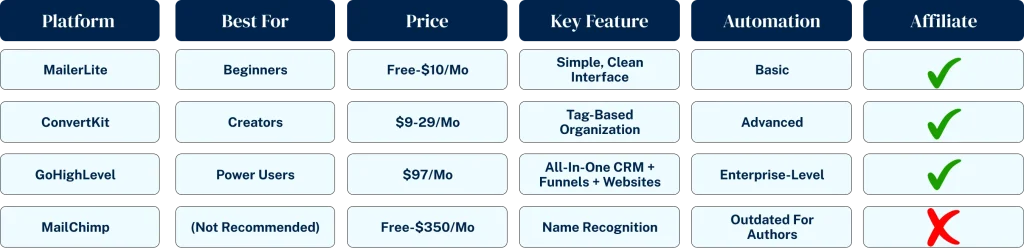
Our Recommendation: For 90% of authors, MailerLite is the perfect place to start. It’s incredibly affordable (free for your first 1,000 subscribers) and has all the power you need to build a professional email marketing system. Our Complete Guide to MailerLite for Authors shows you how to get set up.
For authors who are ready to build a true marketing and sales empire with funnels, courses, and advanced CRM, GoHighLevel is the undisputed king. It’s a significant investment, but its power is unmatched. All of our advanced automation guides are built around the power of GoHighLevel.
The Reach Multipliers
Book Promotion Sites

Book promotion sites (or “promo sites”) are services that have large email lists of readers hungry for discounted or free books. You pay a fee, and they feature your book in their daily email. A single promotion on a top-tier site can result in thousands of sales and downloads in a single day.
- The Tiers of Promo Sites:
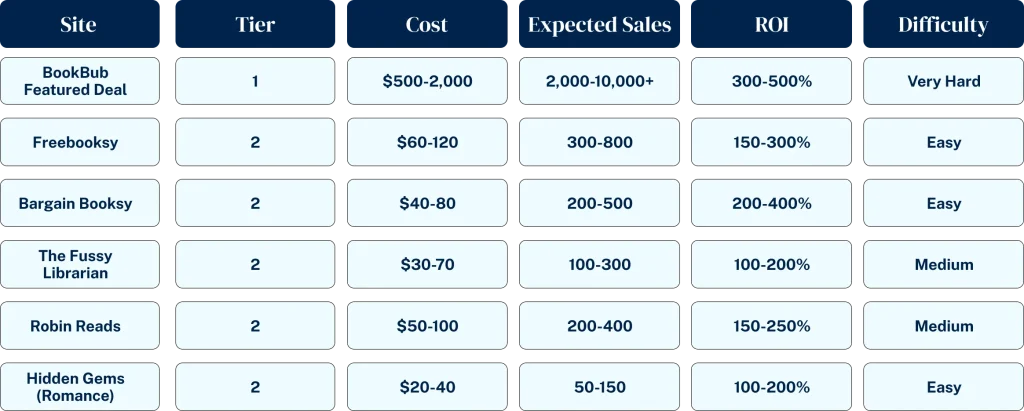
- Tier 1 (The Holy Grail): BookBub Featured Deals. Getting a featured deal on BookBub is the single most effective promotion in the industry. It’s very difficult to get (they are highly selective), but if you do, it can launch a book to the top of the charts and even make an author’s career. Our guide “How to Get a BookBub Featured Deal” breaks down what their editors are looking for.
- Tier 2 (The Workhorses): These sites have large, proven lists and deliver a reliable ROI. This includes sites like Freebooksy, Bargain Booksy, The Fussy Librarian, and Robin Reads. They are the backbone of many authors’ launch plans and weekly promotions.
- Tier 3 (The Specialists): These sites cater to specific genres, like Hidden Gems for romance or Sci-Fi Book Bonanza for science fiction. They are great for reaching a highly targeted audience.
Our “Top 10 Book Promotion Sites and Their ROI” provides a detailed breakdown of costs and expected results for the best sites on the market.
BOOK PROMOTION SITES: Cost VS Expected Sales
Pro tip:
Never pay for a book promotion site until your book has at least 10-15 reviews and a 4.0+ star rating. Promo sites drive traffic, but they can't fix a book with a bad cover, a weak blurb, or poor reviews. Fix your book's fundamentals first, then use promo sites to pour gasoline on the fire. Otherwise, you're just paying to show readers a book they won't buy—and that's a waste of money.
The Conversion Boosters
Reader Magnets & Landing Pages
To build your email list, you need to offer a compelling reader magnet. And to deliver that magnet, you need a simple, effective landing page.
- Reader Magnet Delivery: You need a way to securely deliver your free book or story to new subscribers. BookFunnel is the industry standard. It’s affordable, easy to use, and integrates with all major email providers. It can also be used to deliver ARCs to your launch team. StoryOrigin is a powerful alternative that also includes features for finding newsletter swaps and review copies.
- Landing Page Builders: A landing page is a simple, one-page website designed for a single purpose: to get a visitor to sign up for your email list. While your ESP (like MailerLite or ConvertKit) will have basic landing page features, dedicated builders like Leadpages or ClickFunnels offer more power and flexibility. For GoHighLevel users, a powerful funnel and website builder is included, making it the ultimate all-in-one solution.
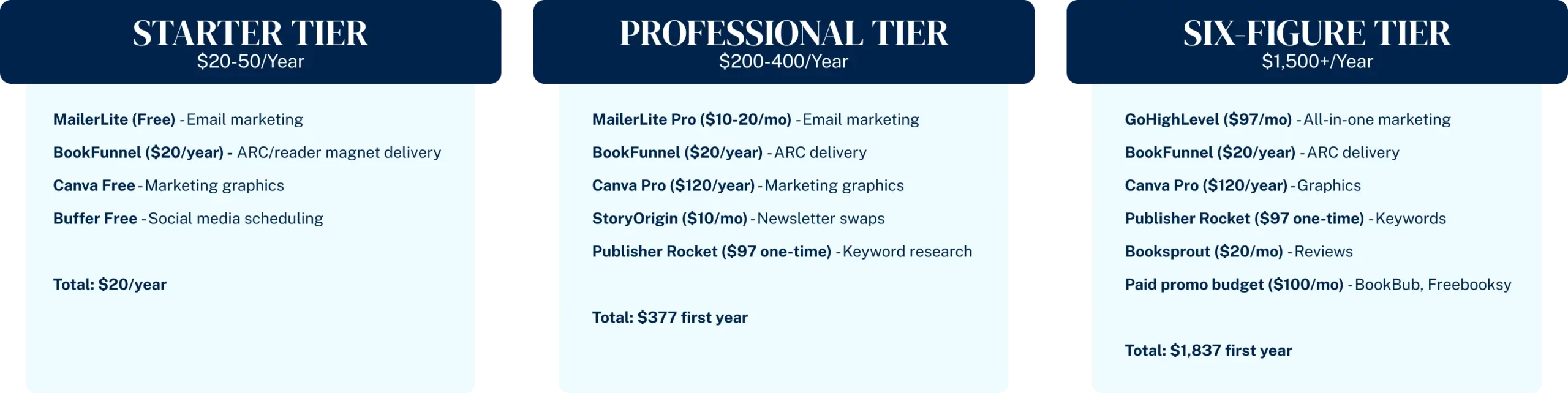
Building your author tech stack is about making smart, strategic investments. Start with the core—a great ESP like MailerLite and a delivery service like BookFunnel—and then add tools as your needs and your budget grow. The right tools won’t just save you time; they’ll build you a more professional, more profitable author business.
author marketing tech stack tools by budget tier
Pro tip:
Don't switch email service providers every time you see a shiny new feature. Migrating your list is a pain, and you risk losing subscribers in the process. Start with MailerLite (free and powerful), and only upgrade to GoHighLevel when you have 2,000+ subscribers and need advanced automation. Most six-figure authors still use MailerLite happily. The tool doesn't make you successful—your consistency and strategy do.

Build Your Author Platform From Scratch: Your First 1,000 True Fans

“Build your platform” is the most common piece of advice given to new authors, and also the most frustrating. What does it actually mean? Your author platform is not about having a million followers on TikTok or being a celebrity. It’s about building a direct, authentic connection with the readers who are most likely to love your work.
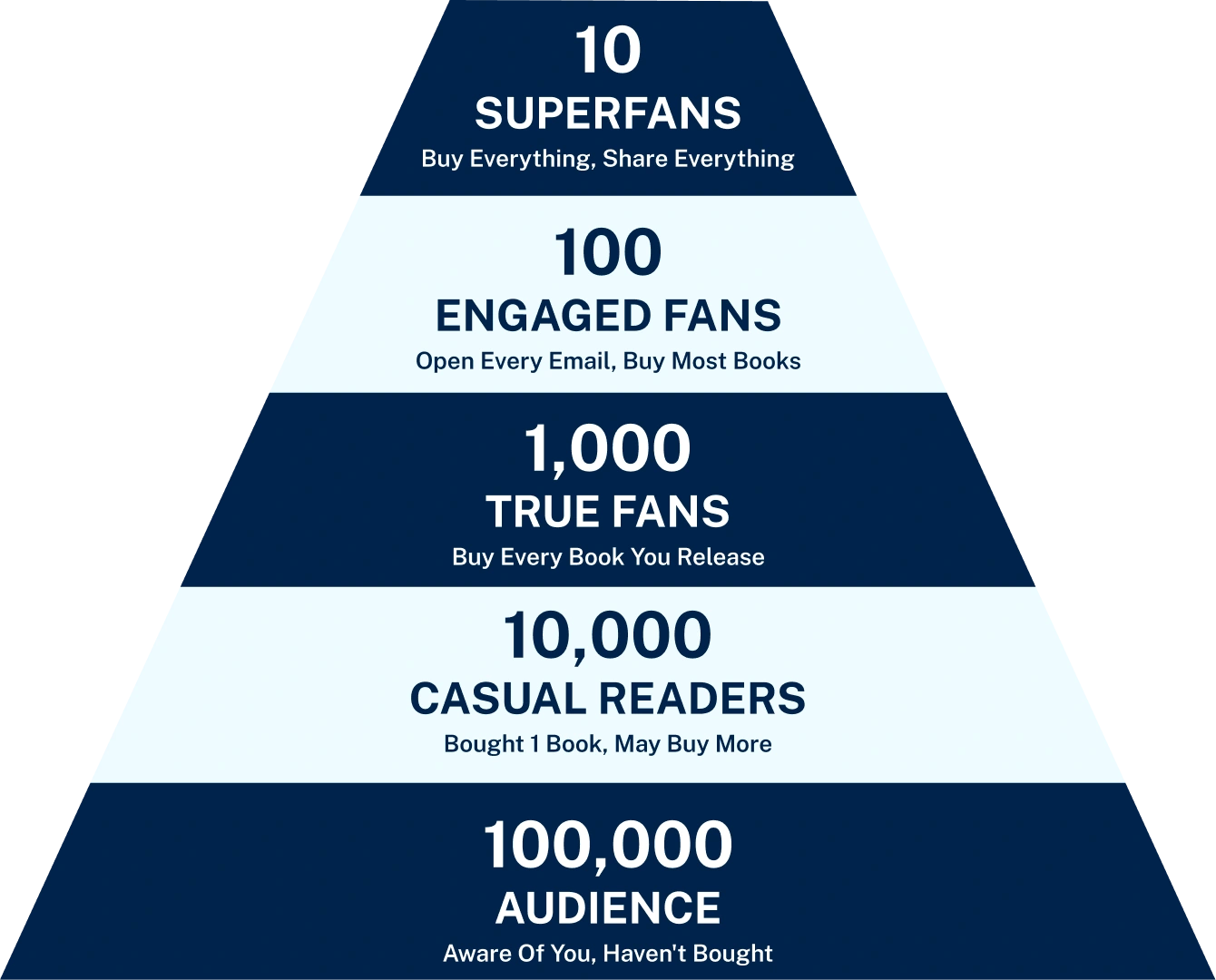
It’s about creating a system to attract your ideal readers, earn their trust, and have a reliable way to tell them when you have a new book. You don’t need a massive platform to be successful; you need the right platform. The famous “1,000 True Fans” theory states that you only need 1,000 dedicated fans to make a living as a creator. This is your goal.
This section is your step-by-step guide to building that platform from zero. We’ll show you how to define your unique Author Brand, how to create a simple but effective Author Website, and how to start your Email List even before your first book is published.
We’ll help you choose the right Social Media Platforms for your genre (and give you permission to ignore the rest), and show you how to create content that attracts readers instead of repelling them. This is not about being fake or “salesy.” It’s about finding your people and serving them with generosity. This is the foundation of a long-term author career.
The 1,000 True Fans Pyramid
Step 1
Define Your Author Brand
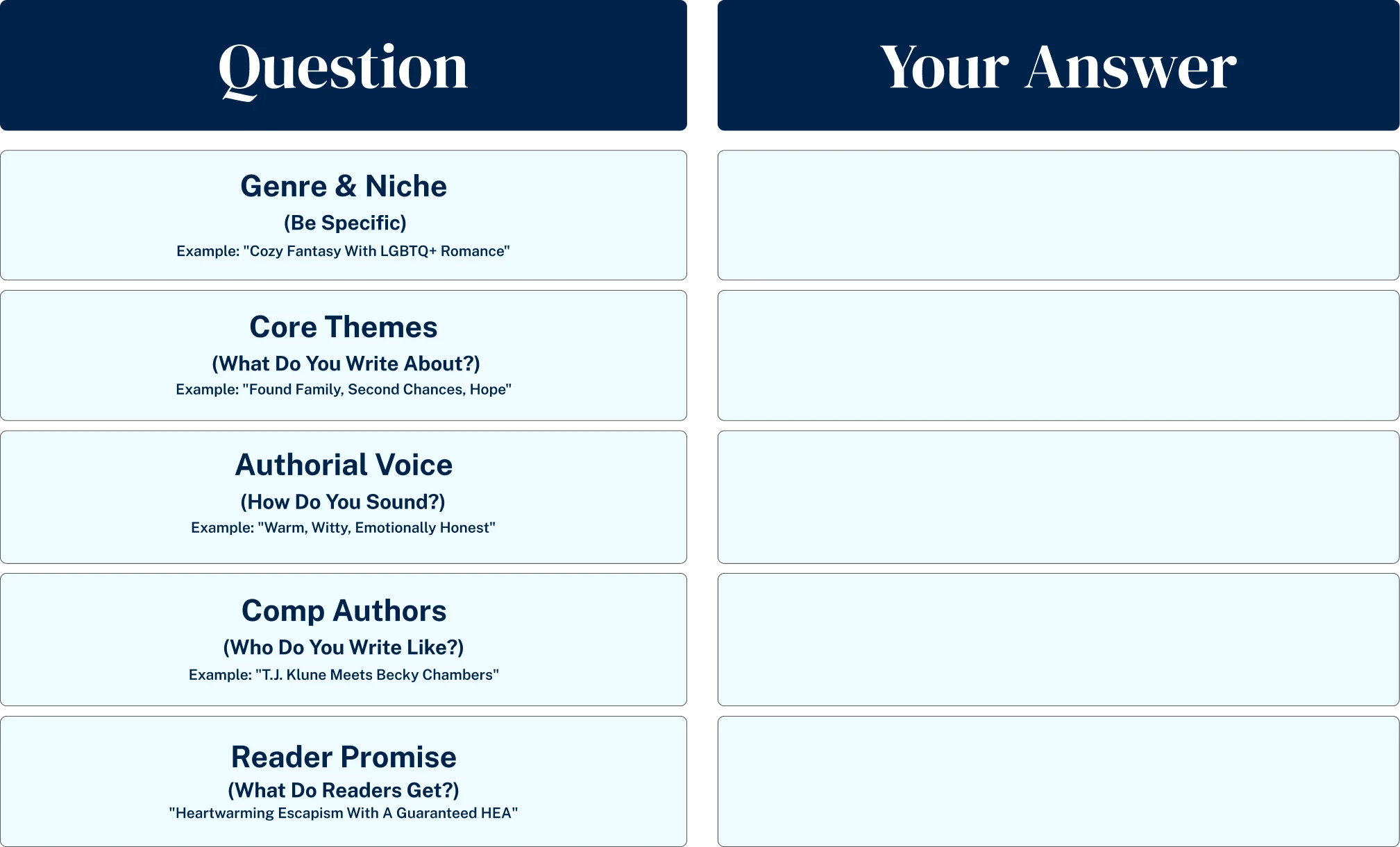
Your brand is your promise to the reader. It’s the consistent feeling and expectation they get from your books, your website, your emails, and your social media. A strong brand makes you memorable and builds trust. Before you can build a platform, you need to know what you want to be known for.
- What is your genre and niche? Be specific. Not just “fantasy,” but “epic fantasy with political intrigue” or “cozy fantasy with a touch of romance.”
- What are your core themes and values? What do you write about? Hope? Justice? The power of friendship? These themes will attract readers who resonate with your worldview.
- What is your authorial voice? Are you witty and sarcastic? Dark and mysterious? Warm and encouraging? Your brand voice should be a natural extension of your personality. Our guide on “Finding Your Unique Author Voice” can help you clarify this.
Define Your Author Brand
Step 2
Build Your Author Website (Your Home Base)
Your author website is the only piece of online real estate that you truly own and control. It’s the central hub of your platform. It doesn’t need to be complicated. A simple, professional website should have four key pages:
- Home Page: A brief, engaging introduction to you and your books.
- Books Page: A page with your book covers, blurbs, and universal buy links.
- About Page: Your author bio and a professional photo.
- Contact Page: A simple contact form or your email address.
The most important element on your website is the email sign-up form. It should be visible on every single page. Our Build Your Author Website hub provides a complete, step-by-step guide to creating your site, and our guide on “Where to Place Sign-Up Forms for Maximum Conversions” is essential reading.
Step 3
Start Your Email List (Your Most Valuable Asset)
We will say this again and again: your email list is the most important asset you will ever build. You need to start building it from day one. But how do you get people to sign up when you don’t even have a book out yet?
- Create a Killer Reader Magnet: A reader magnet is a free gift you offer in exchange for an email address. It needs to be something your ideal reader desperately wants. For fiction authors, the best magnet is a free story—a prequel novella, a bonus epilogue, or a collection of short stories set in your world. For non-fiction authors, it could be a checklist, a resource guide, or a free video course. Our guide “How to Create a Reader Magnet That Attracts Superfans” has dozens of ideas.
- Choose Your Email Service Provider: You need a professional ESP to manage your list. MailerLite is our top recommendation for new authors because it’s powerful, affordable, and free for your first 1,000 subscribers. Our Complete Guide to Getting Started with MailerLite will have you up and running in an hour. As you grow, you may want to upgrade to a more powerful system like GoHighLevel to manage your funnels and automations.
- Set Up Your Welcome Sequence: When someone signs up for your list, they should immediately receive a series of automated emails that deliver the reader magnet and introduce them to you and your world. This is how you begin to build a relationship. Our “5-Day Welcome Sequence Template for Authors” can be used with MailerLite or GoHighLevel.
Pro tip:
Your reader magnet doesn't have to be a full novella. In fact, shorter is often better. A 5,000-10,000 word short story (20-40 pages) is perfect—long enough to showcase your writing, short enough that people actually read it. Fiction authors can write a prequel scene or a "missing chapter." Non-fiction authors can create a simple checklist or template. Use Canva to design a professional cover for your freebie. The goal is to give immediate value and leave them wanting more.
Step 4
Choose Your Social Media Battlefield
You do not need to be on every social media platform. In fact, trying to do so is a recipe for burnout. The key is to choose the one or two platforms where your target readers are most active and go deep there.
- Where Do Your Readers Hang Out?
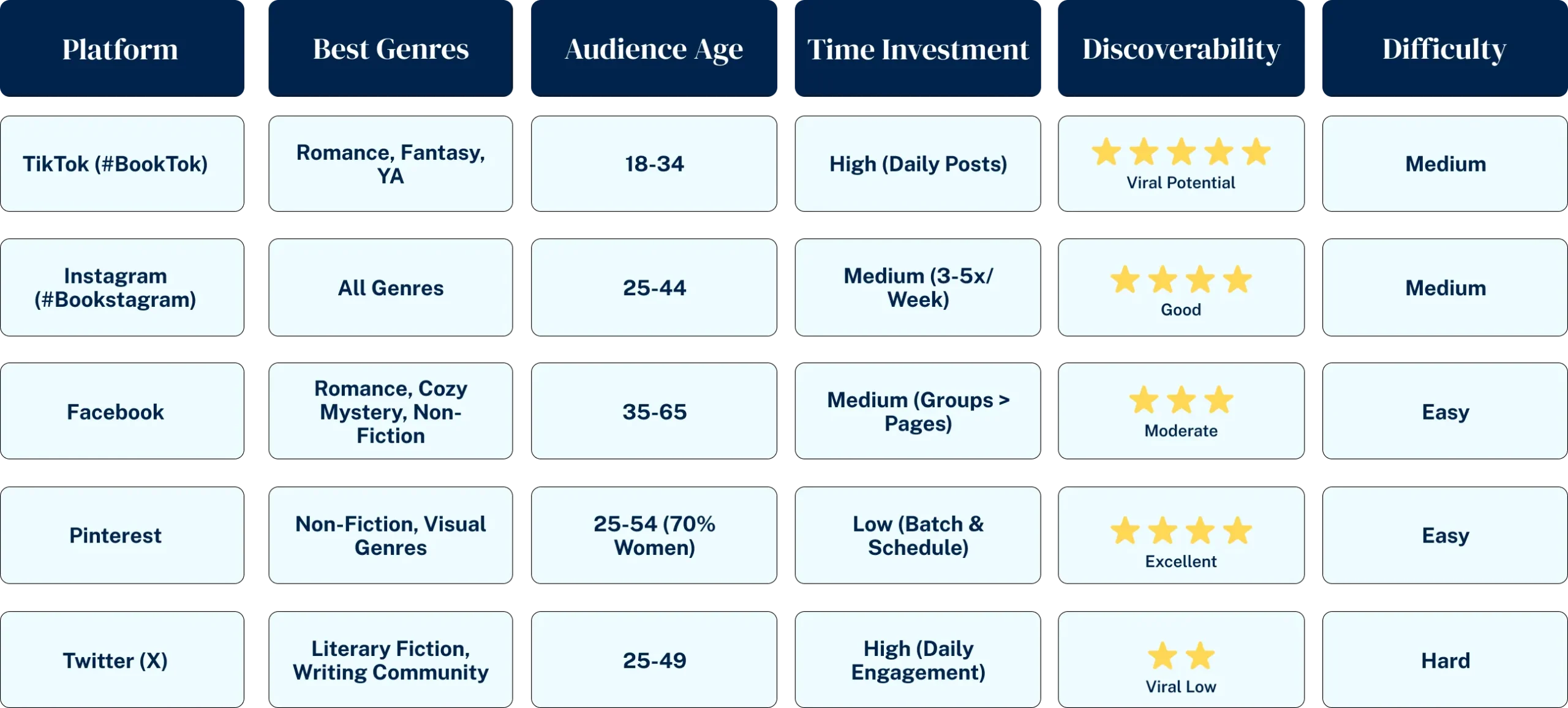
- TikTok (#BookTok): The undisputed king for reaching younger readers, especially in genres like Romance, Fantasy, and Young Adult.
- Instagram (#Bookstagram): A visual platform that’s great for showcasing beautiful book covers, author lifestyle content, and connecting with book reviewers.
- Facebook: Still a powerhouse, especially for reaching older readers. Facebook Groups are an incredibly powerful tool for building a dedicated author community.
- Pinterest: Excellent for visual-heavy genres and non-fiction topics like recipes, self-help, and crafts.
- Twitter (#WritingCommunity): Great for networking with other writers, agents, and industry professionals.
Choose one platform to master first. Create content that is native to that platform and focus on providing value and engaging in conversations. Our guide “Instagram vs. TikTok vs. Facebook for Authors” provides a detailed breakdown.
Which Social media platform is right for your genre
Step 5
Build Relationships
Your platform is not just about your direct followers; it’s also about your relationships with other authors and influencers in your space. The author community is incredibly collaborative.
- Collaborate with Other Authors: Reach out to other authors in your genre who are at a similar stage in their career. Offer to do a “newsletter swap,” where you recommend their book to your list, and they recommend yours to theirs. This is the single fastest way to grow your email list for free. Services like StoryOrigin are designed to facilitate these swaps.
- Engage with Readers: When someone comments on your post or replies to your email, respond to them! Treat them like a real person. These small interactions are how you build a loyal tribe of superfans.
Building a platform is a marathon, not a sprint. It’s about showing up consistently over time and generously sharing your passion with the people who are most likely to appreciate it. Start today, and by the time your book is ready, you’ll have an eager audience waiting to buy it.
Pro tip:
Newsletter swaps with other authors are the fastest way to grow your email list for free. Use StoryOrigin ($10/mo) to find authors in your genre who are looking for swaps. A single well-matched swap can add 50-200 new subscribers to your list in one day. Do 2-3 swaps per month, and you can grow your list by 500+ subscribers in 90 days without spending a dollar on ads. The key is to only swap with authors who write in your exact sub-genre—quality over quantity.

Amazon Ads vs. Facebook Ads: Which Platform Wins for Authors?

In the world of paid advertising for authors, two giants dominate the landscape: Amazon Ads and Facebook Ads. Both are incredibly powerful platforms that can get your book in front of millions of potential readers, but they work in fundamentally different ways. Choosing the right platform for your book, your budget, and your goals is one of the most important marketing decisions you’ll make.
Investing in the wrong platform can be a fast track to burning through your budget with little to show for it. But understanding the unique strengths of each can unlock a stream of consistent, profitable sales that can sustain your author career for the long term.
This section is your head-to-head comparison of these two advertising behemoths. We’re going to break down exactly how each platform works, who you can target, what kind of budget you need, and what a realistic return on investment (ROI) looks like.
We’ll explore why Amazon Ads are the undisputed king of reaching readers with high purchase intent, and why Facebook Ads are a powerful tool for audience building and reaching readers who don’t yet know they want your book. We’ll also touch on the rising star of BookBub Ads as a powerful alternative. This is your guide to moving beyond guessing and into a strategic, data-driven approach to paid advertising.
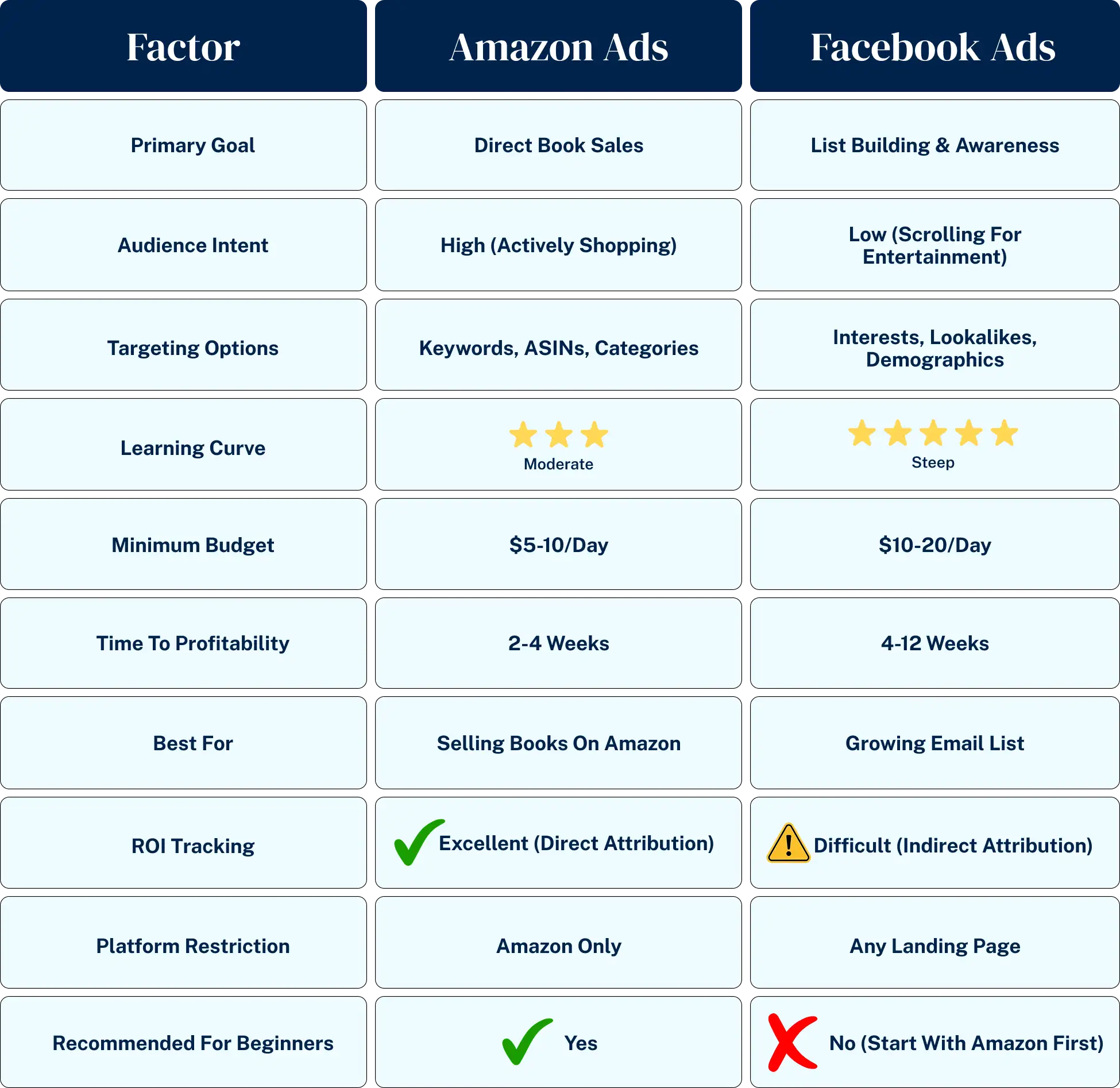
AMAZON ADS vs. FACEBOOK ADS: THE COMPLETE COMPARISON
Amazon Ads
The Power of Purchase Intent
Amazon Advertising is a platform that allows you to advertise your book directly on the Amazon website. Your ads can appear in search results, on the sales pages of other books, and on Kindle lock screens. Its power comes from one simple fact: everyone on Amazon is there to shop.
- How It Works: You bid on keywords or ad placements. When a customer’s search or behavior matches your targeting, your ad is shown. You pay only when a customer clicks on your ad (this is called Pay-Per-Click, or PPC).
- Targeting Options:
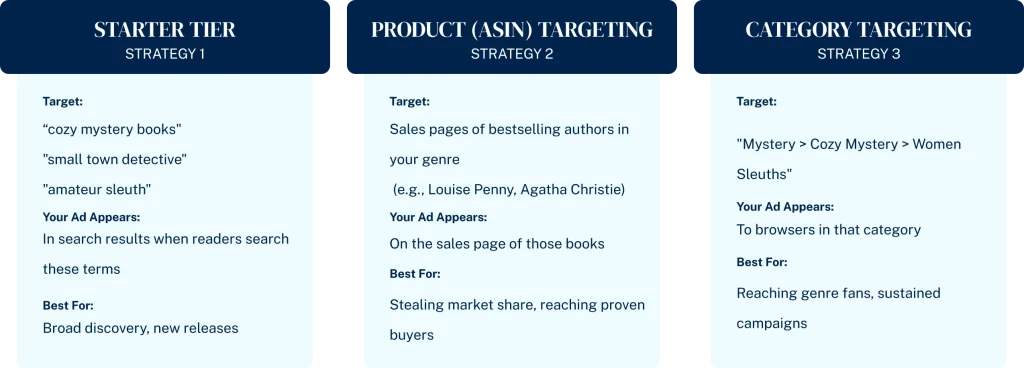
- Keyword Targeting: You target the specific search terms that readers type into the Amazon search bar (e.g., “dragons,” “enemies to lovers romance,” “World War 2 historical fiction”).
- Product Targeting (ASIN Targeting): You target the sales pages of specific books. This is incredibly powerful. You can place your ad directly on the page of a bestselling author in your genre, effectively saying, “If you like that book, you’ll love mine.”
- Category Targeting: You target entire genres or sub-genres.
The Pros
- High Purchase Intent: You are reaching readers at the exact moment they are looking to buy a book.
- Direct ROI Tracking: Amazon’s dashboard shows you exactly how much you’ve spent and how many sales you’ve generated, making it easy to calculate your return on investment.
- Relatively Simple to Learn: The platform is less complex than Facebook Ads.
The Cons
- Can Be Expensive: Popular keywords and author targets can be very competitive and costly.
- Limited to the Amazon Ecosystem: You can only drive traffic to your Amazon sales page.
Our Recommendation: Every author should learn how to run Amazon Ads. It is the most direct and reliable way to sell books on the world’s largest bookstore. Our “Complete Beginner’s Guide to Amazon Ads” is the perfect place to start.
AMAZON ADS: 3 TARGETING STRATEGIES
Pro tip:
Don't waste your Amazon Ads budget on broad keywords like "fantasy" or "romance." These are too competitive and expensive. Instead, use Publisher Rocket ($97 one-time) to find low-competition, high-search-volume keywords like "dragon shifter romance" or "epic fantasy with political intrigue." These niche keywords cost 50-75% less per click and convert 2-3x better because you're reaching readers looking for exactly what you write. This one tool can make the difference between profitable and unprofitable ads.
Facebook Ads
The Power of Audience Building
Facebook Ads (now Meta Ads) allow you to advertise to Facebook’s and Instagram’s massive user base. Unlike Amazon Ads, people on Facebook are not actively shopping for books. They are there to connect with friends and consume content. Therefore, your goal with Facebook Ads is different. It’s less about direct sales and more about interruption and audience building.
- How It Works: You create an ad with an image or video and compelling copy. You then define a target audience based on a huge range of demographics, interests, and behaviors. You can pay per click, per impression, or per conversion.
- Targeting Options:
- Interest Targeting: This is the most powerful feature. You can target users who have expressed an interest in specific authors (e.g., “Stephen King,” “Jane Austen”), genres (“Fantasy fiction”), movies, TV shows, and more.
- Lookalike Audiences: You can upload your email list, and Facebook will create a “lookalike” audience of millions of users who share similar characteristics to your existing fans. This is an incredibly powerful way to find new readers.
- Retargeting: You can show ads to people who have previously visited your website or engaged with your Facebook page.
The Pros
- Incredible Audience Granularity: You can get hyper-specific with your targeting.
- Great for List Building: Facebook Ads are extremely effective for driving traffic to a landing page where you offer a free reader magnet in exchange for an email address.
- Can Drive Traffic Anywhere: You can send users to your Amazon page, your website, or a landing page.
The Cons
- Lower Purchase Intent: You are interrupting someone’s social scrolling. It’s a harder sell.
- Difficult to Track ROI for Amazon Sales: It’s very difficult to know for sure if a click on a Facebook ad led to a sale on Amazon.
- Steep Learning Curve: The platform is complex and constantly changing.
Our Recommendation: Use Facebook Ads primarily for building your email list. Driving traffic to a landing page for a free book is often more cost-effective and builds a long-term asset (your list) rather than just a one-time sale. Our guide “Facebook Ads 101 for Book Marketing” shows you how to set up your first list-building campaign.
Pro tip:
Never send Facebook Ads traffic directly to your Amazon sales page. Facebook's algorithm penalizes ads that send traffic off-platform, making your ads more expensive and less effective. Instead, send traffic to a landing page on your own website (use GoHighLevel or MailerLite's landing page builder) where you offer a free book in exchange for an email address. Then, use your email sequence to sell them your paid books. This strategy builds your list AND sells books—and it's 3-5x more profitable long-term.
The Verdict
Which Platform Wins?
Neither. They are different tools for different jobs. A smart author uses both.
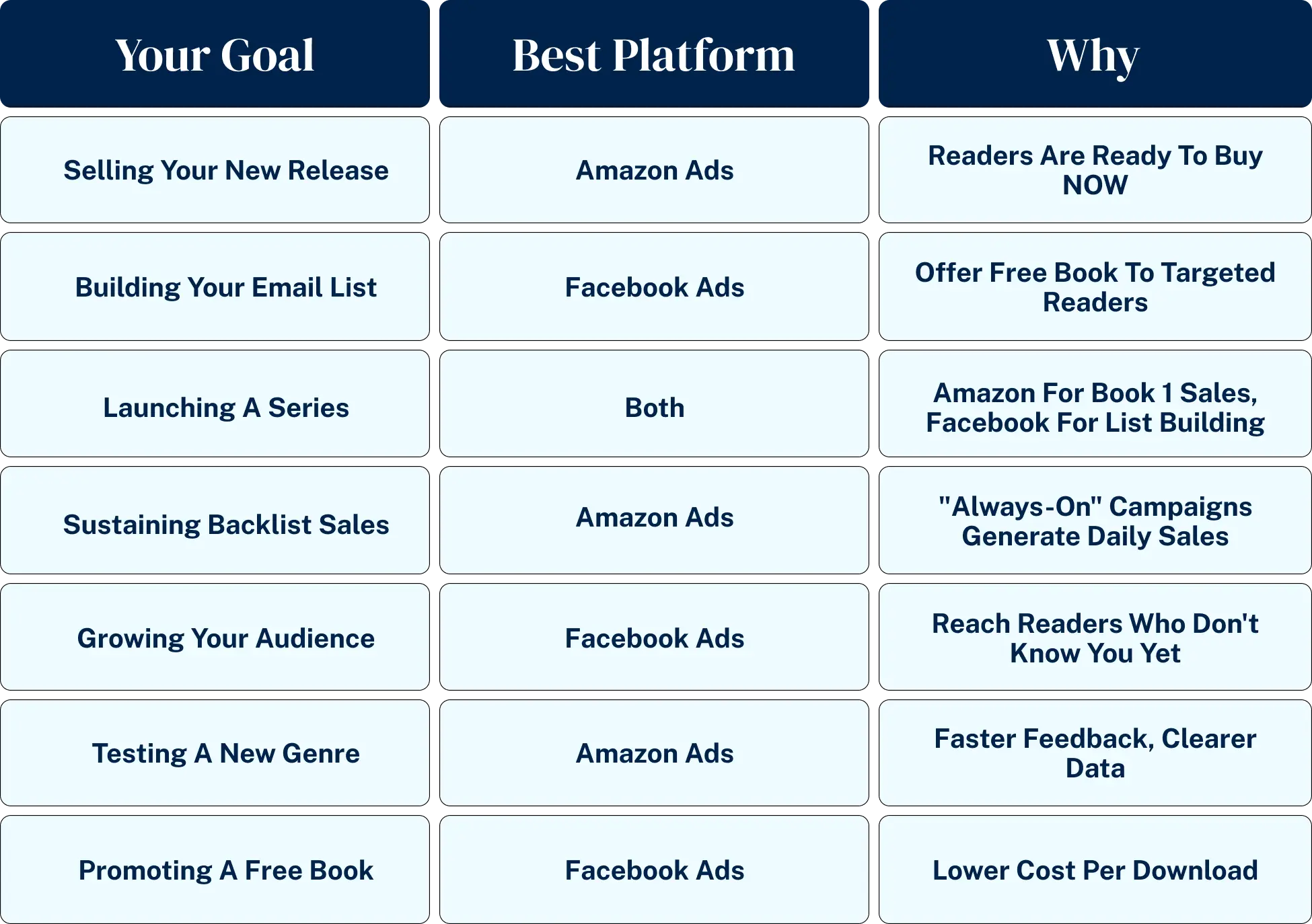
Start with Amazon Ads. Master the platform and get a positive ROI. Then, once you have a profitable system, reinvest your profits into Facebook Ads to grow your email list and build your long-term author platform. For a deep dive on the numbers, check out our analysis: “Which Platform Gives a Better Return? Comparing Costs and ROI.” And for authors looking for a powerful third option, our guide “BookBub Ads Explained: Is It Worth It?” explores another fantastic platform for reaching power readers.

Marketing Mistakes That Kill Book Sales (And How to Avoid Them)

Even with the best intentions, authors often sabotage their own success with a series of predictable and entirely avoidable marketing mistakes. They launch to an audience of zero, they market inconsistently, they chase fleeting trends, and they give up just before their efforts start to compound.
These mistakes are not just costly in terms of time and money; they are emotionally draining and are the primary reason why so many authors conclude that “marketing just doesn’t work.”
But marketing does work. You just need to avoid the traps that ensnare so many of your peers. This final section is your guide to the biggest marketing mistakes that kill book sales. We’ll identify the common errors, explain exactly why they are so destructive, and give you specific, strategic course corrections.
By understanding these pitfalls, you can stop wasting time on activities that don’t move the needle and instead focus your energy on building a sustainable marketing system that sells your books while you sleep.
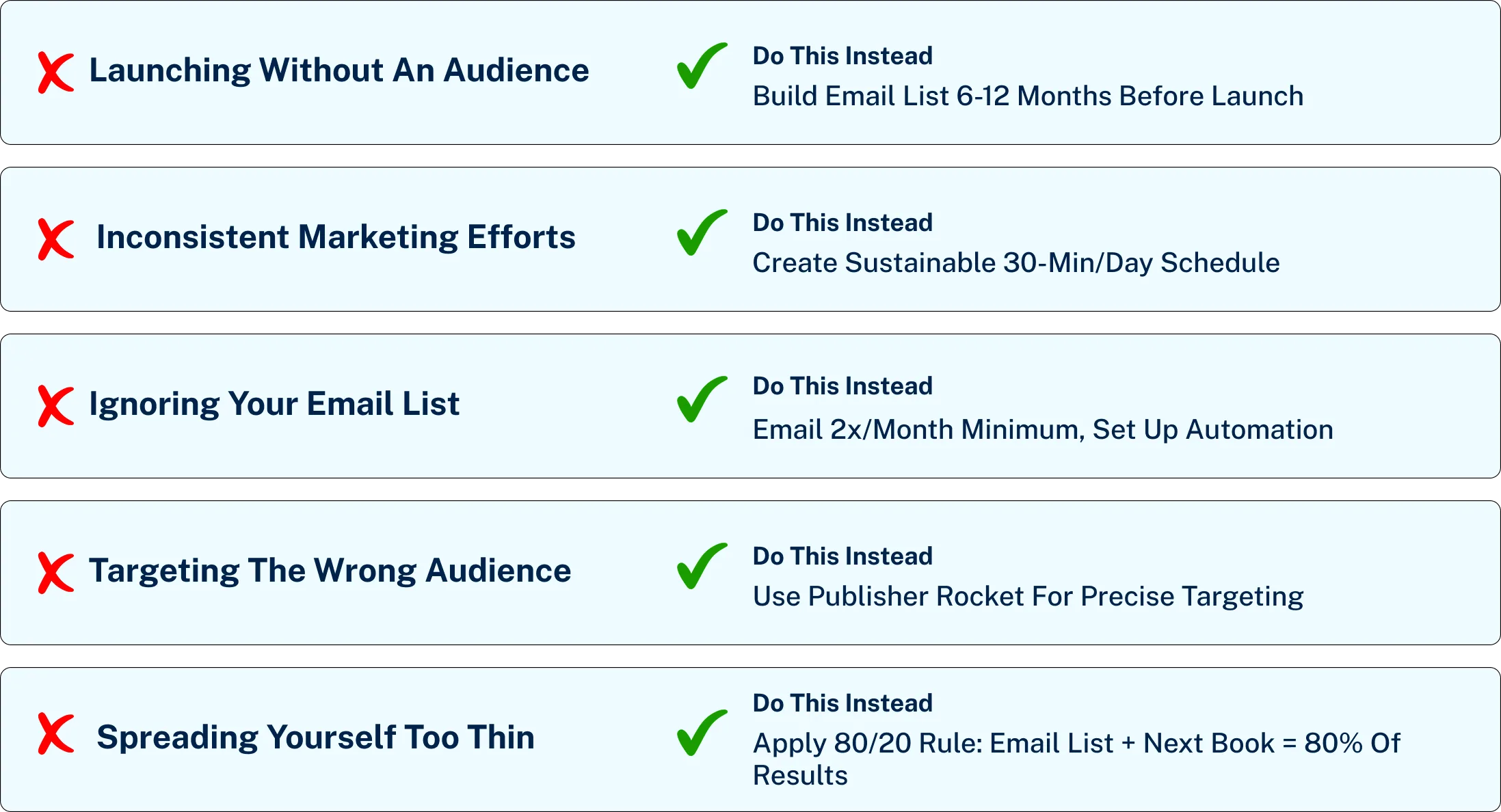
the 6 marketing mistakes that kill book sales
Mistake #1
Launching Without an Audience
This is the original sin of book marketing: the “Field of Dreams” fallacy. Authors believe that if they write a great book, readers will magically appear. They hit “publish” and expect sales to roll in, only to be met with crushing silence. In today’s market, launching without an audience is a guaranteed recipe for failure.
How to Avoid It: You must Build Your Author Platform From Scratch long before you are ready to launch. The single most important thing you can do is start building your email list from day one. Offer a compelling Reader Magnet and start collecting email addresses. Even a small list of 100 engaged subscribers is infinitely more powerful than an audience of zero. Your launch begins the day you start building your platform, not the day you publish.
Pro tip:
If you're reading this and your book is already published, it's not too late. You can still build your platform and relaunch your book. Update your cover and blurb if needed, spend 90 days building an email list of 100-200 subscribers, then do a "relaunch" with a limited-time discount and a coordinated push. Many authors have turned failed launches into bestsellers with a strategic relaunch. Our guide "How to Relaunch a Book That Flopped" provides the complete playbook.
Mistake #2
Inconsistent Marketing Efforts
This is the classic author burnout cycle. You market your book intensely for two weeks during launch, then you get tired and stop. Three months later, you panic because your sales have flatlined, so you market hard for another two weeks, and then you stop again. This stop-and-start approach never allows your efforts to gain traction or compound.
How to Avoid It: Create a sustainable marketing schedule that you can stick to long-term. Consistency is more important than intensity. It’s better to spend 30 minutes a day on marketing every single day than to spend 5 hours one day and then do nothing for a month. Use a social media scheduler like Buffer or the one built into GoHighLevel to plan your content in advance. Set up “always-on” Amazon Ads campaigns with a small daily budget. Create a system that works for you, and then work the system.
Yuo sustainable marketing schedule
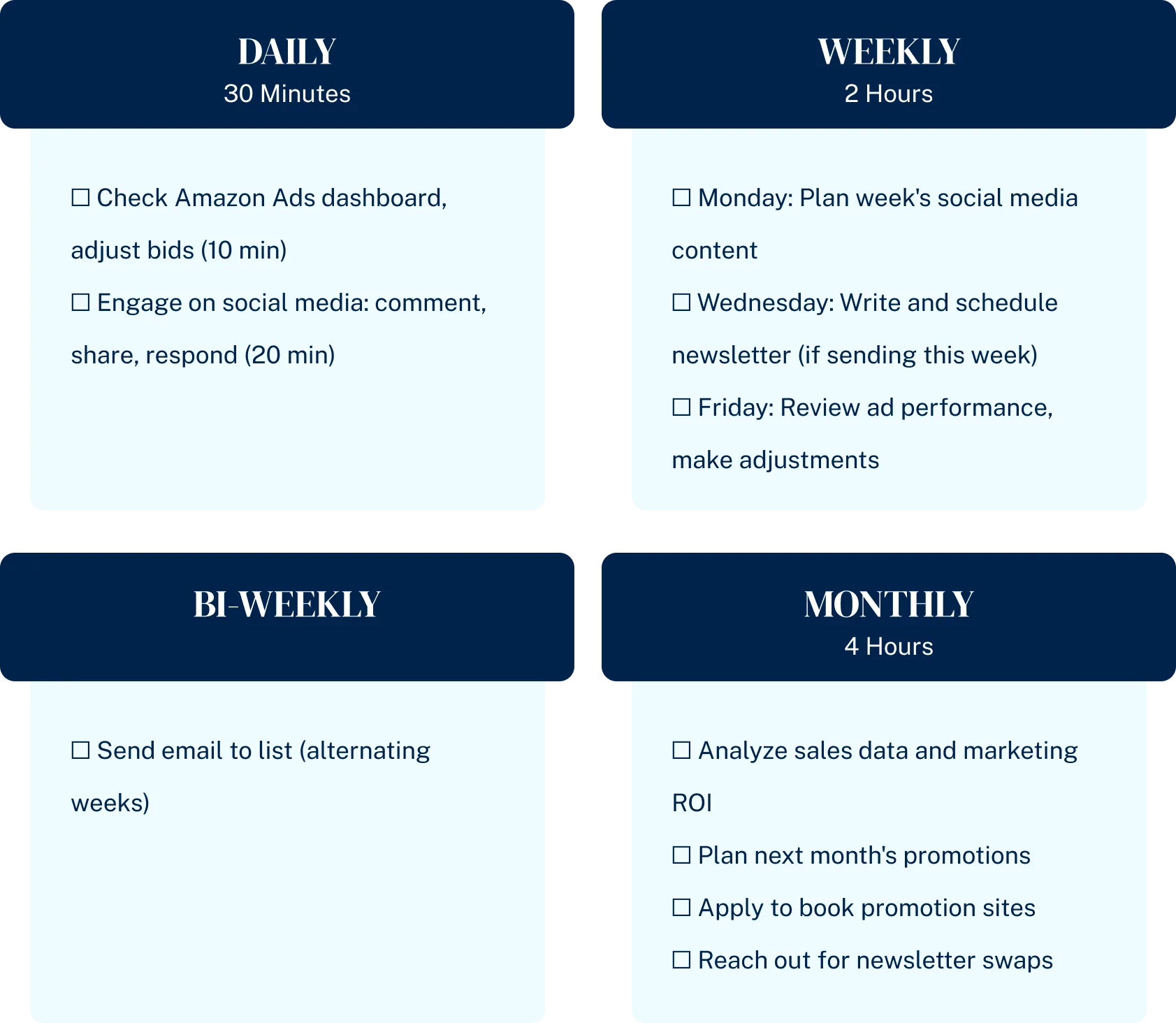
TOTAL TIME: 30 min/day + 2 hours/week + 4 hours/month = ~20 hours/month
This is sustainable. This is how you build a career.
Mistake #3
Ignoring Your Email List
This is the most tragic mistake of all. An author spends months or even years building an email list of thousands of subscribers, and then never emails them. They are afraid of “bothering” their readers, so their most valuable marketing asset—a direct line to their biggest fans—sits collecting dust. An ignored email list is a dead email list.
How to Avoid It: Treat your email list like gold. Nurture it. Email your subscribers consistently (at least once or twice a month) with valuable and entertaining content. Share behind-the-scenes updates, ask them questions, and let them know about your new releases and promotions. Set up an automated welcome sequence using MailerLite or GoHighLevel to build a relationship with new subscribers from the moment they sign up. Remember, these people asked to hear from you. Don’t be afraid to show up in their inbox. Our guide on “How to Reactivate a Dead Email List” can help if you’ve made this mistake.
Mistake #4
Targeting the Wrong Audience
You write an epic fantasy novel, but you run Facebook ads targeting fans of Jane Austen. You write a sweet romance, but you spend your time on a social media platform dominated by horror readers. Targeting the wrong audience is like trying to sell steak to a vegetarian. It doesn’t matter how good your product is; you’re talking to the wrong people.
How to Avoid It: Get crystal clear on who your ideal reader is. What other authors do they read? What movies and TV shows do they watch? What Facebook groups are they in? Use the powerful targeting options in Amazon Ads and Facebook Ads to get your book in front of the right people. Use Publisher Rocket to find the specific keywords and categories your readers are browsing. Stop shouting into the void and start whispering in the right person’s ear.
Mistake #5
Giving Up Too Soon
Book marketing is a marathon, not a sprint. Authors often get discouraged when they don’t see a huge ROI after a few weeks of marketing. They see their ads losing money or their social media growth stalling, and they quit. The reality is that it can take months for your marketing efforts to gain traction and for you to learn what works.
How to Avoid It: Adjust your expectations. It takes time to learn how to run profitable ads. It takes time to build a following on social media. It takes time for word-of-mouth to spread. Commit to a marketing strategy for at least 90 days before you evaluate the results. Focus on leading indicators of progress, like your email list growth rate or your ad click-through rate, not just sales. Be patient, be persistent, and be willing to learn.
Pro tip:
Track "leading indicators" instead of just sales. Leading indicators are the activities that predict future sales: email list growth rate, ad click-through rate, social media engagement rate, and number of reviews. If these numbers are improving, your sales will eventually follow. Create a simple spreadsheet in Google Sheets to track these metrics weekly. Celebrate progress in these areas even when sales are slow. This mindset shift will keep you motivated through the inevitable slow periods.
Mistake #6
Spreading Yourself Too Thin
In a desperate attempt to find what works, many authors try to do everything at once. They try to be active on five social media platforms, run ads on three different ad networks, write a blog, and start a podcast all at the same time. This leads to burnout and mediocre results across the board.ilding an email list of thousands of subscribers, and then never emails them. They are afraid of “bothering” their readers, so their most valuable marketing asset—a direct line to their biggest fans—sits collecting dust. An ignored email list is a dead email list.
How to Avoid It: Apply the 80/20 Rule to Book Marketing. Identify the 20% of marketing activities that will generate 80% of your results. For almost every author, this is: 1) Writing the next book, and 2) Emailing their list. Master those two things first. Then, add one more thing. Master Amazon Ads. Then, master Facebook Ads for list building. Then, master one social media platform. Stop trying to do everything. Start doing a few things exceptionally well.
The 80/20 rule book marketing
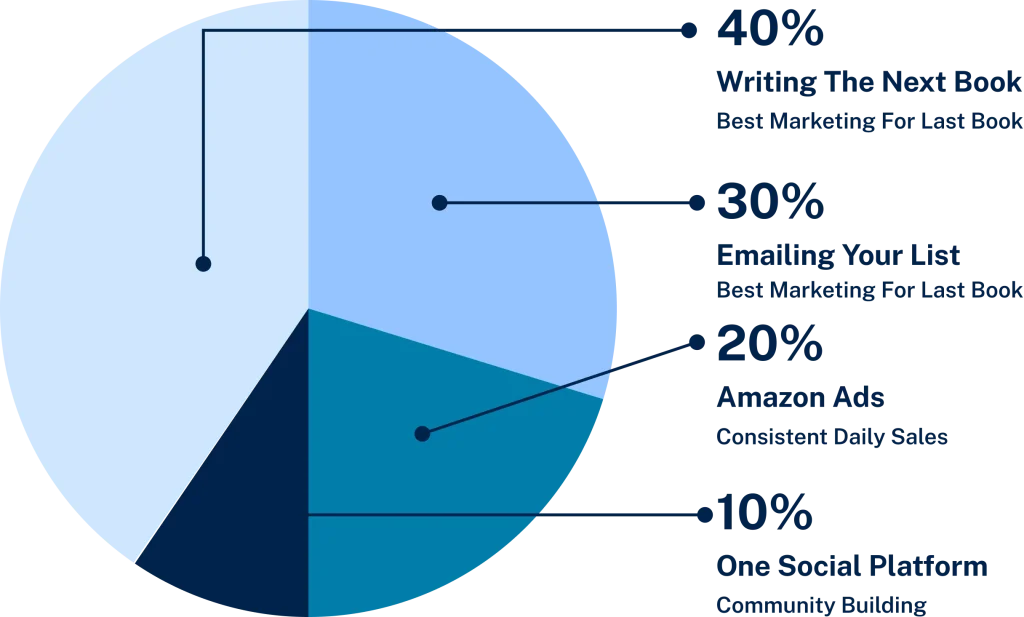
THE 80% THAT DOESN’T (Ignore or Delegate):
- Being on every social platform
- Posting in 50 Facebook groups
- Chasing every new marketing trend
- Obsessing over your Amazon rank
- Constantly redesigning your websit
Your Action Plan:
- Identify your 20% (likely the 4 activities above)
- Block time for them first
- Say “no” to everything else
- Watch your results improve
This hub is like having an entire editing team by your side, explaining every step without the jargon.
Authors Help Kit completely transformed how I approached the editing process. Before discovering this hub, I felt overwhelmed by all the advice online — everyone talked about developmental vs. line editing, but I didn’t actually understand what I needed or when. This hub broke everything down in a clear, structured way that finally made sense.
I started with the Complete Editing Roadmap and followed each step, from self-editing to working with beta readers and comparing professional editing services. The guides were detailed yet approachable, and the examples helped me see exactly what to look for in my own manuscript. The comparison charts alone saved me hundreds of dollars by helping me choose the right type of editor for my book.
By the end, I felt confident, organised, and proud of my polished draft — something I honestly never thought I’d say. This hub is like having an entire editing team by your side, explaining every step without the jargon. For any author who’s serious about producing a professional-quality book, this is hands down the most useful editing resource online.
Samuel C.,
Author