Leverage the Power of Artificial Intelligence to Streamline and Support Your Writing, Research, and Marketing
Discover how to use AI as your tireless brainstorming partner, your brilliant research assistant, and your data-driven marketing strategist—all without losing your unique authorial voice.
er’s block, create stunning covers, generate perfect blurbs, and launch successfully without the overwhelm.
- Ethical frameworks
- Future-proof your career
- For authors, by authors
Artificial intelligence is the most powerful tool an author has seen since the invention of the word processor.
It’s not here to replace your creativity; it’s here to augment it. Below you’ll find everything you need to leverage AI at every stage of your author journey: how to use it for brainstorming and outlining, how to supercharge your editing process, how to streamline your book production, how to create a data-driven marketing plan, and how to use these powerful tools ethically and responsibly. This is not about cheating. This is about working smarter, not harder, so you can focus on what you do best: telling great stories.
AI Tools For Authors Topics
Click below below to jump straight to the topic.

Your Complete AI Writing Roadmap: From Idea to Bestseller

Artificial intelligence is no longer science fiction; it’s the most powerful tool an author has seen since the invention of the word processor. Used correctly, AI can become your tireless brainstorming partner, your brilliant research assistant, your insightful first reader, and your data-driven marketing strategist. It won’t write your book for you—your voice, your story, and your soul are what matter—but it can supercharge every single stage of the author journey, helping you write better, faster, and smarter. This roadmap shows you how.
We’ll explore how AI can help you Validate Your Book Idea with market data, Generate Story Ideas and Outlines to beat the blank page, Draft Faster and More Consistently, Supercharge Your Editing Process, and Create a Marketing Plan That Sells Books. We’ll also look at the critical Ethical Considerations of using AI in your work. This isn’t about replacing your creativity; it’s about augmenting it. Welcome to the future of writing.
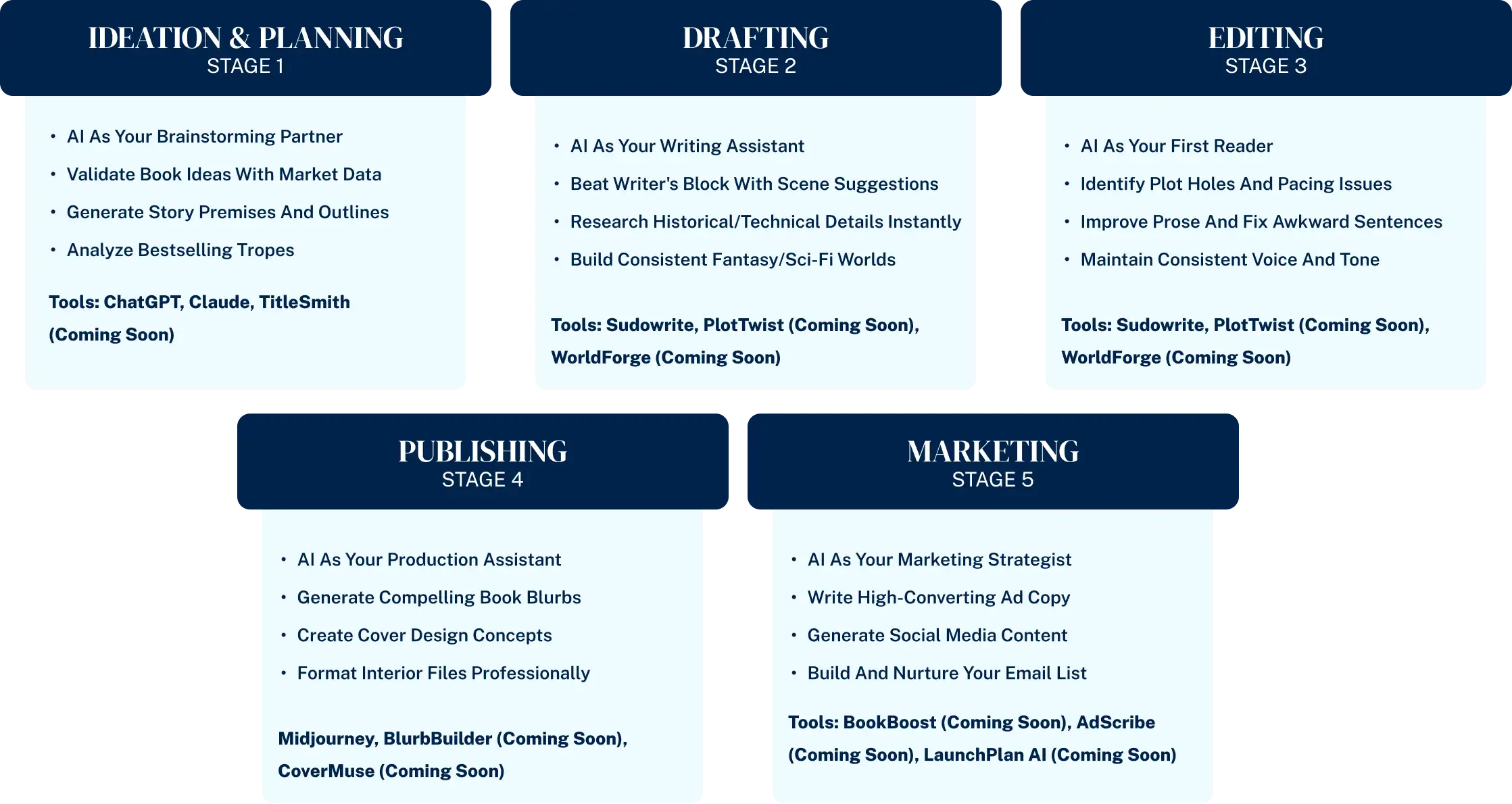
Your A.I Powered Writing Journey: 5 Stages
A.I as partner vs. a.i as ghostwriter
Stage 1
Ideation & Planning (AI as Your Brainstorming Partner)
Before you write a single word, AI can help you ensure your book idea has legs.
- AI for Idea Generation: Stuck for an idea? Tools like ChatGPT and Claude can generate dozens of high-concept premises in minutes. Our guide “How to Write Prompts for Story Ideas” shows you how to get the best results.
- AI for Idea Validation: Is there a market for your book? You can use AI to analyze Amazon categories, identify bestselling tropes, and even generate potential titles and subtitles. This is where your future tool TitleSmith will shine.
- AI for Outlining: Whether you’re a plotter or a pantser, AI can help you structure your story. It can help you flesh out a 3-Act Structure, develop a “Save the Cat!” beat sheet, or simply brainstorm a few key plot points to guide your discovery writing. Your future tool BookArchitect will be a game-changer here.
Pro tip:
When using AI for brainstorming, always generate at least 20-50 ideas, not just 3-5. The first 10 ideas AI gives you will be generic and obvious. The magic happens in ideas 15-50, where the AI starts making unexpected connections. Ask ChatGPT or Claude to "give me 50 high-concept premises for a [genre] novel about [theme]," then cherry-pick the 3-5 that spark your imagination. This is how you find truly original ideas hidden in the noise.
Stage 2
Drafting (AI as Your Writing Assistant)
This is where you get the words on the page, and AI can help you do it faster.
- AI for Beating Writer’s Block: Stuck on a scene? AI can provide a dozen different ways the scene could go. Your future tool PlotTwist is designed for exactly this.
- AI for Research: Writing a historical novel set in ancient Rome? Ask an AI to give you a list of common foods, clothing, and occupations from that period. It’s like having a research assistant on call 24/7.
- AI for World-Building: Creating a fantasy or sci-fi world? AI can help you brainstorm unique cultures, magic systems, and technologies. Your future tool WorldForge will be indispensable for this.
Stage 3
Editing (AI as Your First Reader)
AI can help you see your manuscript with fresh eyes.
- AI for Developmental Editing: Is your pacing off? Does a character’s motivation feel weak? You can feed a chapter into an AI and ask it to identify potential plot holes or inconsistencies. Your future tool StoryThread will automate this process.
- AI for Line Editing: Tools like ProWritingAid and Grammarly use AI to go beyond basic spell-checking to improve your prose, fix awkward sentences, and enhance your style. Your future tool ToneTuner will take this to the next level.
Stage 4
Publishing (AI as Your Production Assistant)
AI can streamline the complex process of turning your manuscript into a book.
- AI for Blurb Writing: Writing a compelling book description is an art form. AI can generate dozens of variations in minutes. Your future tool BlurbBuilder will be a must-have for this.
- AI for Cover Design Concepts: Need ideas for your book cover? AI image generators like Midjourney can create stunning concept art to give to your designer. Your future tool CoverMuse will streamline this process.
Stage 5
Marketing (AI as Your Marketing Strategist)
AI can help you find your readers and sell more books.
- AI for Ad Copy and Keywords: Writing Amazon or Facebook ads? AI can generate compelling ad copy and identify profitable keywords. Your future tool AdScribe will be a game-changer for author advertising.
- AI for Social Media Content: Need ideas for your author newsletter or social media posts? AI can generate a month’s worth of content ideas in minutes. Your future tool BookBoost will automate this.
By integrating AI into every stage of your process, you can free up your time and energy to focus on what you do best: telling great stories. The rest of this hub will show you the specific tools and techniques to make it happen.
Pro tip:
Never publish AI-generated ad copy or social media posts without editing them first. AI-generated marketing copy often sounds robotic and lacks emotional resonance. Use AI to generate 10 variations, then combine the best parts of 2-3 into your own version. Add your personality, your humor, and your voice. The goal is to use AI to overcome the blank page, not to automate your entire marketing presence. Readers can smell inauthenticity from a mile away.
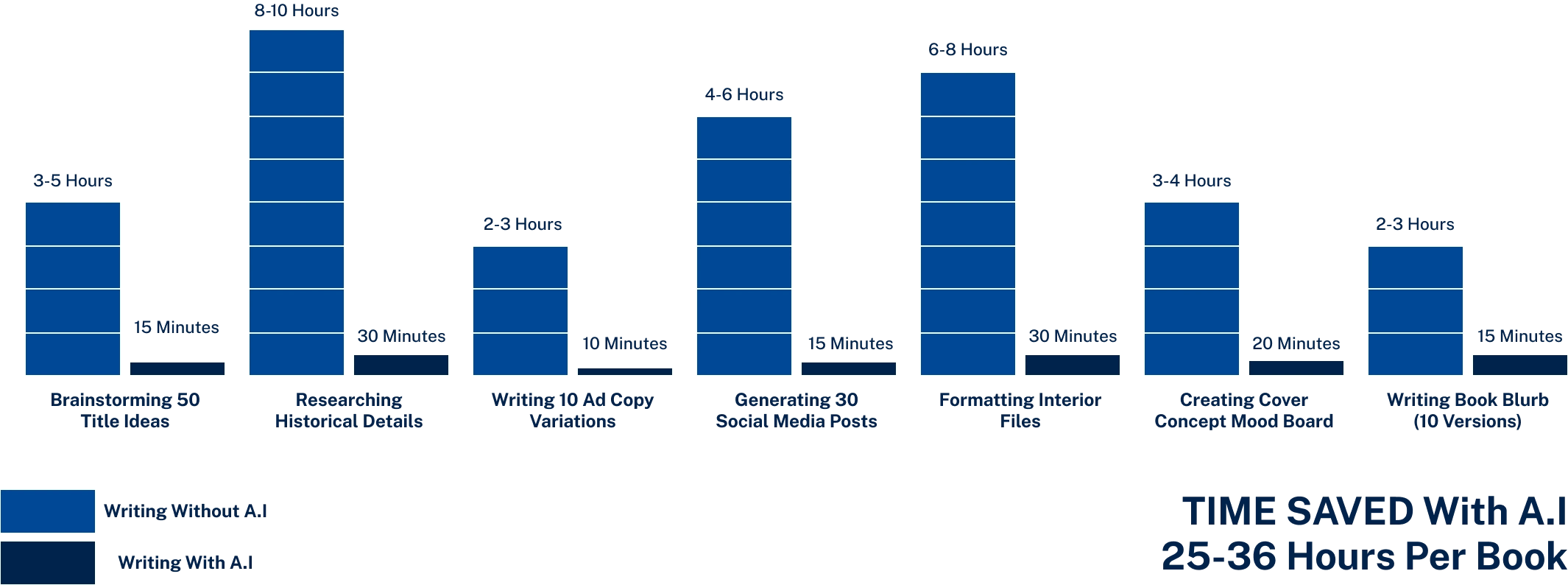
How much time does a.i save auhors?

AI Tools for Writing & Creativity: Your New Brainstorming Partner

The blank page is the most intimidating part of the writing process. But what if you never had to face it alone again? AI writing and creativity tools are designed to be your tireless brainstorming partner, your world-building assistant, and your secret weapon against writer’s block. These tools don’t write for you; they write with you, providing a springboard for your own ideas and helping you explore creative possibilities you might not have considered. This section covers the most powerful AI tools for the ideation and drafting stages of your book.
We’ll explore the big players like ChatGPT and Claude, which are like having a brilliant, all-knowing creative assistant on call 24/7. We’ll also dive into specialized, author-focused tools like Sudowrite, which is designed specifically for fiction writers. And most excitingly, we’ll give you a sneak peek at the next generation of AI creativity tools we’re building right here at Author’s Help Kit, including PlotTwist, CharacterPulse, SceneSurge, and WorldForge. Whether you’re looking for a single sentence to get you unstuck or an entire world to explore, these tools will revolutionize the way you create.
General-Purpose AI Assistants: ChatGPT vs. Claude
These are the Swiss Army knives of AI. They can do almost anything, from brainstorming plot ideas to writing a query letter.
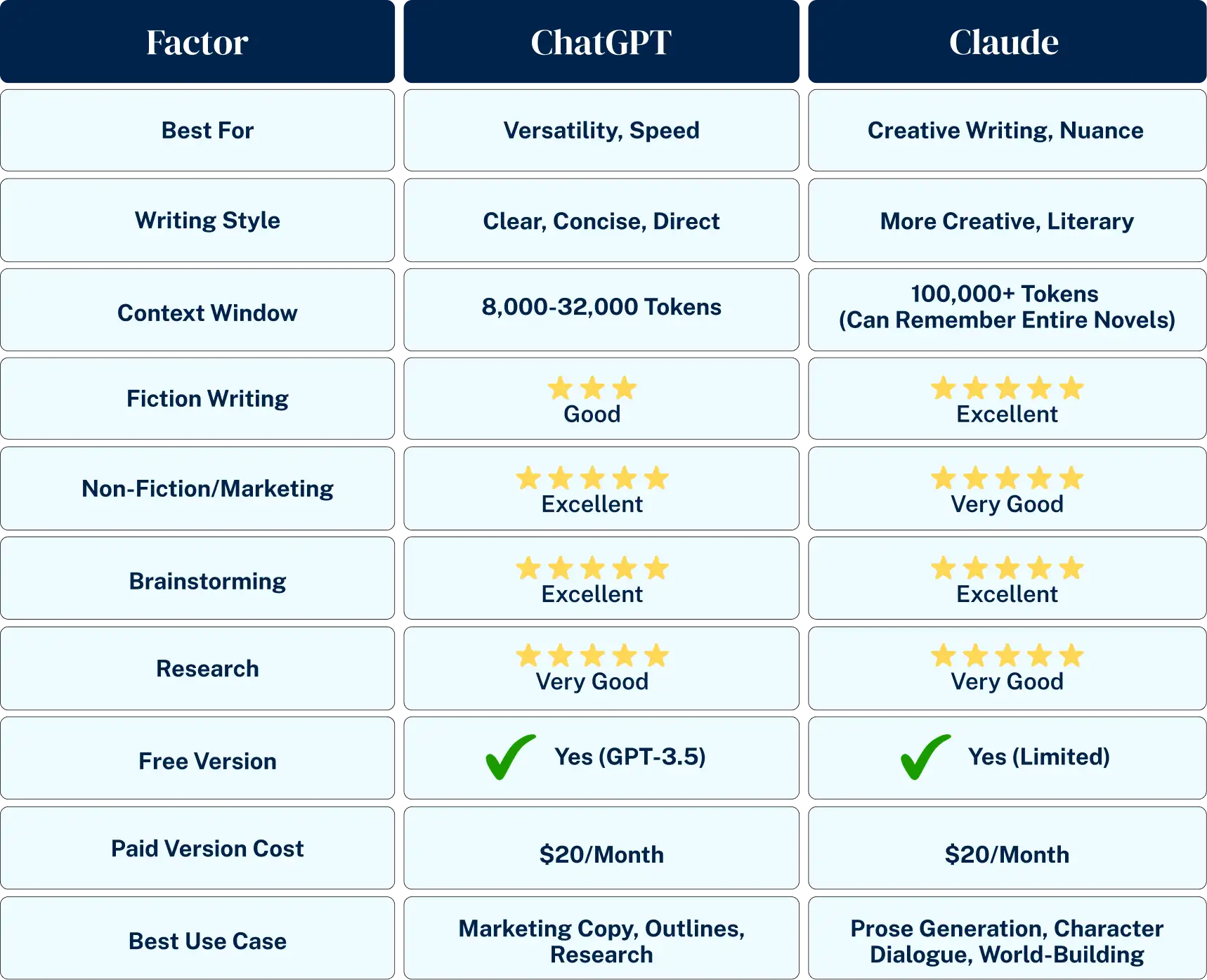
- ChatGPT: The most well-known AI assistant from OpenAI. It’s incredibly versatile and has a massive user base. The free version is powerful, but the paid ChatGPT Plus subscription offers access to more advanced models and features.
- Claude: A powerful competitor from Anthropic. Many authors find that Claude has a more creative and nuanced writing style than ChatGPT, making it particularly well-suited for fiction. It also has a larger context window, meaning it can remember more of your conversation.
The Verdict: Both are essential tools for any author. We recommend using the free versions of both to see which one you prefer for different tasks. Our guide “ChatGPT vs. Claude for Authors” provides a detailed comparison with writing-specific examples.
chatGPT V.S Clause: Which is better or authors?
Pro tip:
Create a "master prompt" document where you save your best-performing prompts for different tasks. When you find a prompt that generates great results (like "Give me 30 plot twist ideas for [situation]"), save it and reuse it for future books. Over time, you'll build a personal library of prompts that are fine-tuned to your writing style and genre. Use a tool like Notion or Google Docs to organize them by category (plot, character, dialogue, world-building, marketing).
Specialized AI Writing Tools for Fiction
These tools are built from the ground up for fiction writers.
- Sudowrite: The most popular and powerful AI writing tool designed specifically for novelists. It has features like “Write,” which continues your prose in your style; “Describe,” which adds vivid sensory details; and “Brainstorm,” which gives you plot twists, character ideas, and more. It’s a paid tool, but it’s a game-changer for many authors.
- Jasper (formerly Jarvis): Another popular AI writing assistant that is very good at marketing copy and non-fiction, but it also has templates for fiction writing. It’s a powerful all-around tool.
The Verdict: If you’re a fiction writer who is serious about using AI, Sudowrite is the best tool on the market. It’s designed for you. Our “Sudowrite for Novelists” guide shows you how to get the most out of it.
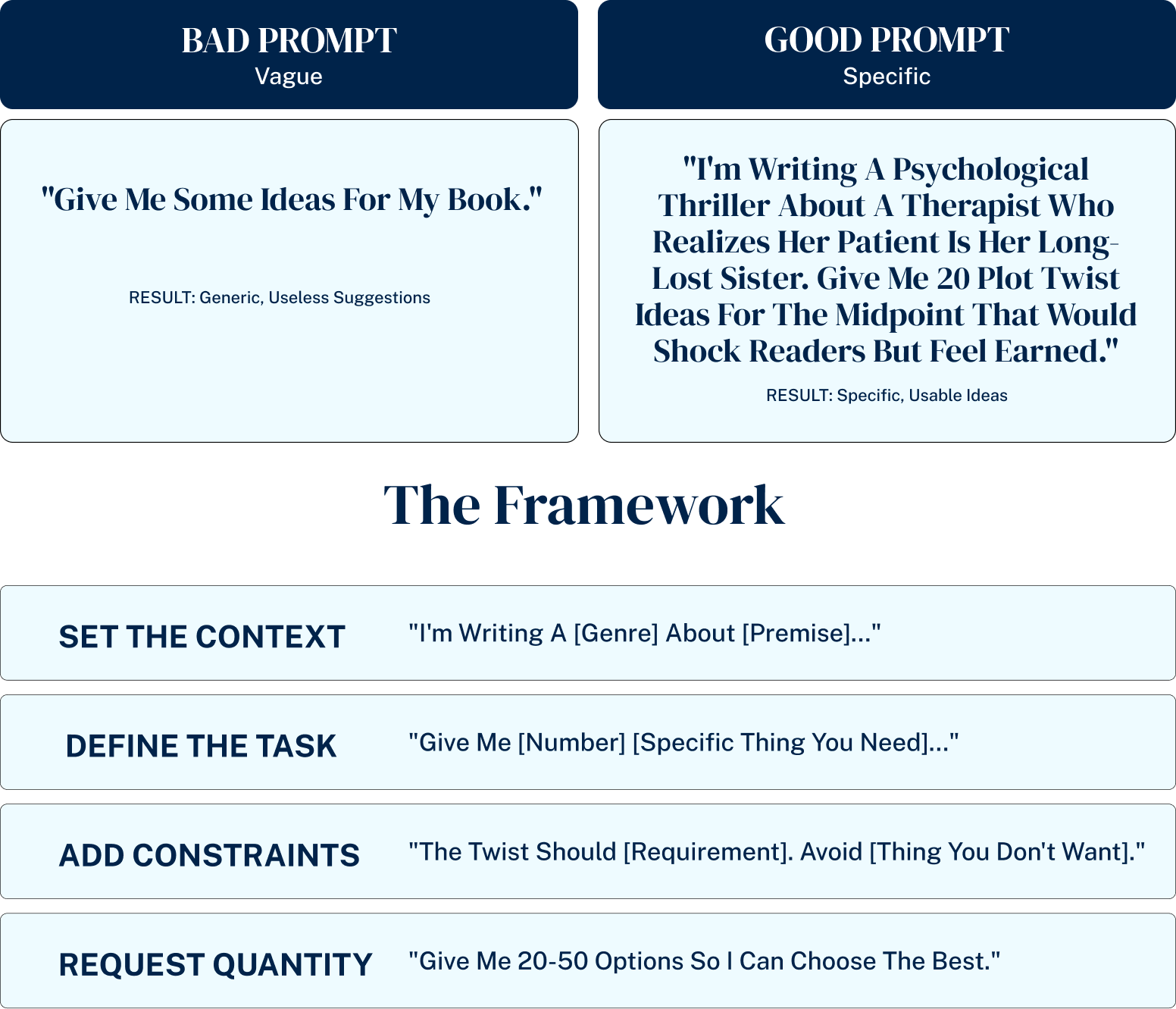
Example prompts for authors
For Plot Ideas: “I’m writing a cozy mystery set in a bookshop. Give me 30 unique murder weapon ideas that would fit the cozy genre (no gore, clever and quirky).”
For Character Names: “I need 20 names for a strong female protagonist in a fantasy novel. The names should sound elegant but not too flowery. Think ‘Katniss’ not ‘Bellatrix.'”
For World-Building: “I’m creating a magic system based on music. Give me 15 unique ways this magic could work, including limitations and costs.”
For Dialogue: “My character is a sarcastic detective confronting a suspect. Give me 10 different ways she could deliver the line ‘Where were you last night?’ with subtext.”
Coming Soon!
Compare Website Builders Side-by-Side: A Head-to-Head Analysis
We’ve studied all the existing tools, and we’re building a suite of AI assistants designed to solve the specific problems that authors face every day.
By combining the power of general-purpose AI assistants with specialized fiction tools and the next generation of author-focused AI, you can build a creative process that is faster, more fun, and more imaginative than ever before. The future of writing is a collaboration between human and machine, and it’s happening right now.
Here’s a preview of what’s coming:
PlotTwist (Writer’s Block Breaker): Feeling stuck? PlotTwist gives you high-leverage “what if?” prompts that change the stakes, introduce a secret, or create a moral dilemma, jolting you out of your rut without providing generic filler. [CTA: Get on the waitlist for PlotTwist!]
CharacterPulse (Character Depth Builder): Go beyond flat character profiles. CharacterPulse uses psychology-based frameworks to help you build characters with deep motivations, compelling flaws, and a unique voice. [CTA: Get on the waitlist for CharacterPulse!]
SceneSurge (Scene Generator & Fixer): Turn a simple idea (“the hero confronts the villain”) into a fully-realized scene outline with a clear goal, conflict, and outcome. It can also diagnose and fix draggy scenes that are killing your momentum. [CTA: Get on the waitlist for SceneSurge!]
WorldForge (World-Building Companion): Create consistent and immersive fantasy or sci-fi worlds. WorldForge helps you generate cultures, histories, magic systems, and lore, and then ensures that you don’t contradict yourself in Chapter 20. [CTA: Get on the waitlist for WorldForge!]

AI Tools for Editing & Polish: Your AI-Powered First Reader
Finishing your first draft is a monumental achievement, but it’s just the beginning. The editing process is where you transform that rough block of marble into a polished sculpture. Traditionally, this has meant relying on your own tired eyes or waiting weeks for feedback from beta readers. But with AI, you can get instant, insightful feedback on your manuscript, helping you see your work with fresh eyes and identify areas for improvement long before it ever reaches a human editor. This section covers the AI tools that will revolutionize your editing process.
We’ll explore how you can use general-purpose AI like ChatGPT and Claude for developmental and line editing, and we’ll revisit the powerful, AI-driven grammar and style checkers ProWritingAid and Grammarly. We’ll also give you a preview of the next generation of AI editing tools we’re building, including ToneTuner, which helps you refine your authorial voice, and StoryThread, which acts as a continuity assistant to catch dropped plot points and inconsistencies. These tools won’t replace a professional human editor, but they will make your manuscript infinitely better before you pay for one.
editing workflow: traditional v.s a.i assisted
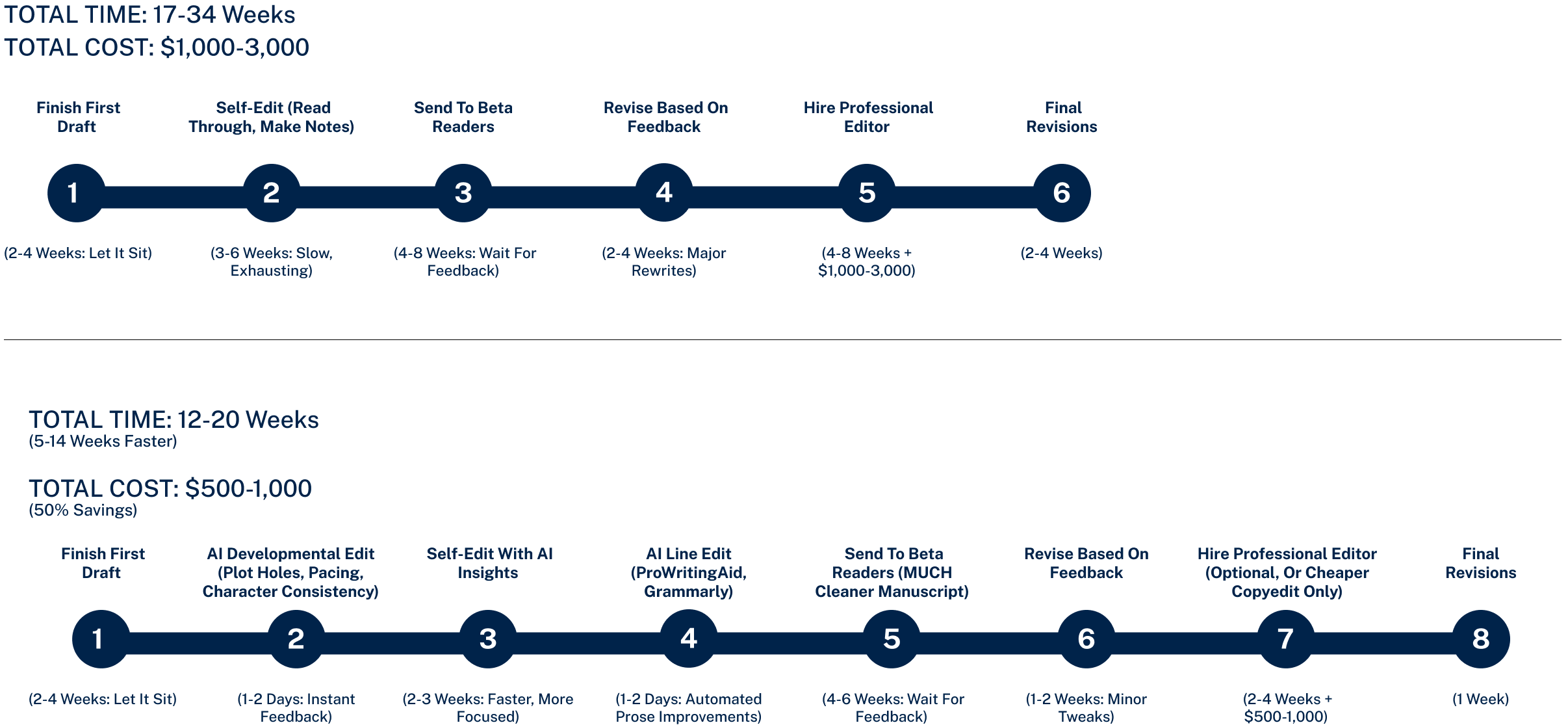
- 30-40% faster editing process
- 50% cost savings on professional editing
- Higher-quality manuscript before human eyes see it
- Less stress and frustration
AI for Developmental Editing
Seeing the Big Picture
Developmental editing is about the story itself—the plot, the characters, the pacing. AI can act as an incredibly insightful first reader, giving you feedback on the big-picture elements of your story.
- Using ChatGPT and Claude for Story-Level Feedback: You can paste a chapter (or even your entire manuscript, with Claude’s large context window) into an AI and ask it specific questions like: “Is my main character’s motivation clear in this chapter?” “Is the pacing of this scene too slow?” “Can you identify any potential plot holes?” The feedback can be astonishingly good. Our guide “How to Use AI as a Developmental Editor” provides a list of powerful prompts.
- The Next Generation: StoryThread (Continuity Assistant): One of the hardest parts of editing a long manuscript is tracking all the details. Did you say your character’s eyes were blue in Chapter 3 but brown in Chapter 27? StoryThread is an AI we’re developing that reads your entire manuscript and flags potential continuity errors, from physical descriptions to forgotten plot points (Chekhov’s guns). It’s like having a super-powered continuity editor on call. [CTA: Get on the waitlist for StoryThread!]
AI DEVELOPMENTAL EDITING: POWERFUL PROMPTS FOR STORY-LEVEL FEEDBACK
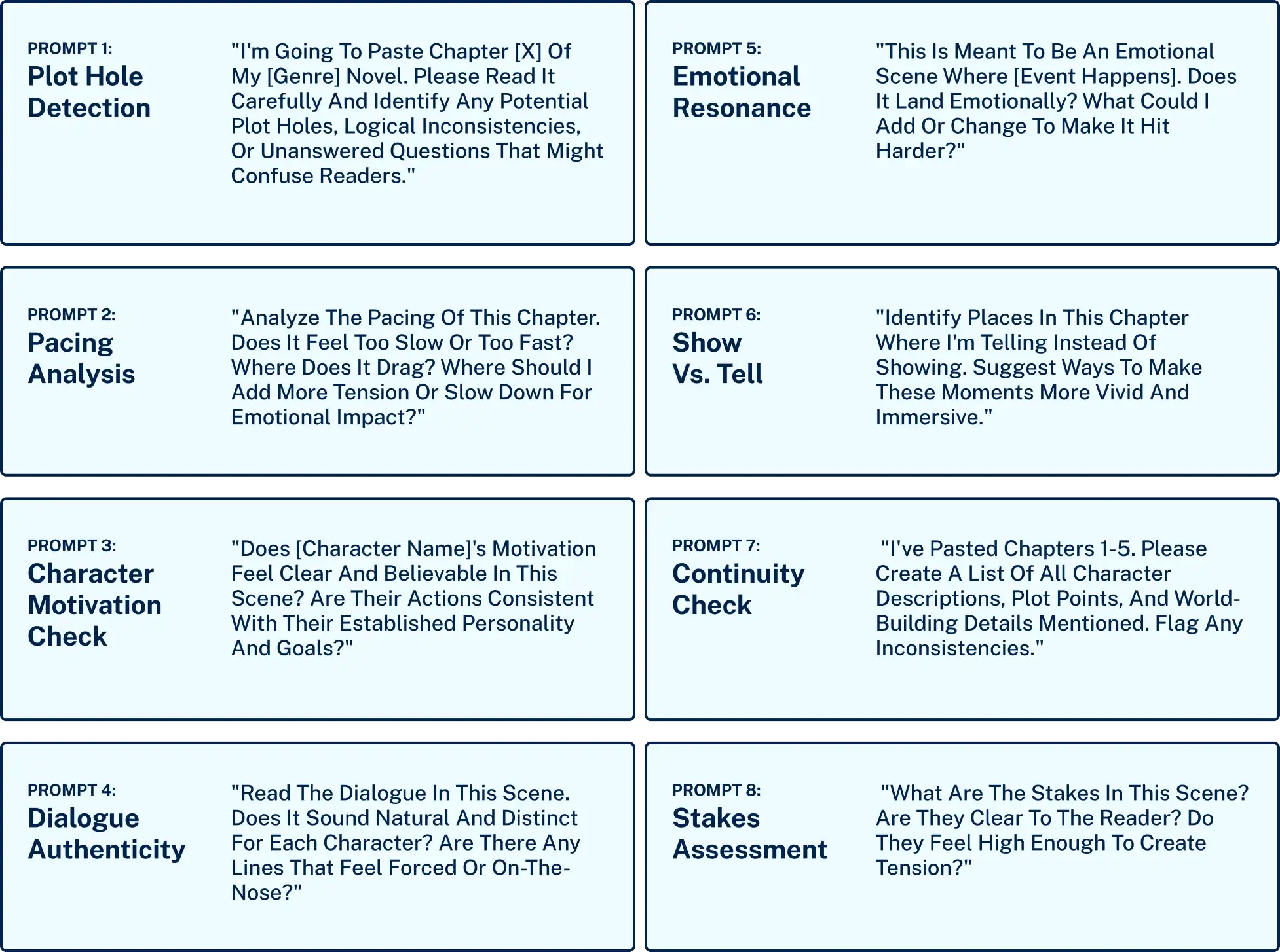
HOW TO USE THESE PROMPTS:
- Copy the prompt
- Paste your chapter/scene below the prompt
- Send to ChatGPT or Claude
- Review the feedback critically (AI isn’t perfect)
- Implement changes that resonate with your vision
Pro tip:
Don't paste your entire manuscript into AI and ask "Is this good?" That's too vague. Instead, ask specific, targeted questions about individual chapters or scenes. AI is best at identifying specific problems (plot holes, pacing issues, weak motivation) when you give it a focused task. Think of AI as a beta reader who can only give feedback on one chapter at a time. Use Claude for this because it has a much larger context window (100,000+ tokens) and can remember more of your story.
AI for Line Editing
Honing Your Prose
Line editing is about the writing itself—the flow, the rhythm, and the style of your sentences.
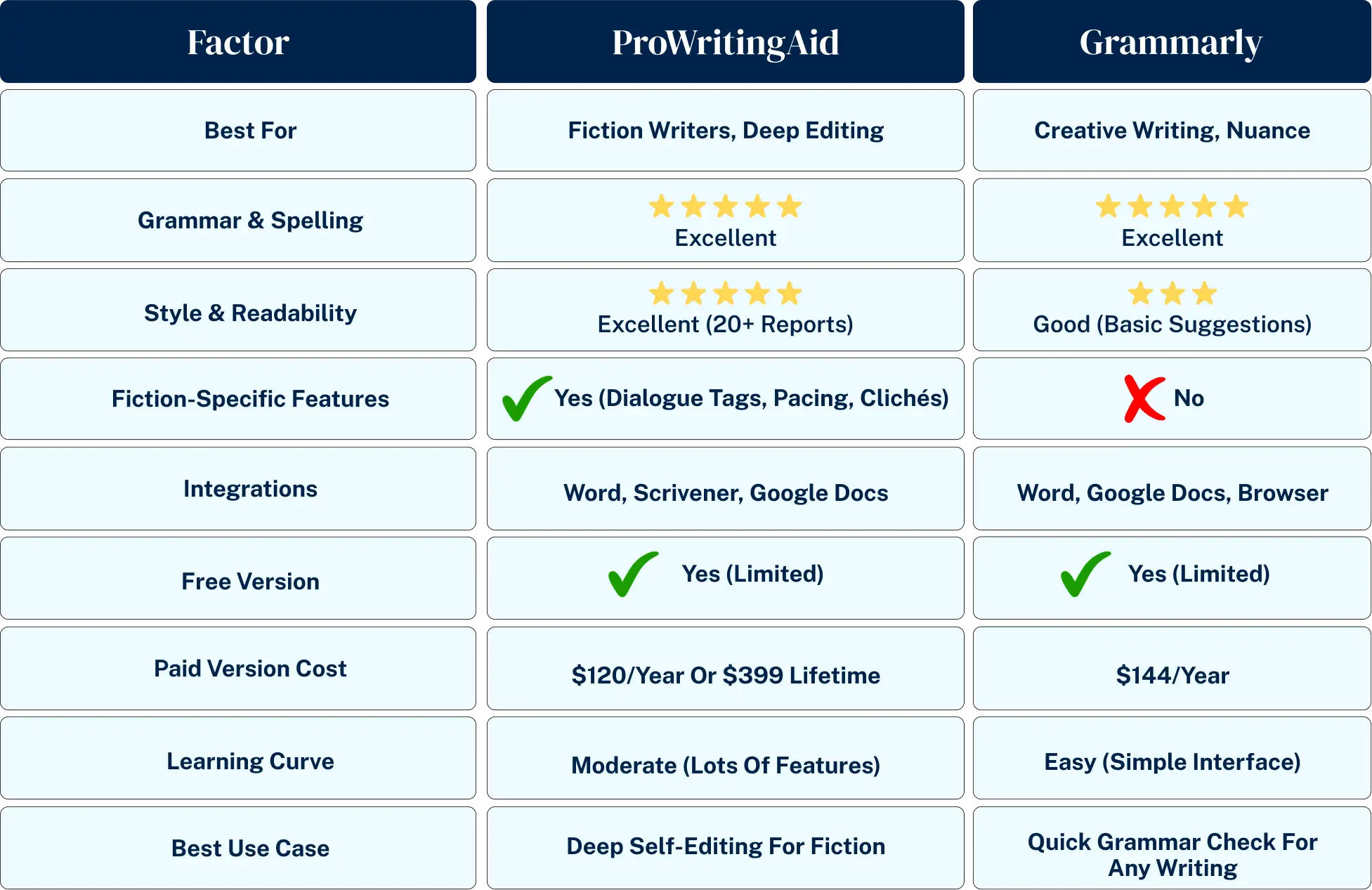
- ProWritingAid and Grammarly: These are the essential AI tools for line editing. Grammarly is excellent for catching typos and grammatical errors. ProWritingAid is even more powerful for fiction writers, with over 20 reports that analyze your writing for things like pacing, sentence length variation, dialogue tags, and clichés. It’s the best self-editing tool on the market.
- The Next Generation: ToneTuner (Voice & Style Adjuster): Have you ever felt that your writing voice is uneven? ToneTuner is an AI we’re developing that analyzes your prose for tone and style, and then provides gentle edits to help you maintain a consistent voice. You can even ask it to make a chapter feel more “whimsical” or “dark,” and it will provide suggestions that preserve your unique style. [CTA: Get on the waitlist for ToneTuner!]
prowritingaid v.s grammarly: which is better for authors
Pro tip:
ProWritingAid's "Echoes" report is a game-changer for fiction writers. It identifies words and phrases you overuse (like "just," "that," "started to," "began to"). Run this report on your manuscript and you'll be shocked at how many crutch words you rely on. Eliminating these echoes can tighten your prose by 10-15% without losing any meaning. This one feature alone is worth the $120/year subscription. Run it on every manuscript before you send it to beta readers.
AI for Blurb Writing
The Ultimate Sales Pitch
Your book description is one of the most important pieces of marketing copy you’ll ever write. AI can help you craft a blurb that sells.
- Using AI to Write Compelling Blurbs: You can feed your synopsis into an AI and ask it to generate a dozen different blurbs in various styles. This is a huge time-saver and can help you find the perfect hook.
- The Next Generation: BlurbScore (Blurb Effectiveness Scorer): How do you know if your blurb is any good? BlurbScore is an AI we’re developing that analyzes your blurb for conversion power, comparing it to thousands of bestselling book descriptions in your genre. It will give you a score and specific suggestions for improvement. [CTA: Get on the waitlist for BlurbScore!]
By leveraging these AI editing tools, you can go into the professional editing process with a much cleaner, more polished manuscript. This will not only save you money on editing fees but will also make you a better writer. The future of editing is a partnership between human and machine, and it’s already here.

AI Tools for Publishing & Production: Your AI-Powered Production Team

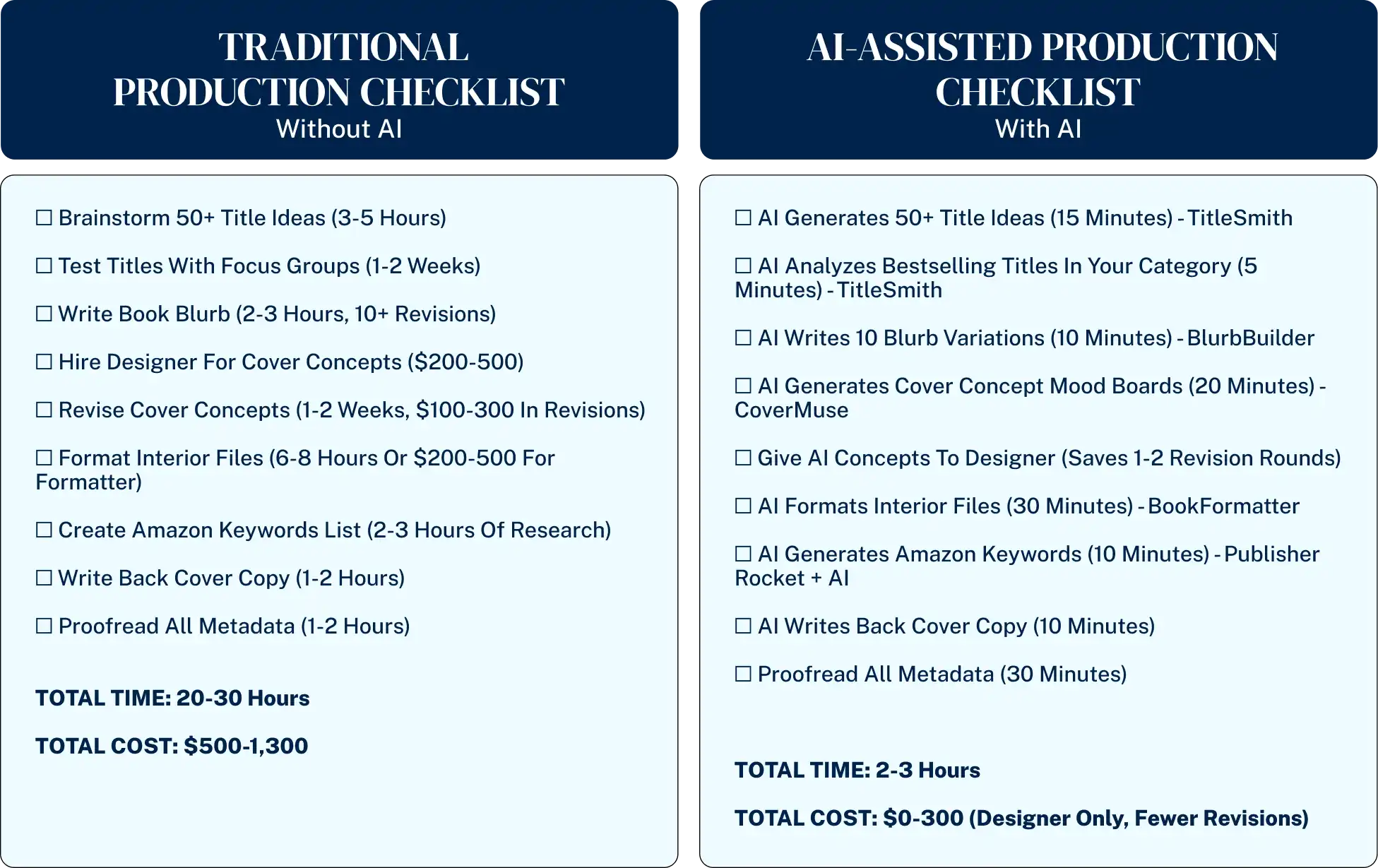
The journey from a finished manuscript to a published book is filled with dozens of small, technical, and often frustrating tasks. From choosing the perfect title to formatting your interior files, the production process can be a huge time-sink for authors. But with AI, you can streamline and automate many of these tasks, freeing you up to focus on your next book. This section covers the AI tools that will become your indispensable production team.
This is an area where the current AI tools are still catching up, which is why we are so excited about the suite of production tools we are building at Author’s Help Kit. We’ll give you a sneak peek at TitleSmith, our AI-powered title and subtitle generator; BlurbBuilder, which crafts conversion-ready book descriptions; CoverMuse, which creates stunning visual concepts for your designer; BookFormatter, which will handle the technical details of interior typesetting; and SubmitSmart, which will streamline the process of submitting to agents and publishers. These tools will take the headache out of book production.
THE DIFFERENCE:
- 85-90% time savings
- 60-75% cost savings
- Less stress and decision fatigue
- Professional results without the learning curve
AI for Titles and Subtitles
Your title is your book’s first impression. It has to be memorable, genre-appropriate, and SEO-friendly. AI can help you brainstorm hundreds of options in minutes.
- Using ChatGPT for Title Ideas: You can feed your book’s premise into an AI and ask for 50 different title ideas. You can specify the genre, the tone, and even ask for titles that are similar to bestselling authors in your space.
- The Next Generation: TitleSmith (Book Title & Subtitle Generator): TitleSmith is an AI we’re developing that goes beyond simple brainstorming. It analyzes the top 100 bestselling titles in your specific Amazon category to identify patterns, and then generates titles and subtitles that are optimized for discoverability. It even checks for Amazon-style length requirements. [CTA: Get on the waitlist for TitleSmith!]
NON-FICTION TITLE FORMULA:
[Benefit/Promise] + [Qualifier/Timeframe]
Examples:
- “Atomic Habits: An Easy & Proven Way to Build Good Habits & Break Bad Ones”
- “The 4-Hour Workweek: Escape 9-5, Live Anywhere, and Join the New Rich”
- “Can’t Hurt Me: Master Your Mind and Defy the Odds”
Why it works: Clear value proposition, specific promise, SEO-friendly
AI PROMPT FOR TITLE GENERATION:
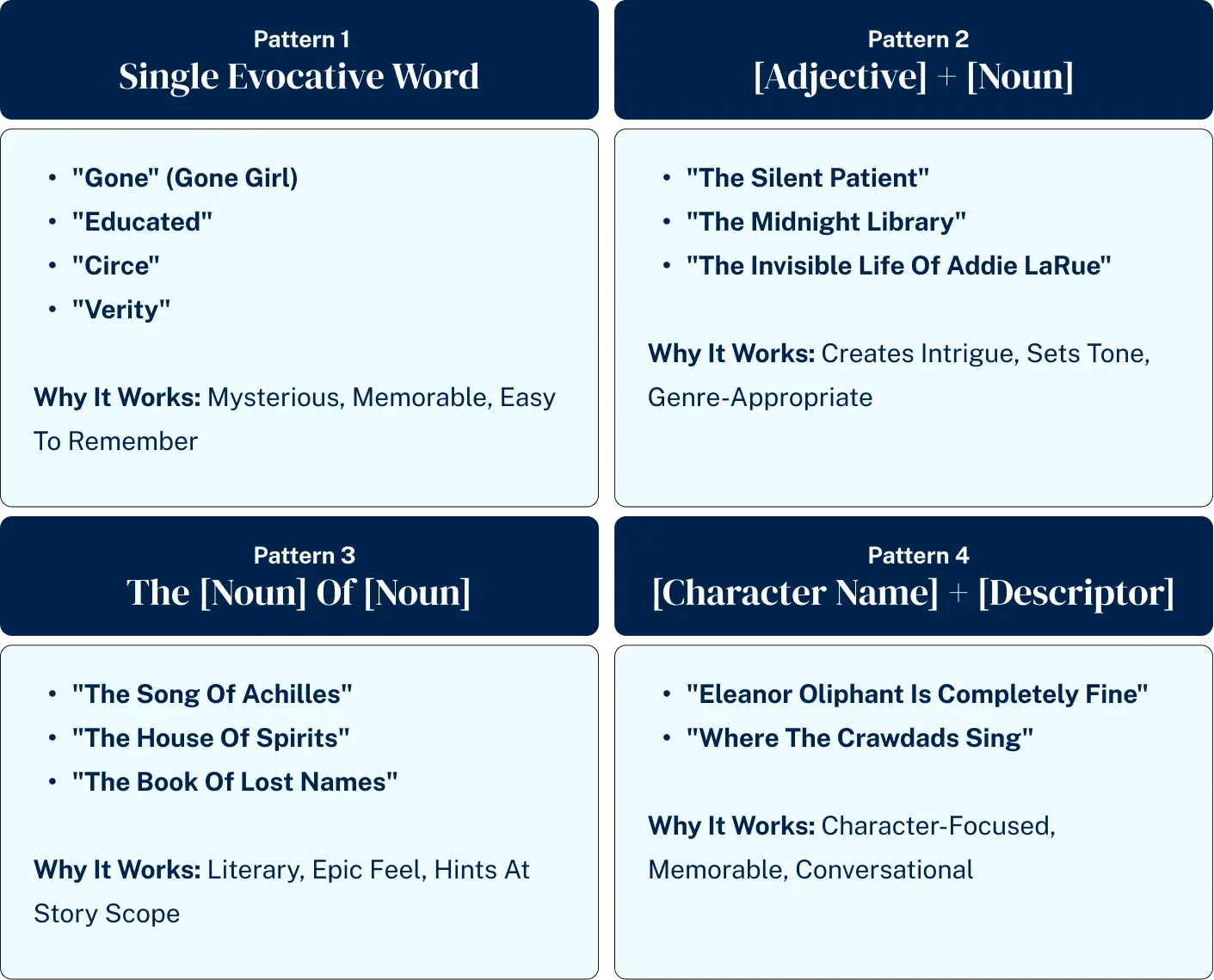
“I’m writing a [genre] about [one-sentence premise]. Analyze the top 20 bestselling titles in [Amazon category] and generate 30 title ideas that follow the most common patterns. Include a mix of single-word titles, [Adjective + Noun] titles, and ‘The [Noun] of [Noun]’ titles. Make them mysterious and intriguing without being too on-the-nose.”
Pro tip:
Before you finalize your book title, search it on Amazon to see if there are already 10+ books with the same or very similar titles. If there are, your book will get lost in the noise. Use AI to generate 50 title variations, then manually check the top 10 on Amazon for uniqueness. Also, check if the domain name [YourBookTitle].com is available—if you plan to build a series or brand around the title, you'll want to own the domain. Namecheap is the cheapest place to check domain availability.
AI for Book Descriptions
We covered this in the editing section, but it’s so important it’s worth repeating. Your blurb is your most important piece of sales copy.
- The Next Generation: BlurbBuilder (Description That Sells): BlurbBuilder is an AI we’re developing that uses proven copywriting formulas to craft hook-first, conversion-ready blurbs. You feed it a few key story facts, and it generates multiple blurb variants with different headlines and calls to action. [CTA: Get on the waitlist for BlurbBuilder!]
AI for Cover Design
A professional cover is non-negotiable. While AI won’t replace a human designer, it can be an incredible tool for creating concepts and providing clear direction.
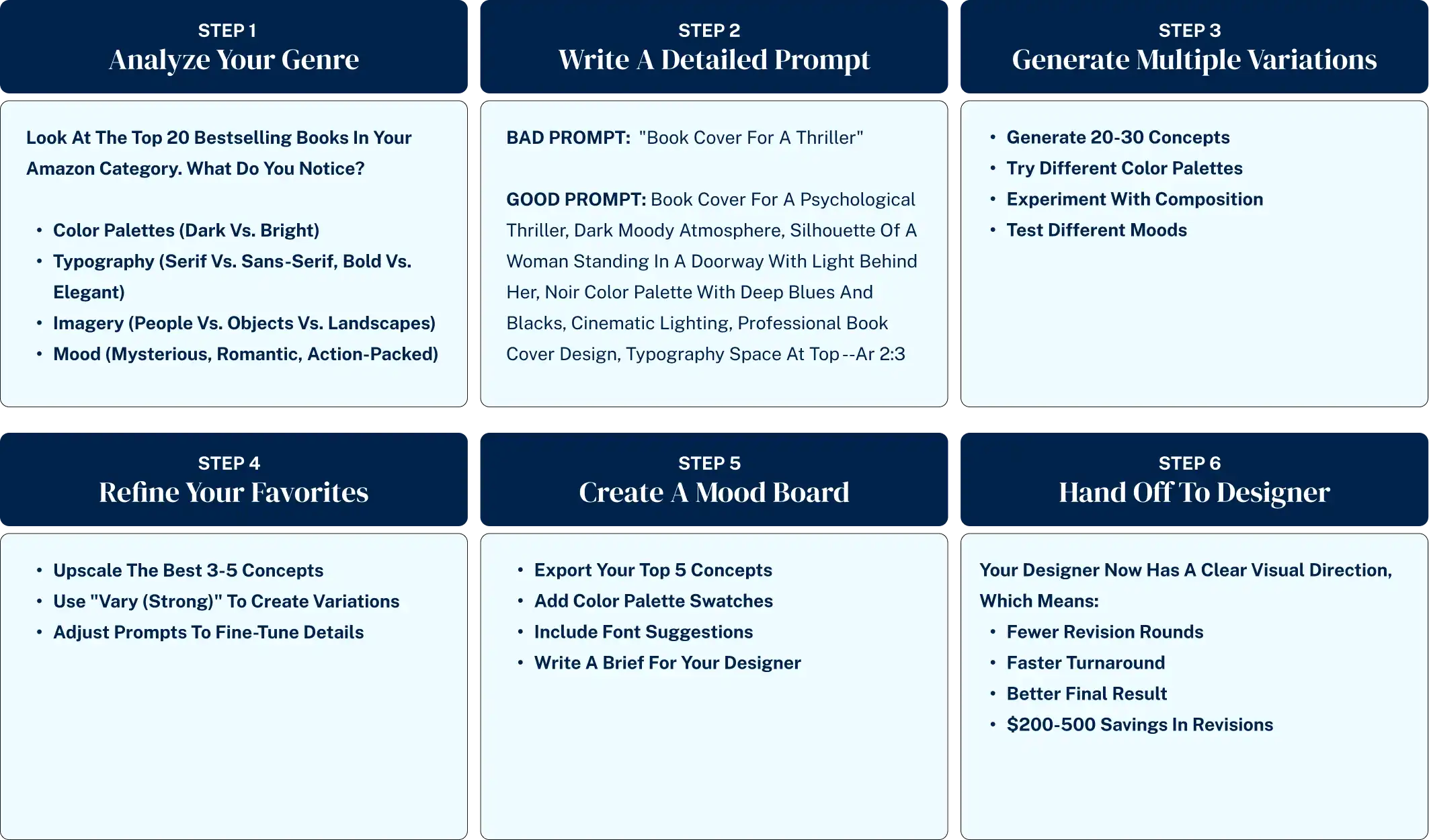
- Using Midjourney for Cover Concepts: AI image generators like Midjourney can create stunning, professional-quality concept art for your book cover. You can experiment with different styles, color palettes, and imagery, and then provide your designer with a clear visual brief. This can save you hundreds of dollars in costly revisions. Our guide “How to Write Midjourney Prompts for Book Covers” is a great place to start.
- The Next Generation: CoverMuse (Visual Concept Starter): CoverMuse is an AI we’re developing that streamlines the concept process. You tell it your genre and a few key story elements, and it generates a mood board with color palettes, font suggestions, and three distinct cover concepts with detailed art briefs that you can hand directly to your designer. [CTA: Get on the waitlist for CoverMuse!]
EXAMPLE PROMPTS BY GENRE:
Romance: “Book cover for a contemporary romance, couple silhouette at sunset, warm golden hour lighting, soft focus, elegant serif typography, romantic and dreamy atmosphere –ar 2:3”
Fantasy: “Book cover for an epic fantasy novel, ancient castle on a cliff, dramatic storm clouds, magical glowing elements, rich jewel tones, cinematic composition –ar 2:3”
Thriller: “Book cover for a crime thriller, urban noir aesthetic, rain-slicked city streets at night, neon reflections, gritty and atmospheric, bold sans-serif typography –ar 2:3”
Pro tip:
When using Midjourney for cover concepts, add "--ar 2:3" to the end of every prompt. This creates an image with the correct aspect ratio for a book cover (2:3 ratio, which is standard for most book sizes). Without this, Midjourney defaults to square images, which won't work for covers. Also, always specify "professional book cover design" and "typography space at top" in your prompt to ensure the composition leaves room for your title. These small details save hours of frustration.
AI for Interior Formatting
Formatting your book for ebook and print can be a technical nightmare. AI is poised to solve this problem.
- The Next Generation: BookFormatter (Interiors/Typesetting): BookFormatter is an AI we’re developing that will turn your Word document into a professionally formatted ebook and print-ready PDF, automatically handling trim sizes, chaptering, and widow/orphan control. It will have compliance checks for KDP and IngramSpark built-in. [CTA: Get on the waitlist for BookFormatter!]
AI for Traditional Publishing Submissions
For authors seeking a traditional publishing deal, the submission process is a daunting task.
- The Next Generation: SubmitSmart (Complete Submission Pack): SubmitSmart is an AI we’re developing that compiles your entire submission package. It will help you write a professional query letter, format your synopsis, and even create a checklist of agents who are looking for books like yours. [CTA: Get on the waitlist for SubmitSmart!]
By leveraging these AI production tools, you can save dozens of hours and thousands of dollars, all while creating a more professional and marketable book. The future of book production is here, and it’s powered by AI.

AI Tools for Marketing & Launch: Your AI-Powered Marketing Team

Writing the book is only half the battle. Marketing is where many authors struggle, and it’s a relentless, time-consuming job. From writing ad copy to generating social media content, the demands are endless. This is where AI can be your ultimate secret weapon. By automating the most tedious and data-driven marketing tasks, AI frees you up to do what you do best: connect with your readers. This section covers the AI tools that will become your 24/7 marketing team, helping you launch your book successfully and sell more copies for years to come.
This is another area where the market is just beginning to catch up, which is why we are building a suite of powerful AI marketing tools specifically for authors. We’ll give you a preview of BookBoost, which generates endless marketing copy and social media snippets; AdScribe, which writes high-converting ad copy for Amazon and Facebook; LaunchPlan AI, which turns your launch chaos into a manageable calendar; and ReaderMagnet, which helps you build and nurture your email list. These tools will give you an unfair advantage in a crowded market.
You 30 day book launch calendar with a.i
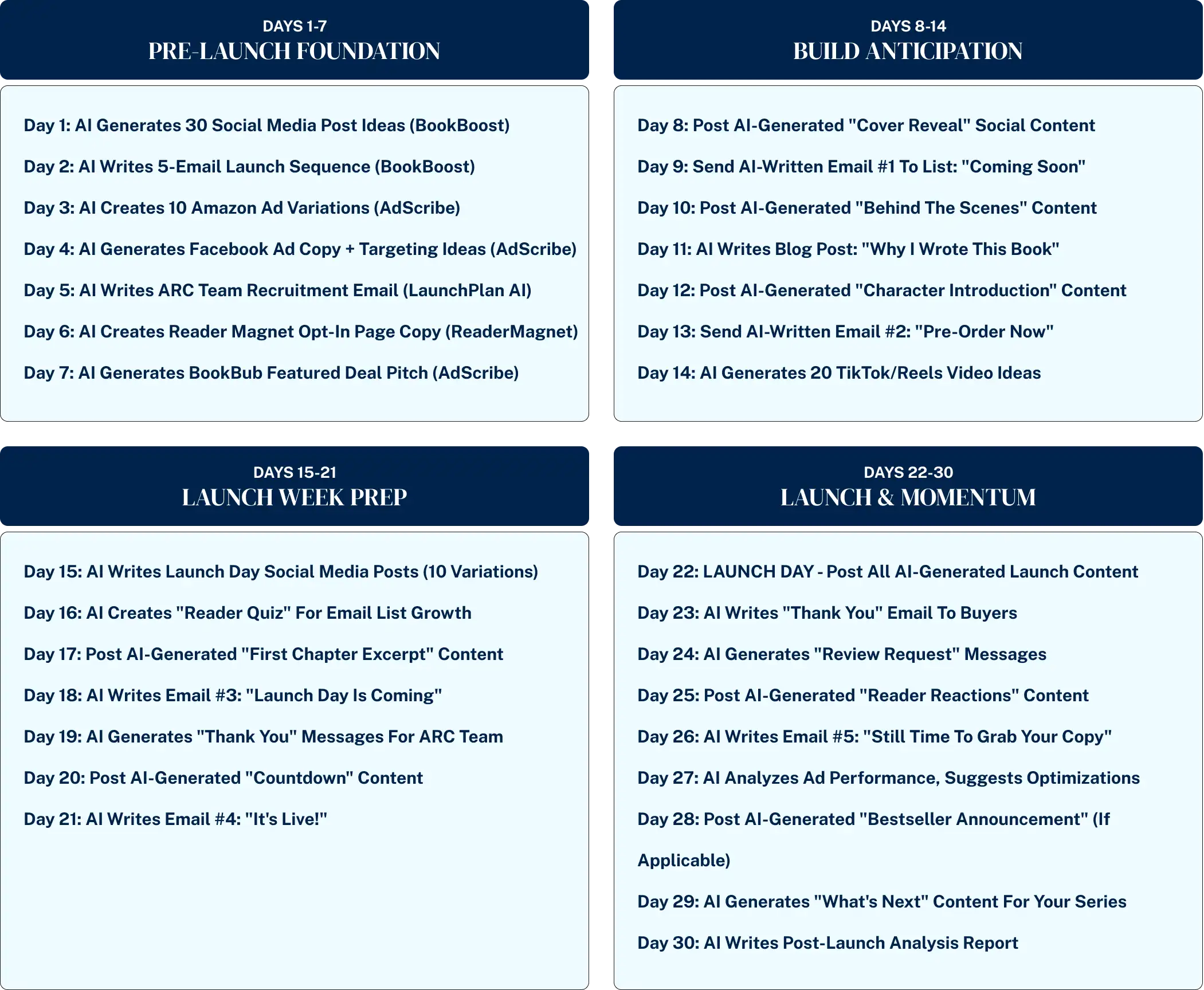
TIME SAVED WITH AI: 40-60 hours COST SAVED WITH AI: $1,000-2,000 (if you hired a marketing assistant)
AI for Marketing Copy and Social Media
Never stare at a blank social media calendar again. AI can generate a year’s worth of content ideas in a single afternoon.
- Using ChatGPT for Content Ideas: You can ask an AI to “act as a social media manager for a fantasy author” and have it generate a month’s worth of posts, including excerpts, behind-the-scenes content, and reader questions.
- The Next Generation: BookBoost (Marketing Copy & Launch Snippets): BookBoost is an AI we’re developing that generates fast, genre-aware marketing copy for any platform. It has modes for TikTok/Reels video ideas, email newsletter content, and website copy. It can even generate a “reader hook” email to send to your list. [CTA: Get on the waitlist for BookBoost!]
Your a.i generated social media content calendar
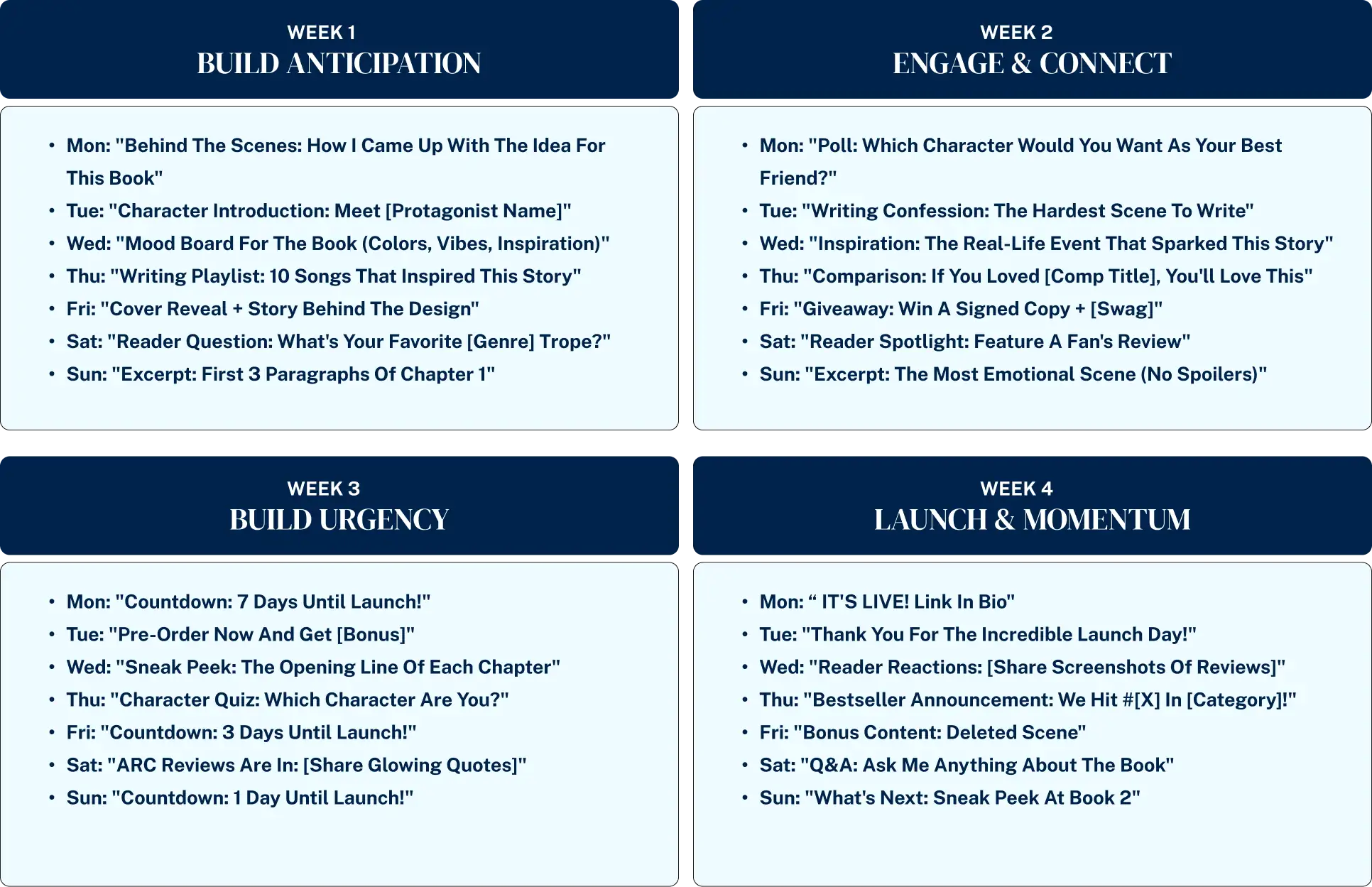
HOW TO GENERATE THIS: Use AI (ChatGPT, Claude, or BookBoost) with this prompt: “I’m launching a [genre] book called [title] in 30 days. Generate a 30-day social media content calendar with daily post ideas that build anticipation, engage readers, and drive pre-orders. Include a mix of behind-the-scenes content, excerpts, polls, giveaways, and countdown posts.”
Pro tip:
When AI generates social media content for you, always add your own personality and voice in the final edit. AI-generated posts can sound robotic and generic. Use AI to overcome the blank page and generate 30 ideas, then spend 5-10 minutes per post adding your humor, your anecdotes, and your unique perspective. The goal is to use AI for the structure and ideas, then inject your humanity. Readers follow YOU, not a robot. Use MailerLite or GoHighLevel to schedule these posts in advance so you're not scrambling every day.
AI for Paid Advertising
Paid ads are one of the fastest ways to find new readers, but they can be a huge money pit if you don’t know what you’re doing. AI can help you write better ads and find better keywords.
- Using AI for Ad Copy: You can feed your book’s blurb into an AI and ask it to generate 10 different ad headlines and body copy variations for Amazon or Facebook ads. This allows you to test different hooks and find what resonates with readers.
- The Next Generation: AdScribe (Ads & Keywords Generator): AdScribe is an AI we’re developing that writes Amazon, Facebook, and BookBub ads with keyword clusters. It helps you write better ad copy for a lower CPC and provides keyword and targeting suggestions to improve your campaigns. [CTA: Get on the waitlist for AdScribe!]
a.I generated ad copy: before. v.s after
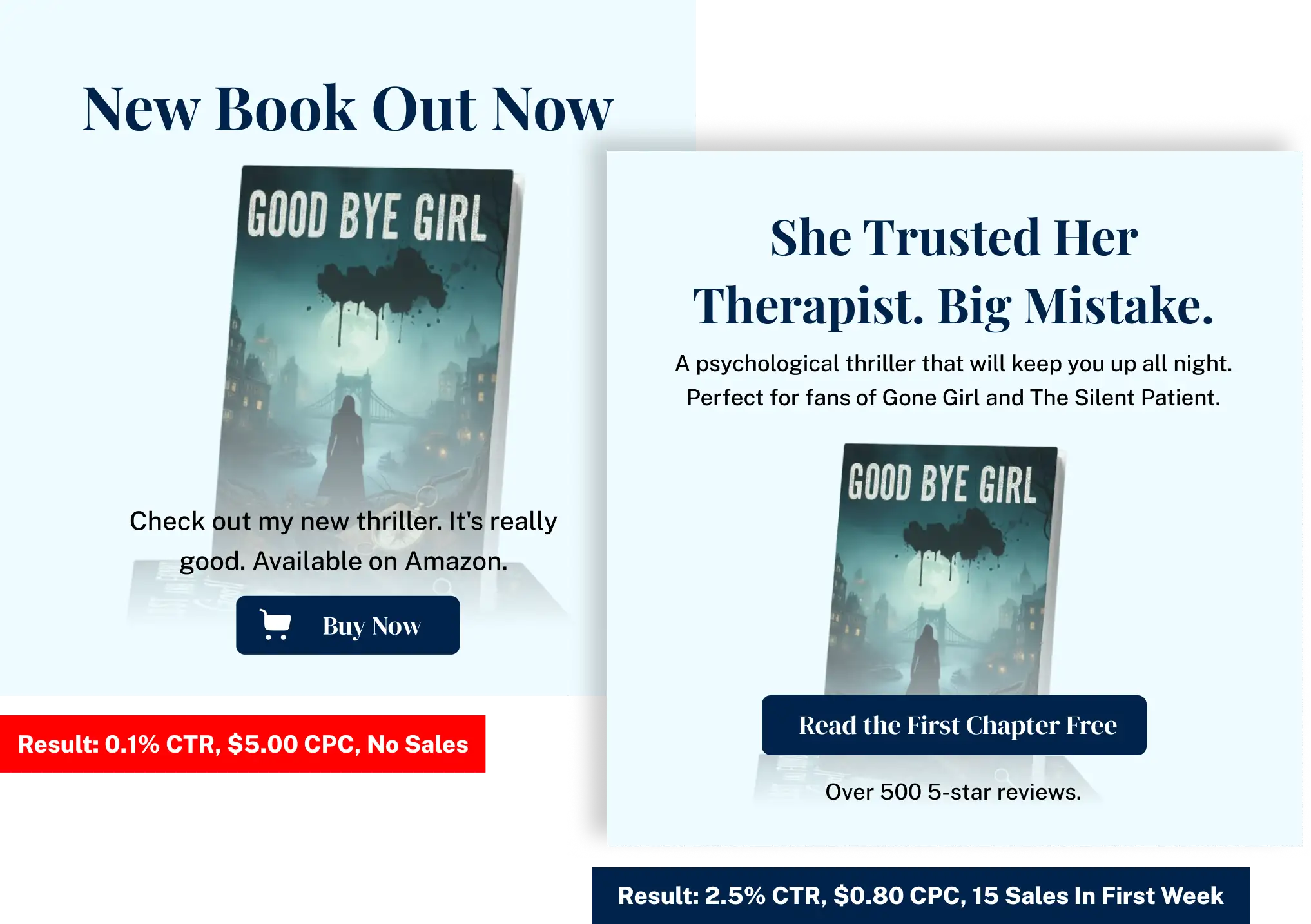
THE DIFFERENCE:
- Compelling hook (creates curiosity)
- Genre positioning (fans of…)
- Social proof (500 5-star reviews)
- Low-friction CTA (free chapter, not “buy”)
AI PROMPT FOR AD COPY:
“I’m advertising a [genre] book called [title]. The book is about [one-sentence premise]. My target audience is readers who loved [comp title 1] and [comp title 2]. Write 10 different Facebook ad variations with compelling headlines, benefit-driven body copy, and clear CTAs. Make them curiosity-driven without giving away the plot.”
MORE AI AD EXAMPLES:
Romance: Headline: “One Summer. Two Hearts. A Secret That Changes Everything.” Body: “A swoony beach read for fans of Emily Henry. Grab your copy and escape to the coast.”
Fantasy: Headline: “Magic Has a Price. She’s About to Pay It.” Body: “Epic fantasy meets political intrigue. Perfect for fans of Leigh Bardugo and Sarah J. Maas.”
Thriller: Headline: “Everyone Has Secrets. Hers Could Get Her Killed.” Body: “A twisty domestic thriller that will leave you breathless. Fans of The Woman in the Window will devour this.”
Pro tip:
Never run a single ad variation. Always test 5-10 different headlines and body copy combinations to see what resonates with your audience. Use AI to generate 20 ad variations in 5 minutes, then pick the top 10 to test. After 3-5 days, kill the worst performers and double down on the winners. This is called "A/B testing," and it can improve your ad performance by 200-300%. Use Publisher Rocket to find profitable keywords, then feed those keywords into your AI prompt for even better ad copy.
AI for Book Launches
A successful book launch requires military-grade planning and coordination. AI can be your launch manager.
- The Next Generation: LaunchPlan AI (30/60-Day Launch Manager): LaunchPlan AI turns your launch chaos into a dated checklist and content pack. You give it your launch date and assets, and it generates a day-by-day plan, from pre-launch outreach to post-launch follow-up. It even provides email templates for your ARC team. [CTA: Get on the waitlist for LaunchPlan AI!]
AI for Email List Building
Your email list is your most valuable marketing asset. AI can help you grow it faster.
- The Next Generation: ReaderMagnet (List-Building & Nurture): ReaderMagnet is an AI we’re developing that helps you create compelling opt-in incentives like quizzes and short stories. It can even write a 5-email welcome sequence to turn new subscribers into loyal fans. [CTA: Get on the waitlist for ReaderMagnet!]
AI for Reader Engagement
Managing your author brand and responding to reviews can be a time-consuming and emotionally draining task.
- The Next Generation: ReviewReply (Respond to Reviews Gracefully): Got a negative review? Don’t respond in anger. ReviewReply is an AI we’re developing that drafts polite, professional, and non-defensive replies that protect your brand. It can also draft grateful replies to your positive reviews. [CTA: Get on the waitlist for ReviewReply!]
By handing off the repetitive and data-heavy marketing tasks to AI, you can focus on the human side of marketing: building genuine connections with your readers. This is how you build a long-term author career.

How to Use AI Ethically (Without Losing Your Voice): A Framework for Responsible AI

Let’s address the elephant in the room: Is using AI cheating? Is it going to steal your voice and make your writing generic? The answer is a resounding no—if you use it correctly. AI is a tool, just like a thesaurus, a grammar checker, or a story structure framework.
It is a powerful lever that can augment your creativity, not replace it. The key is to remain the author, the artist, and the final decision-maker in your creative process. This section provides a framework for using AI ethically, responsibly, and in a way that enhances, rather than diminishes, your unique authorial voice.
We’ll explore the critical difference between AI as a Partner vs. AI as a Ghostwriter, the importance of Disclosure and Transparency with your readers, and how to Train AI on Your Own Voice to ensure stylistic consistency. We’ll also cover the essential legal topic of Copyright and AI-Generated Content, and provide a Code of Ethics for AI-Assisted Authors.
This is the most important section in this entire hub, because it will give you the confidence to use these powerful tools without sacrificing your integrity or your art.
THE AI ETHICS FRAMEWORK FOR AUTHORS
the a.i ethics framework for authors
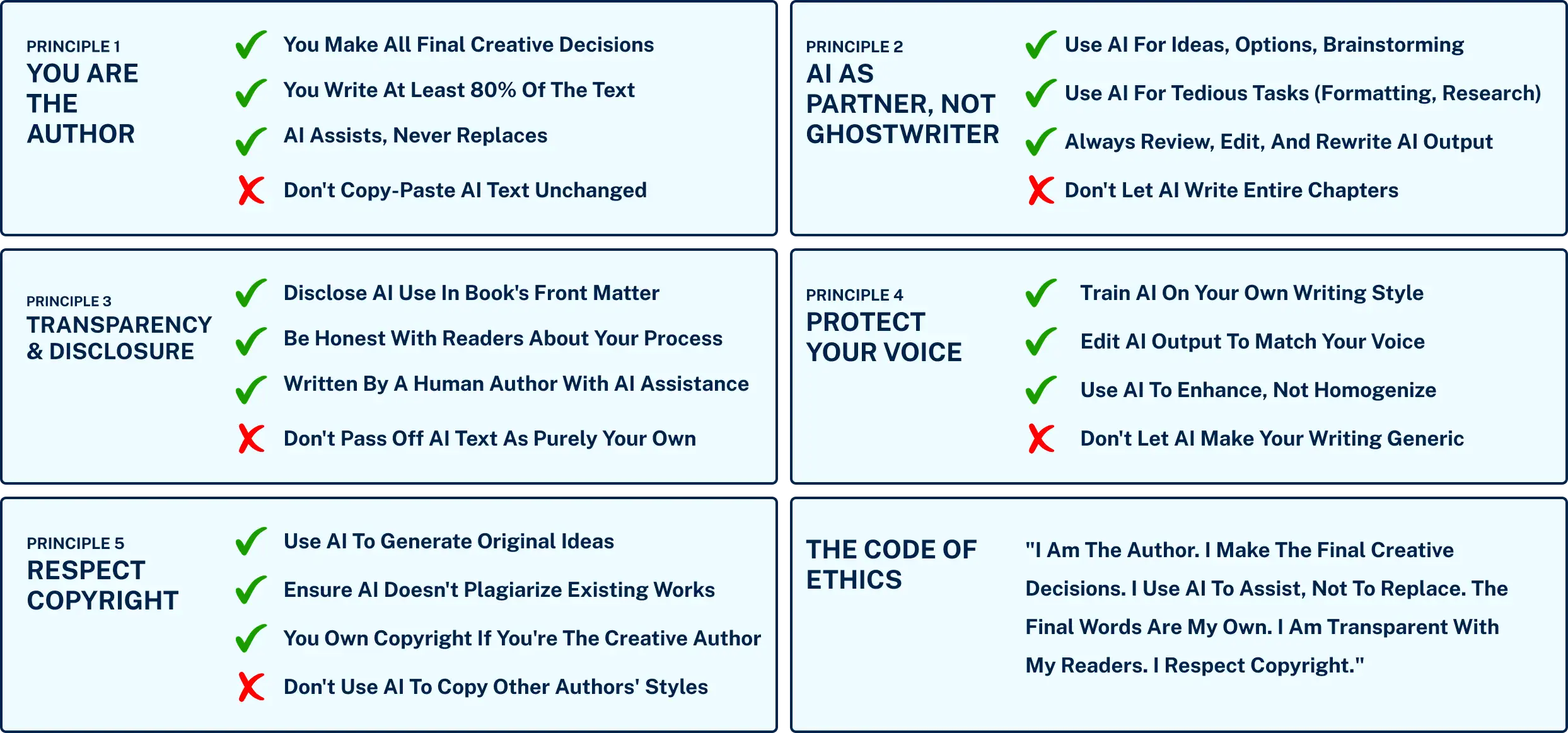
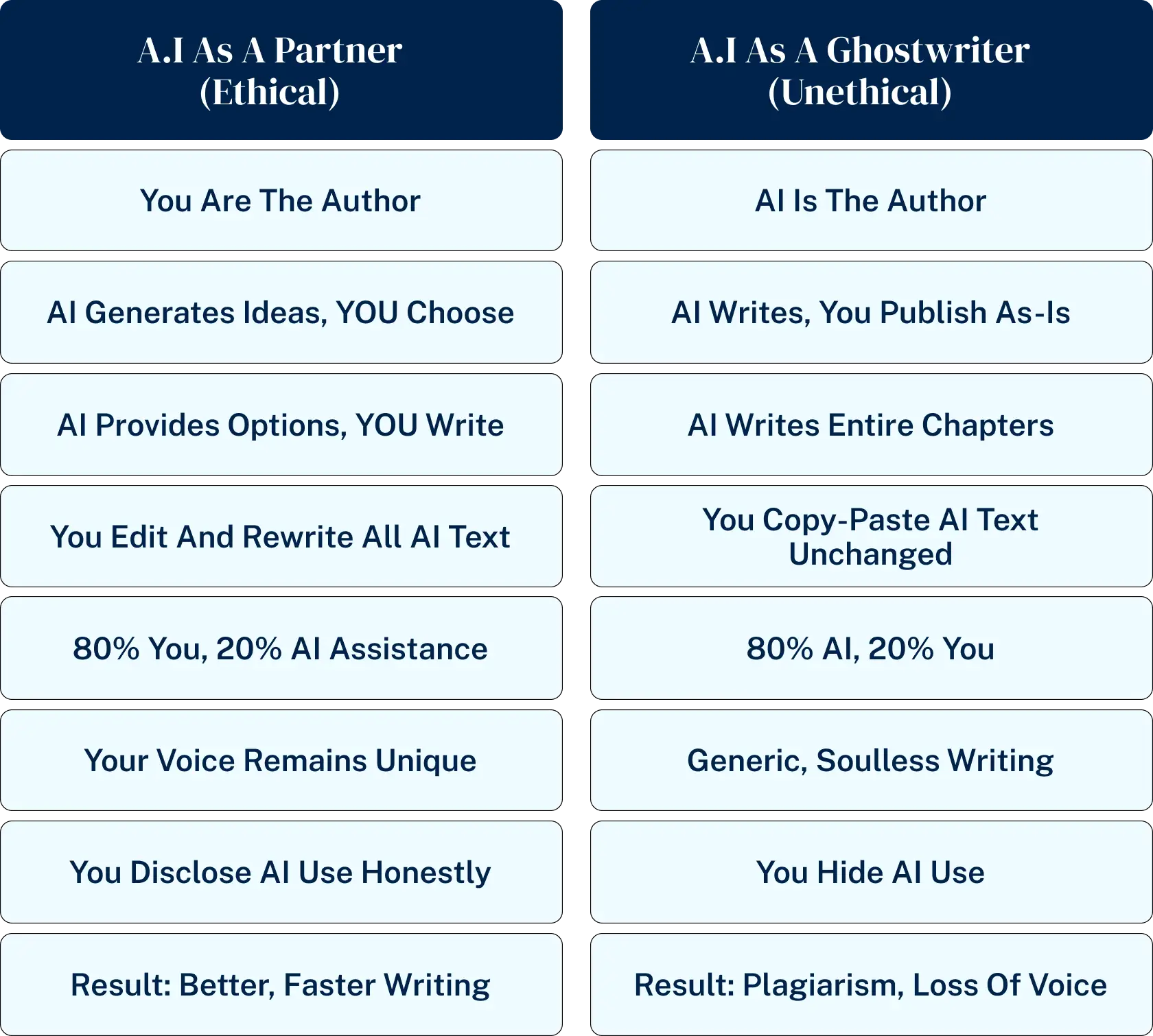
AI as a Partner, Not a Ghostwriter
This is the single most important mindset shift you need to make. You are the author. The AI is your assistant. You are the chef; the AI is the sous chef chopping the vegetables.
- You Are Always in Control: Never accept AI-generated text without reviewing, editing, and rewriting it to fit your voice and your story. Use AI for ideas, for options, and for first drafts of non-creative text (like ad copy), but the final words should always be yours.
- The 80/20 Rule for AI: A good rule of thumb is that you should be doing at least 80% of the creative work. Use AI for the 20% of tasks that are draining your time and energy, like brainstorming 50 title ideas or summarizing research.
Pro tip:
Create a personal "AI usage policy" document where you define your own rules for how you'll use AI in your writing. For example: "I will use AI for brainstorming and outlining, but never for writing dialogue or emotional scenes." Having clear boundaries helps you stay ethical and prevents scope creep where you start relying on AI too heavily. Review this policy every 6 months as AI tools evolve. Share it with your readers in your author newsletter to build trust and transparency.
Disclosure and Transparency: To Tell or Not to Tell?
The question of whether to disclose your use of AI is a hot topic. There is no legal requirement to do so, but it is a question of ethics and reader trust.
- A Spectrum of Disclosure: We recommend a simple, honest approach. A brief note in your book’s front matter like, “This book was written by a human author who used AI tools for brainstorming, research, and editing assistance,” is a great way to be transparent without overstating the AI’s role.
- When Disclosure Is Essential: If you are using AI to generate significant portions of your text (which we do not recommend), you absolutely must disclose it. Passing off AI-generated text as your own is plagiarism, and it will destroy your reputation.
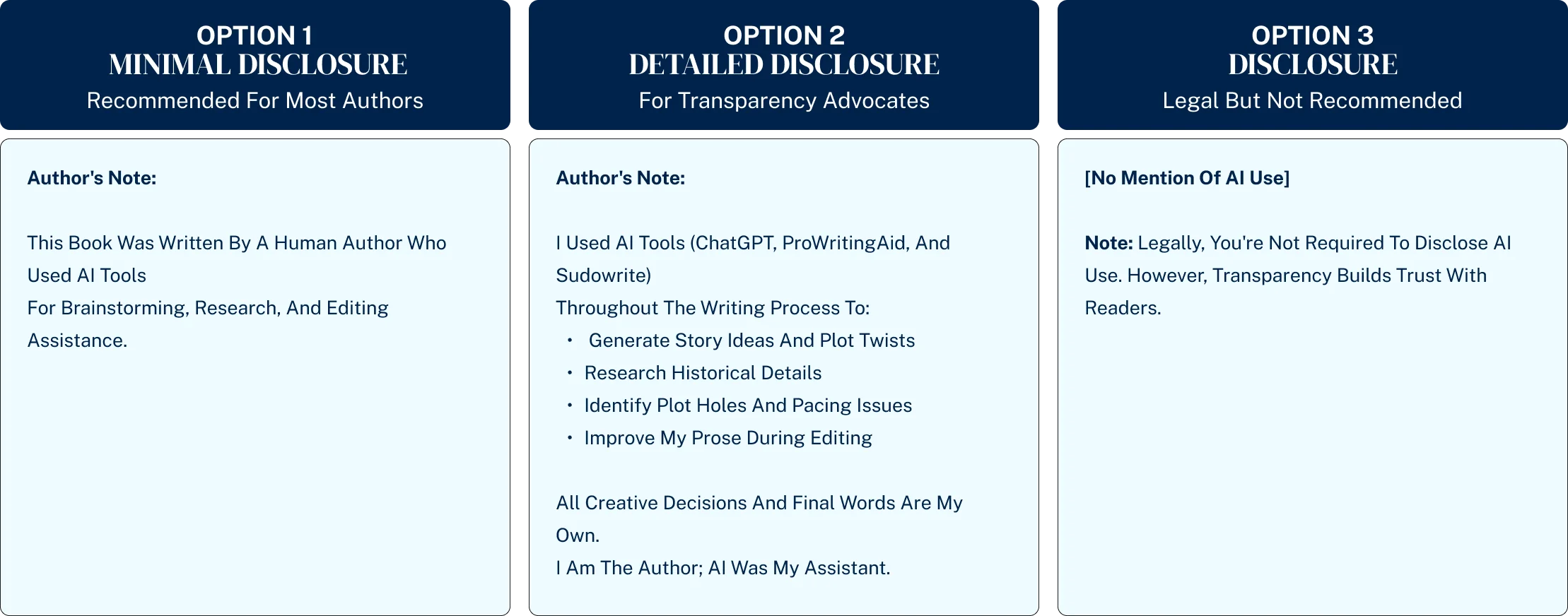
WHERE TO PLACE YOUR DISCLOSURE:
- In the book’s front matter (after dedication, before Chapter 1)
- On your website’s “About” page
- In your author bio
- Don’t hide it or make it hard to find
WHEN DISCLOSURE IS ESSENTIAL:
If you used AI to generate significant portions of text (which we don’t recommend), you MUST disclose it. Passing off AI-generated text as your own is plagiarism.
READER REACTIONS: Most readers don’t care if you used AI for brainstorming or editing. They care about:
- Is the story good
- Is it YOUR voice
- Did you put in the work?
Be honest, be transparent, and your readers will respect you.
How to Train AI on Your Own Voice
One of the biggest fears authors have is that AI will make their writing sound generic. The solution is to train the AI on your own writing.
- Creating a “Style Guide” for Your AI: You can feed an AI a chapter of your writing and say, “Analyze the style, tone, and voice of this text. Now, using that style, give me some ideas for the next scene.” This will give you results that are much closer to your own voice.
- The Next Generation: StyleMirror (Analyze & Mirror Your Unique Style): StyleMirror is an AI we’re developing that creates a “style fingerprint” of your writing. You can then use this fingerprint to have the AI generate text that is stylistically consistent with your own work. It’s like having a private, fine-tuned version of the AI that only knows how to write like you. [CTA: Get on the waitlist for StyleMirror!]
Pro tip:
To train AI on your voice, paste 2-3 chapters of your published work into Claude (it has a large context window) and say: "Analyze the style, tone, voice, and sentence structure of this text. Create a 'style guide' that describes how I write." Save this style guide, then use it as a prefix for all future AI prompts: "Using the style guide below, help me brainstorm..." This ensures AI-generated ideas feel like they came from YOU, not a generic robot. Update your style guide with each new book to capture your evolving voice.
Copyright and AI-Generated Content
This is a complex and rapidly evolving area of law. As of late 2025, the U.S. Copyright Office has stated that purely AI-generated work cannot be copyrighted. However, work that is created with the assistance of AI by a human author can be copyrighted.
- What You Need to Know: As long as you are the author making the creative decisions and writing the majority of the text, your copyright is secure. This is another reason why it is so important to use AI as a partner, not a ghostwriter.
- Disclaimer: We are not lawyers, and this is not legal advice. We recommend consulting with an intellectual property lawyer for specific questions about your work.
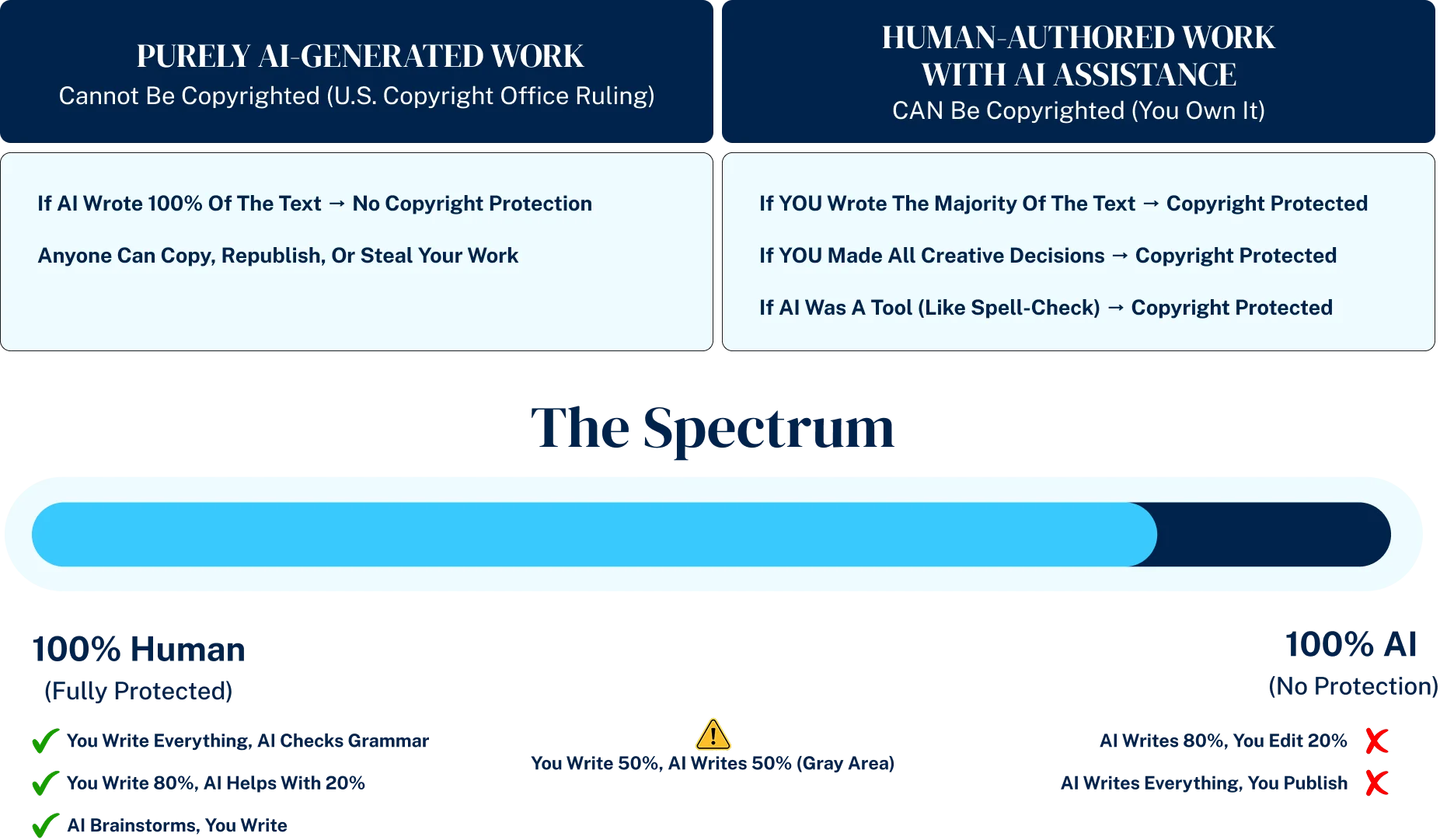
WHERE IS THE LINE? The U.S. Copyright Office says: “The work must be the product of human creativity.”
SAFE ZONE:
- You are the author making creative decisions
- You write at least 70-80% of the text
- AI assists with brainstorming, research, editing
- You review and rewrite all AI output
DANGER ZONE:
- AI writes entire chapters unchanged
- You copy-paste AI text without editing
- AI makes the creative decisions
DISCLAIMER: We are not lawyers. This is not legal advice. Consult an intellectual property lawyer for specific questions about your work.
BOTTOM LINE: If you’re using AI as a partner (not a ghostwriter), your copyright is secure.
A Code of Ethics for AI-Assisted Authors
We propose a simple code of ethics for authors using AI:
- I am the author. I make the final creative decisions.
- I use AI to assist, not to replace. I use it for ideas, options, and to automate tedious tasks.
- The final words are my own. I review, edit, and rewrite all AI-generated text to fit my voice.
- I am transparent with my readers. I disclose my use of AI in a clear and honest way.
- I respect copyright. I do not use AI to plagiarize the work of others.
By following this framework, you can leverage the incredible power of AI to become a better, faster, and more successful author, all while maintaining the artistic integrity and unique voice that make you a writer in the first place. This is not cheating. This is the future.
A Writer’s Revelation: Why the Authors Helpkits AI and Tools Hub is the Future of Craft
Before I found the Authors Helpkits AI and Tools Hub, I was a frustrated “pantser” trapped in a plotter’s world. My process was pure chaos: a sprawling mess of 100,000 words in a document that had no clear Plotting, terrible pacing in the middle, and characters who changed their motivations more often than their socks. The sheer labour of self-editing felt insurmountable, leaving me stuck in a permanent state of Writer’s Block.
I was sceptical of AI tools at first, worried they would dilute my voice. But the Hub isn’t about replacing the author; it’s about being the ultimate structural assistant, editor, and brainstorming partner. It truly changed my life and allowed me to finally finish writing my book—not just one, but two—in the last year alone.
Cedric L.,
Author