Publish Your Book Like a Pro Without the Confusion, Costly Mistakes, or Overwhelm
Everything you need to get your book on Amazon, IngramSpark, and beyond, step-by-step guides, tool comparisons, and insider tips from authors who’ve been there.
- Used by Published Authors
- 100% Free resources
- No Fluff, Just Results
Publishing your book is one of the most important decisions you’ll make as an author, yet most approach it with outdated information, myths, and confusion.
Should you self-publish or chase a traditional deal? Amazon only or wide distribution? Which tools are worth the investment, and which are just expensive distractions? The wrong choices can cost you thousands of dollars and, worse, leave your book invisible to the readers it was meant for.
This is your definitive guide to publishing the right way. We’ve created a complete, multi-level roadmap to navigate every publishing decision with confidence. Below, you’ll find six comprehensive sections that cover the entire journey, from choosing your publishing path to launching your book and beyond.
We provide honest, side-by-side tool evaluations for formatting and cover design, identify the critical mistakes that kill book sales before they start, and give you the professional strategies you need for a successful launch and long-term career.
Whether you’re publishing your first book or your tenth, start with the section where you need the most clarity. Let’s turn your finished manuscript into a global success story.
Publish your Book Topics
Click below below to jump straight to the topic.

Your Complete Publishing Roadmap: From Manuscript to Global Distribution

Your book is written, edited, and polished. It’s a powerful, compelling story that you’ve poured your soul into, and now it’s ready to meet the world. But the journey from a finished manuscript file on your computer to a live book for sale on Amazon, Barnes & Noble, and in bookstores across the globe is a journey in itself.
This is the publishing process, and it’s a path filled with critical decisions, technical hurdles, and incredible opportunities. Getting it right can be the difference between a book that languishes in obscurity and one that finds its audience and thrives.
This roadmap is your step-by-step guide through the entire publishing journey. We’ll demystify the process, breaking it down into manageable stages from the moment your edits are complete to the day you hold the finished book in your hands. We’ll explore the fundamental differences between Traditional vs. Self-Publishing, helping you decide which path is right for your career.
We’ll provide a complete Self-Publishing Checklist that takes you from manuscript to launch, explain the complexities of Rights, Royalties, and Contracts, and even touch on what it takes to get your book published internationally. Whether this is your first book or your tenth, this roadmap will ensure you approach the publishing process with clarity, confidence, and a professional strategy.
traditional vs self-publishing decision tree flowchart

The Fork in the Road
Traditional vs. Self-Publishing
Before you take another step, you must make a foundational decision that will shape your entire author career: do you want to pursue a traditional publishing deal, or do you want to self-publish?
There is no right or wrong answer here, both are valid and potentially lucrative paths. The right choice depends entirely on your goals, your timeline, your entrepreneurial spirit, and how much creative control you want to maintain.
Traditional Publishing
Traditional Publishing is the model you see in movies. You (usually via a Literary Agent) sell the rights to your manuscript to a publishing house (like Penguin Random House or HarperCollins).
They pay you an advance against future royalties and handle every aspect of the production process: editing, cover design, formatting, printing, distribution, and marketing.
- Pros: The prestige and validation of a traditional deal are significant. You have a team of professionals working on your book, and you don’t have to pay for anything out of pocket. Their distribution network can get your book into physical bookstores, which is very difficult to achieve as a self-published author.
- Cons: The process is incredibly slow, it can take years from signing a deal to seeing your book on shelves. You give up a significant amount of creative control over your cover, title, and even the final edit. Royalty rates are much lower (typically 7-15% on print books), and it is extremely difficult to get a deal in the first place. Our guide “The Truth About Traditional Publishing: What Publishers Actually Do” breaks it down.
Self-Publishing
Self-Publishing (or Indie Publishing) is the entrepreneurial path. You are the publisher. You are responsible for hiring your own editors, cover designers, and formatters.
You manage your own distribution through platforms like Amazon KDP and IngramSpark, and you are in charge of all your own marketing.
- Pros: You have 100% creative control over every aspect of your book. The time to market is incredibly fast—you can go from a finished manuscript to a published book in a matter of weeks. Your royalty rates are significantly higher (typically 40-70%), and you have direct access to sales data, allowing you to make smart marketing decisions.
- Cons: You bear all the upfront costs, which can range from a few hundred to several thousand dollars. You are responsible for everything, which can be overwhelming. While the stigma is fading, it can still be difficult to get reviews from major publications or achieve widespread bookstore distribution. Our Complete Self-Publishing Checklist will walk you through every step.
We also have a deep-dive comparison, Traditional vs. Self-Publishing: Which Path is Right for Your Book?, that can help you make this critical decision.
There is also a third path, Hybrid Publishing, but it comes with its own set of risks and rewards that we explore in our article “What is Hybrid Publishing, Really?”

Understanding Your Rights and Royalties

Whether you publish traditionally or self-publish, you need a basic understanding of publishing contracts and how you get paid. In a traditional deal, you are selling the rights to your work. The contract will specify which rights the publisher is acquiring (e.g., North American print rights, audiobook rights, translation rights) and for how long.
It’s crucial to have a Literary Agent or an intellectual property lawyer review any contract before you sign it. As a self-published author, you retain all your rights, which is a major advantage. You are simply using platforms like Amazon KDP as a distributor. When it comes to royalties, the difference is stark:
author royalty rates comparison traditional vs self publishing 2025
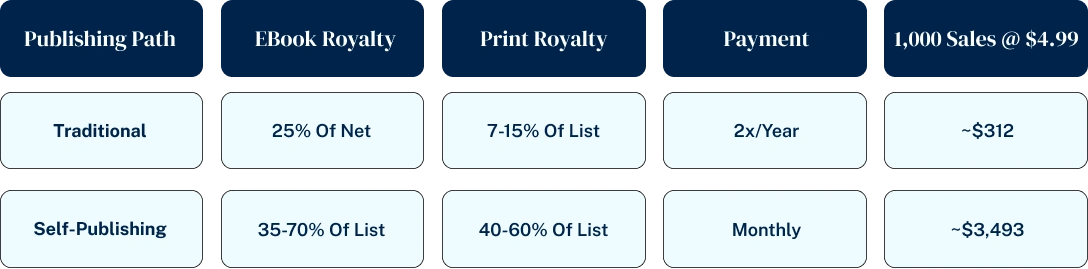
Understanding how this works is key to forecasting your potential income. Our guide, “How Author Royalties Actually Work,” breaks down the math with real-world examples.
Pro tip:
You don't have to choose one path forever. Many successful authors start by self-publishing to build an audience and prove their market viability, then use their sales data as leverage to negotiate a better traditional deal later. Publishers love authors who come with a built-in audience and proven sales. This "hybrid career" approach gives you the best of both worlds.
International Publishing: Thinking Globally
In today’s digital marketplace, your book can be available to readers all over the world with the click of a button. If you’re self-publishing, platforms like Draft2Digital and IngramSpark make it easy to distribute your ebook and print book to dozens of countries.
However, you also need to consider translation rights. You can sell these rights to foreign publishers, who will then translate and publish your book in their market. This can be a complex but lucrative endeavor.
Our introduction to Publishing in Multiple Countries can help you understand the basics of what’s involved in taking your author career global, including the role of foreign rights agents and international book fairs like the Frankfurt Book Fair.

Which Publishing Platform Is Right for You?
Amazon vs. Wide Distribution
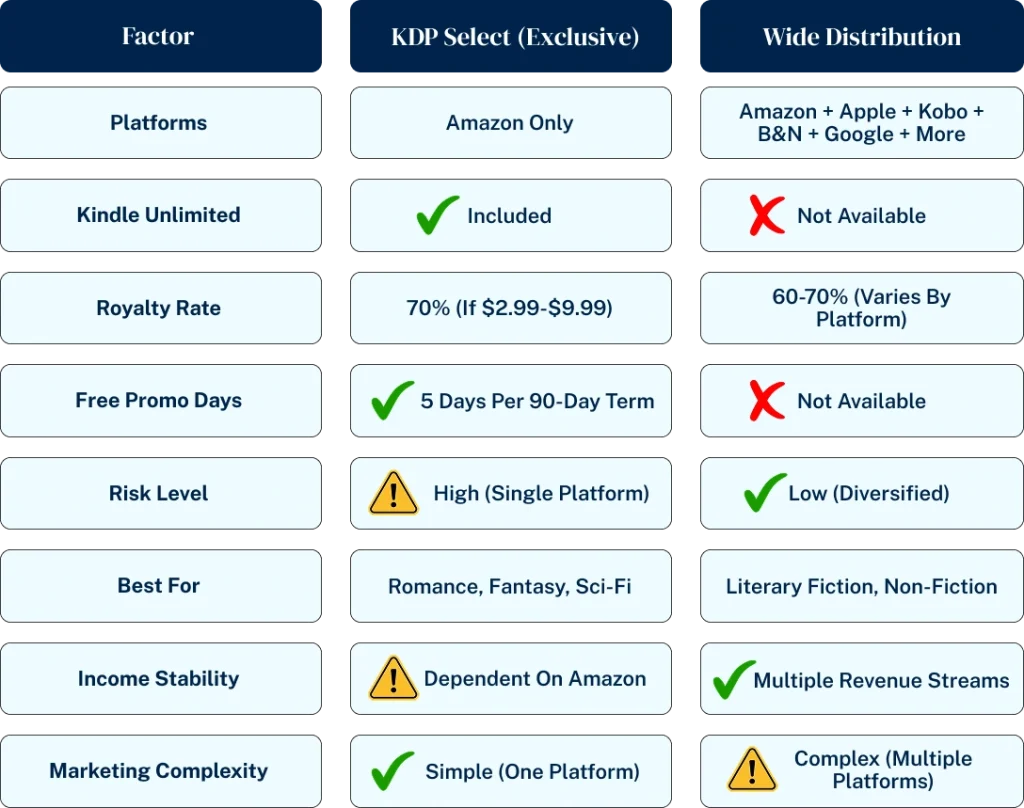
Once you’ve decided to self-publish, your next major decision is where to publish. This choice will determine where your book is available for sale, how much you earn per copy, and how much control you have over your pricing and promotions. The central debate in the indie author community is Amazon KDP Select vs. Wide Distribution.
Do you grant Amazon exclusivity in exchange for access to their powerful marketing tools, or do you distribute your book as widely as possible across all available online retailers?
This is not a one-size-fits-all decision. The right strategy depends on your genre, your marketing plan, your long-term career goals, and whether you’re launching a standalone book or a multi-book series. This section will break down the pros and cons of both approaches, giving you the information you need to choose the distribution strategy that best aligns with your goals.
We’ll do a deep dive into the major platforms like Amazon KDP, IngramSpark, and Draft2Digital, and help you understand how to leverage each one for maximum profit and reach.
The Behemoth
Amazon KDP and KDP Select

Amazon Kindle Direct Publishing (KDP) is the 800-pound gorilla of the self-publishing world. It is the largest single marketplace for books in the world, and it is non-negotiable. Every self-published author, regardless of their strategy, should be on Amazon.
The real question is whether you should enroll your ebook in KDP Select, an optional program that requires you to make your ebook exclusive to Amazon for 90-day renewable terms.
In exchange for this exclusivity, Amazon gives you access to two powerful marketing tools:
- Kindle Unlimited (KU): Your book is placed in the Kindle Unlimited library, a subscription service where readers can read as many books as they want for a monthly fee. You get paid for each page a KU subscriber reads from your book.
- Kindle Free Promotions & Countdown Deals: You can run limited-time promotions, either making your book free for up to 5 days or offering a timed discount. These can be powerful for driving visibility and sales.
- Pros of KDP Select: Access to the massive KU audience can lead to a significant number of page reads and a steady income stream, especially for popular genres like Romance, Fantasy, and Sci-Fi. Free promotions can be a powerful launch tool to garner initial reviews and visibility.
- Cons of KDP Select: You are completely dependent on a single retailer. You cannot sell your ebook on any other platform, including your own website. Any changes to Amazon’s algorithm or royalty structure can devastate your income overnight. Our guide, “The Complete KDP Setup Guide,” walks you through the entire process.
kdp select vs wide distribution comparison chart 2025
Pro tip:
If you're unsure whether to go exclusive or wide, start with KDP Select for your first 90 days. Use the free promo days and KU exposure to build initial reviews and visibility. After 90 days, opt out and go wide with Draft2Digital. This "test and expand" strategy lets you leverage Amazon's power for launch, then diversify for long-term stability.
Going Wide
The Strategy of Diversification

Going “wide” means distributing your book to as many retailers as possible. This includes not only Amazon (without enrolling in KDP Select) but also other major players like Apple Books, Barnes & Noble (Nook), Kobo, and Google Play.
It also includes library services like OverDrive and international retailers. Since uploading and managing your book on every single platform individually would be a nightmare, most authors use an aggregator.
An aggregator is a service that distributes your book to a wide range of online retailers and library systems for you. You upload your book once, and they handle the rest, collecting the royalties and paying them out to you in a single monthly payment (after taking a small percentage).
The Top Aggregators:
- Draft2Digital: Known for its user-friendly interface, excellent customer service, and simple royalty structure (they take 10% of the retail price). They make it incredibly easy to get your book into dozens of stores. Our guide “How Draft2Digital Simplifies Wide Distribution” explains their service in detail.
- Smashwords: One of the original ebook aggregators. They have a massive distribution network, but their interface is less user-friendly than Draft2Digital’s. (Note: In 2022, Draft2Digital acquired Smashwords, and they are in the process of integrating their platforms).
- PublishDrive: Another popular aggregator that operates on a subscription model, which can be more cost-effective for authors with a large backlist.
- Pros of Going Wide: You are not dependent on a single retailer, which makes your income more stable and secure. You can reach readers who don’t shop on Amazon. You can run promotions across multiple platforms and sell your ebooks directly from your own website using services like Shopify or WooCommerce, earning a 90%+ royalty rate. Our article “The Pros and Cons of Selling Books Directly From Your Website” explores this strategy.
- Cons of Going Wide: Marketing is more complex, as you have to manage promotions across multiple platforms. You lose access to the Kindle Unlimited audience, which can be a significant source of income in certain genres. It can take longer to gain traction and visibility without the focused power of Amazon’s promotional tools.
book distribution aggregators draft2digital publishdrive ecosystem

The Best of Both Worlds
Print Distribution with IngramSpark
This is a critical point that confuses many new authors: ebook exclusivity is separate from print book exclusivity. You can enroll your ebook in KDP Select and still distribute your print book widely. For this, you need IngramSpark.
IngramSpark is a print-on-demand (POD) service owned by the Ingram Content Group, the largest book distributor in the world. While KDP Print can get your paperback onto Amazon, IngramSpark can get your paperback and hardcover books into the catalogs that thousands of bookstores, libraries, and online retailers around the world use to order books. If you want your print book to be available beyond Amazon, using IngramSpark is essential.
KDP print vs ingramspark comparison chart print on demand
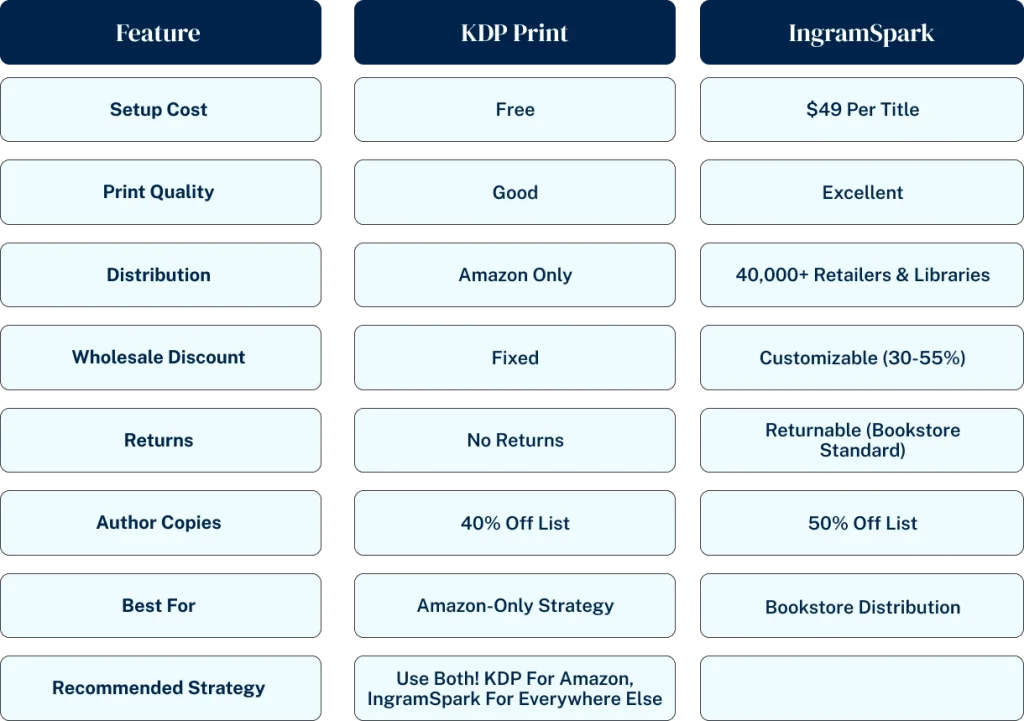
Our in-depth comparison, “KDP Print vs. IngramSpark: Which One Should You Use (and Why You Might Need Both),” breaks down the costs, quality, and strategic advantages of each.
Ultimately, the “Amazon vs. Wide” debate has no single answer. Many authors start in KDP Select to build an initial audience and then go wide later. Others go wide from day one to build a more resilient, long-term business. Analyze your goals, study your genre, and choose the path that feels right for you. You can always change your strategy later.
Pro tip:
Ebook exclusivity is separate from print exclusivity. You can enroll your ebook in KDP Select (Amazon exclusive) while distributing your print book widely through IngramSpark. This hybrid approach gives you access to Kindle Unlimited page reads while still getting your print book into bookstores and libraries. Many six-figure authors use this exact strategy.

Everything You Need to Publish Successfully: Cover, Formatting, & Legal Essentials

Publishing a book isn’t as simple as uploading a Word document and hoping for the best. A successful, professional-quality book is an assembly of carefully crafted assets, each one playing a critical role in how readers discover, purchase, and experience your story.
Before you can even think about hitting that “publish” button, you need to have all your materials in order. This includes a stunning, genre-appropriate cover; a perfectly formatted interior for both ebook and print; a unique ISBN for each format; and the necessary legal pages to protect you and inform your readers.
This section is your pre-flight checklist for publication. We’ll walk you through every essential asset you need to produce a book that looks and feels as professional as one from a major publishing house. We’ll explore the different paths to getting a killer Book Cover Design, whether you hire a pro, use a pre-made cover, or go the DIY route. We’ll demystify the technical world of Interior Formatting and compare the top software tools that make it easy.
We’ll explain what an ISBN is and why you need one, and provide a simple guide to the Copyright and Legal Pages every book should have. Investing time and resources here is non-negotiable; these elements are what separate an amateur product from a professional one.
Your Book’s #1 Marketing Tool: The Cover

Your book cover is the single most important marketing asset you have. Before a reader ever sees your brilliant prose or compelling plot, they see your cover. In a crowded online marketplace, your cover has less than two seconds to grab a potential reader’s attention and communicate your book’s genre, tone, and quality.
A professional, genre-appropriate cover signals that a professional author wrote the book. An amateurish cover screams “amateur” and will kill your sales before they even have a chance.
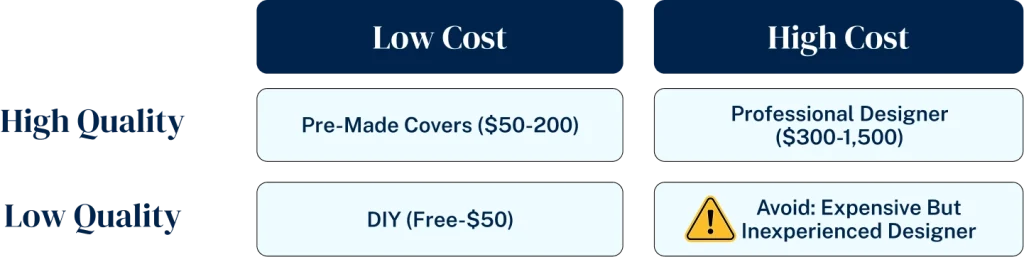
- Hiring a Professional Designer: This is the best option if you have the budget. A professional cover designer who specializes in your genre knows the specific visual language that appeals to your target readers. You can find talented designers on platforms like Reedsy, 99designs, and Fiverr Pro. Expect to pay anywhere from $300 to $1,500 for a high-quality cover. Our guide, “How to Find a Cover Designer in Your Budget,” provides a detailed breakdown of what to look for and what to expect.
- Pre-Made Covers: If a custom design is out of your budget, pre-made covers are a fantastic alternative. These are high-quality covers that designers create and sell on sites like The Book Cover Designer and Self-Pub Book Covers. You buy the cover, and the designer adds your title and author name. The cost is significantly lower (typically $50 – $200), and you get a professional-looking cover instantly.
- DIY Covers: We strongly advise against this unless you are a professional graphic designer. However, if you must go the DIY route, use professional tools and templates. Canva has thousands of book cover templates, and a tool like BookBrush is specifically designed to help authors create covers and marketing graphics. Our tutorial, “DIY Cover Design Tools That Actually Work,” can help you avoid the most common mistakes.
book cover design options comparison cost quality matrix
Pro tip:
Before hiring a cover designer, create a "comp sheet" of 5-10 bestselling covers in your sub-genre that you love. Screenshot them and send them to your designer with notes on what you like (fonts, colors, imagery, mood). This ensures you and your designer are on the same page and dramatically increases the chances you'll love the first draft. Use 99designs if you want to see multiple design concepts from different designers.
The Reading Experience: Interior Formatting

Interior formatting is the art of designing the inside of your book to be readable and professional. For ebooks, this means creating a reflowable file (usually an EPUB) that looks great on any device, from a Kindle to a smartphone.
For print books, it means designing a PDF with proper margins, headers, page numbers, and chapter headings. Poor formatting can ruin the reading experience and lead to bad reviews.
- Formatting Software (The Best DIY Option): For most authors, dedicated formatting software is the way to go. These tools are designed to be user-friendly and produce professional results for both ebook and print.
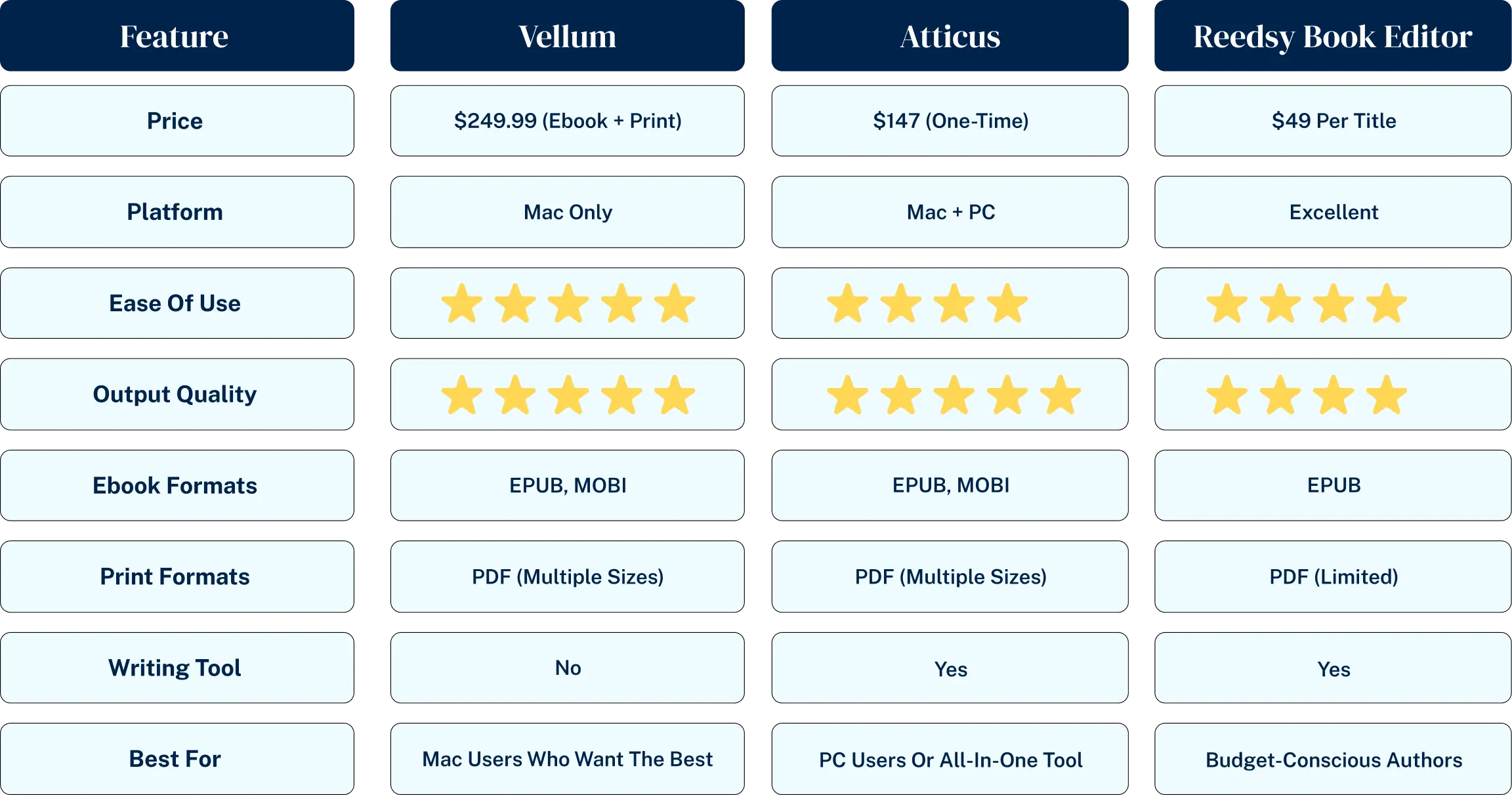
- Atticus: A powerful, all-in-one tool that works on all operating systems. It’s a word processor, formatting tool, and book-planning software rolled into one. (AFFILIATE OPPORTUNITY)
- Vellum: The long-time industry standard, known for producing beautiful, elegant interiors. It is famously easy to use, but it is Mac-only and comes at a premium price. (AFFILIATE OPPORTUNITY)
- Reedsy Book Editor: A free, web-based tool that handles both writing and formatting. It’s a great option for authors on a budget. Our side-by-side comparison, “Atticus vs. Vellum vs. Reedsy Book Editor,” will help you choose the right tool for your needs.
- Hiring a Formatter: If you have a complex book with lots of images or unique design elements, or if you simply don’t want to deal with the technical side of things, you can hire a freelance formatter on platforms like Fiverr or Upwork.
book formatting software comparison vellum atticus reedsy 2025
Your Book’s Fingerprint: The ISBN

An International Standard Book Number (ISBN) is a 13-digit number that uniquely identifies your book. Think of it as your book’s social security number. You need a different ISBN for each format of your book (ebook, paperback, hardcover, audiobook).
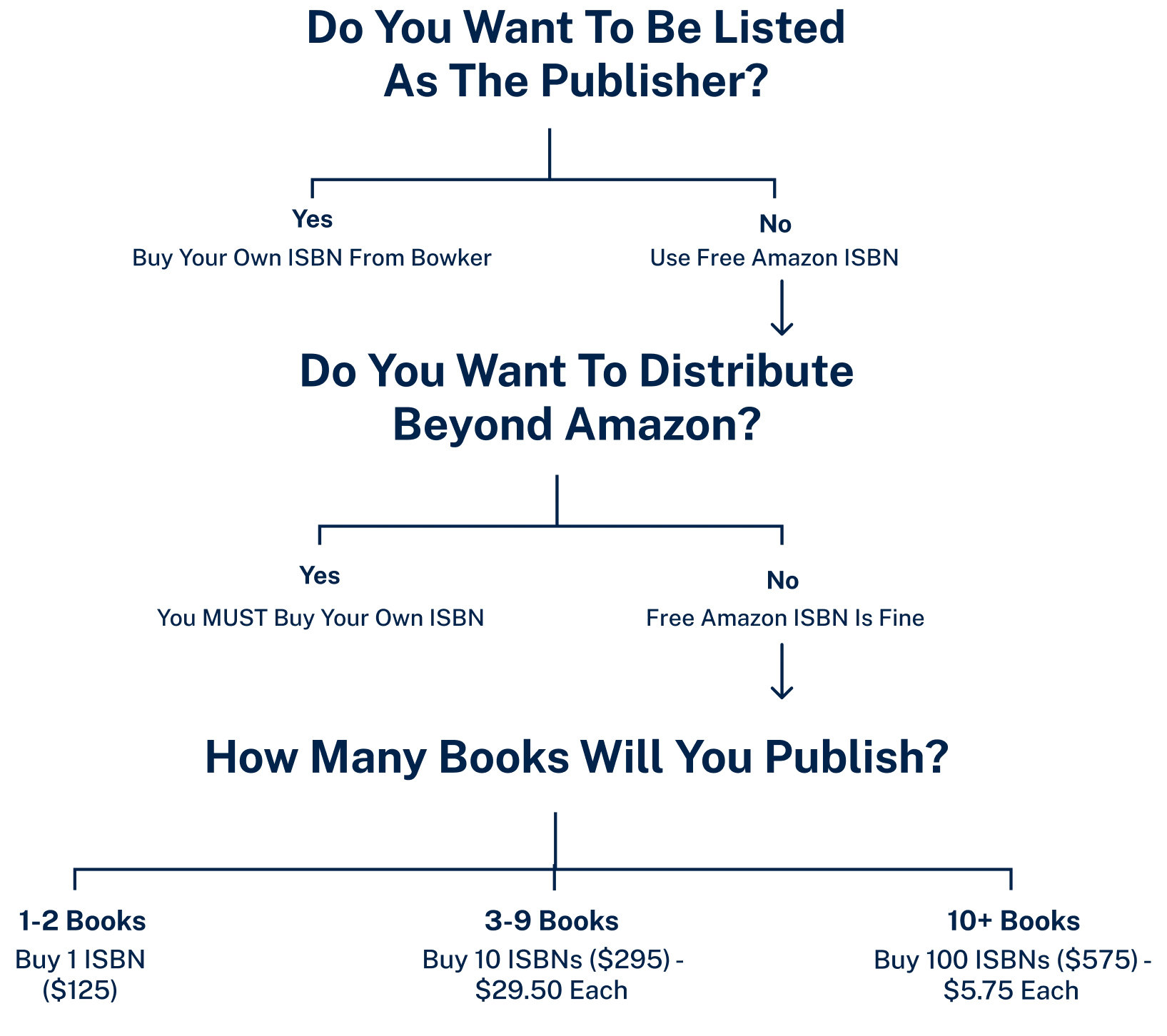
- Do you need your own ISBN? If you publish directly through a platform like Amazon KDP, they will assign you a free ISBN. However, this ISBN lists them as the publisher of record, and you can only use it on their platform. If you want to be the publisher of record and distribute your book widely through services like IngramSpark, you need to buy your own ISBNs.
- Where to Buy ISBNs: In the United States, ISBNs can only be purchased from Bowker. You can buy a single ISBN or a block of 10 or 100. Buying in bulk is significantly more cost-effective. Our guide, “Bowker vs. Free ISBNs: Do You Really Need to Buy Your Own?” explains the pros and cons in detail.
iSBN decision flowchart bowker vs free amazon iSBN
The Fine Print: Copyright and Legal Pages
Every book needs a few key pages at the beginning to protect your work and provide important information. These are typically found on the copyright page, right after the title page.
- Copyright Notice: This is a simple statement that asserts your ownership of the work (e.g., “Copyright © 2025 by [Your Name]”). While your work is technically copyrighted the moment you write it, you can also officially register it with the U.S. Copyright Office for added legal protection.
- All Rights Reserved: A standard legal phrase that indicates you reserve all rights to your work.
- ISBNs: List the ISBN for each format of the book.
- Disclaimers: For fiction, a standard disclaimer is “This is a work of fiction. Any resemblance to actual persons, living or dead, or actual events is purely coincidental.” For non-fiction, you may need disclaimers related to advice given (e.g., medical, financial). Our guide “Disclaimers and Legal Pages You Need for Your Book” provides templates you can use.
Pro tip:
f you're planning a series or a long-term author career, buy ISBNs in bulk from Bowker. A block of 10 ISBNs costs $295 ($29.50 each) versus $125 for a single ISBN. A block of 100 costs just $575 ($5.75 each). Remember: you need a separate ISBN for each format (ebook, paperback, hardcover, audiobook). Buying in bulk is a smart long-term investment.

7 Publishing Mistakes That Kill Book Sales (And How to Avoid Them)

Your book is finally published. It’s live on Amazon, a beautiful product of your hard work, ready to be discovered by millions of readers. You wait for the sales to roll in… and you hear nothing but crickets. It’s a heartbreakingly common scenario.
So many authors invest thousands of hours writing a brilliant book, only to see it disappear into the digital abyss because of a few entirely avoidable mistakes. These aren’t small details; they are fundamental errors that sabotage your book’s visibility and sales potential before it ever has a chance to find its audience.
This section is your guide to the seven deadliest publishing mistakes that can kill your book sales. We’re going to shine a light on the common traps that ensnare new authors, from amateur cover design and invisible keywords to a book description that doesn’t sell and a launch plan that doesn’t exist.
Understanding these pitfalls is the first step to avoiding them. By learning to think like a marketer from the very beginning, you can give your book the strong foundation it needs to not only survive but thrive in a crowded marketplace.
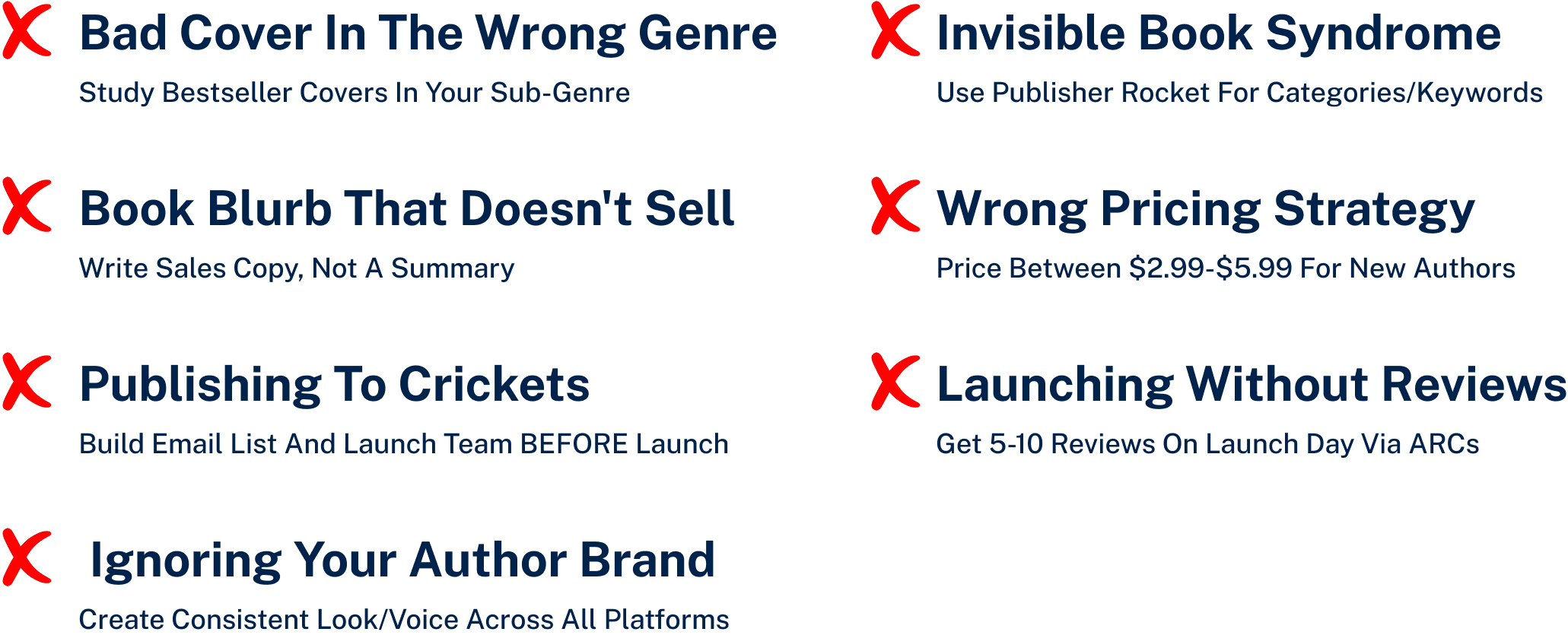
7 publishing mistakes that kill book sales checklist
Mistake #1
A Bad Cover in the Wrong Genre

We can’t say it enough: your cover is your #1 marketing tool. But a “bad” cover isn’t just one that’s poorly designed; it’s one that fails to meet the expectations of your target genre. Readers are incredibly savvy, and they judge books by their covers every single day.
A romance novel needs a cover that looks like a romance novel. A thriller needs a cover that looks like a thriller. If your epic fantasy has a cover that looks like a contemporary romance, the right readers will scroll right past it, and the wrong readers who do click will be disappointed.
- How to Avoid It: Study the bestseller lists in your specific sub-genre on Amazon. What fonts are they using? What is the color palette? What is the imagery? Your goal is not to copy these covers, but to understand the visual language of your genre so your cover instantly signals to the right readers: “if you like those books, you’ll love this one.” When you hire a designer from Reedsy or 99designs, make sure they specialize in your genre and provide them with examples of covers you like. Our guide “How to Spot a Professional Cover” shows you what to look for.
Mistake #2
Invisible Book Syndrome (Wrong Categories & Keywords)

Publishing your book on Amazon without choosing the right categories and keywords is like writing a brilliant message, putting it in a bottle, and tossing it into the ocean. No one will ever find it. Amazon is a search engine.
Readers find books by browsing categories and typing in keywords. Your job is to choose categories that are relevant but not overly competitive, and keywords that your target reader is actually typing into the search bar.
- How to Avoid It: This is where you need a secret weapon: Publisher Rocket. This software is the undisputed king of Amazon keyword and category research. It allows you to find less-competitive categories where your book has a real chance of hitting the #1 spot (which triggers a flood of visibility from Amazon’s algorithm). It also helps you find profitable keywords that readers are actively searching for. Don’t guess at this. A few hours of research with Publisher Rocket can be the difference between total obscurity and consistent daily sales. We have a detailed guide on “How to Research Profitable Categories and Keywords” that walks you through the process.
Pro tip:
Don't waste one of your 7 Amazon keywords on your book title, author name, or series name—Amazon already indexes these automatically. Instead, use all 7 keyword slots for phrases your target reader is actually searching for. Use Publisher Rocket to find low-competition, high-search-volume keywords like "small town murder mystery" or "enemies to lovers romance." This one change can 10x your discoverability.
Mistake #3
A Book Blurb That Doesn’t Sell

Your cover gets the click, but your book description (the blurb) gets the sale. Many authors make the mistake of writing a blurb that is a dry summary of the plot. Your blurb is not a book report; it is sales copy. Its only job is to be so compelling, so intriguing, and so emotionally resonant that the reader has no choice but to click “Buy Now.”
- How to Avoid It: Learn the classic formulas for writing blurbs that convert. For fiction, it’s typically: introduce the character and their world, present the inciting incident and the character’s goal, and hint at the conflict and the stakes. For non-fiction, it’s: identify the reader’s problem, agitate the problem by showing them the consequences of inaction, and present your book as the solution. Study the blurbs of the bestselling books in your genre and use them as a model. Our guide, “The Formula for Writing Converting Book Descriptions,” provides templates you can use.
book blurb examples good vs bad book description sales copy

Mistake #4
A Pricing Strategy That Repels Readers

Pricing your ebook at $19.99 because you think it’s “worth it” is a fatal error. Ebook pricing has its own psychology, and readers have strong expectations based on genre, author reputation, and format. Pricing your book incorrectly can make it dead on arrival.
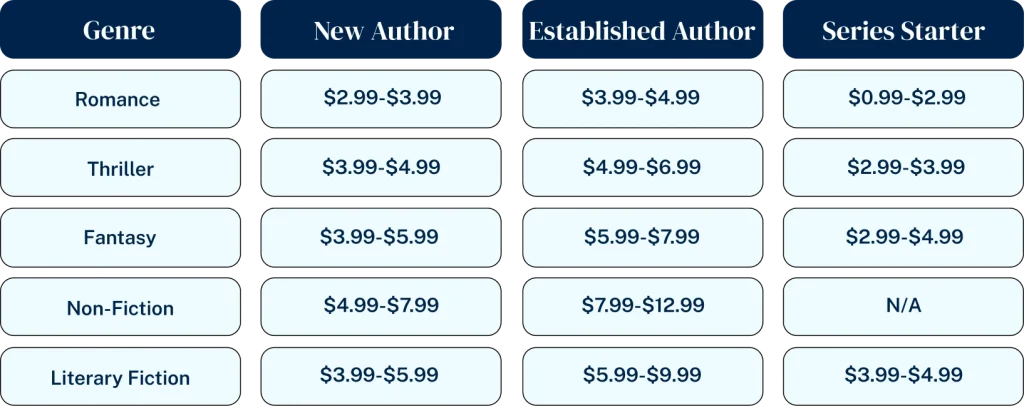
- How to Avoid It: For a new author, the sweet spot for a full-length novel is typically between $2.99 and $5.99. This price is low enough to encourage impulse buys but high enough to signal quality. Many authors launch a new book at a temporary discount price of $0.99 or $1.99 to drive initial sales and reviews before raising it to its regular price. Look at the top 100 books in your category. What are they priced at? That is what the market has decided your book is worth. Our deep dive on the “Psychology of Pricing for Authors” can help you develop a smart pricing strategy for your entire career.
ebook pricing guide by genre 2025 self publishing
Mistake #5
Publishing to Crickets (No Pre-Launch Plan)

A book launch is not a single day. It’s a three-month (or longer) process of building buzz and anticipation. Hitting “publish” without telling anyone beforehand is a surefire way to launch to zero sales and zero visibility. You need to build an audience before your book is available.
- How to Avoid It: The single most important asset you can have is an email list. Start building your list today by offering a free lead magnet (like a short story or a helpful checklist). Use an email service provider like MailerLite or GoHighLevel to manage your list and build a relationship with your readers. Weeks before your launch, you can recruit a “launch team” or “street team” from your most engaged subscribers who will get an advance copy of your book and be ready to leave a review on launch day. Our hub on Building Your Author Website and our Complete Guide to Email Marketing for Authors are essential reading.
Pro tip:
Start building your email list TODAY, even if your book won't be ready for 6-12 months. Offer a free lead magnet (a short story, a deleted scene, a character guide, or a helpful checklist) in exchange for email addresses. Use MailerLite (free up to 1,000 subscribers) or GoHighLevel (if you want advanced automation). By launch day, you'll have a warm audience ready to buy. Every author wishes they'd started their list sooner—don't be one of them.
Mistake #6
Launching Without Reviews
Reviews are “social proof.” They are the single most important factor (after the cover) that readers use to decide whether to buy your book. A book with zero reviews is a huge red flag for potential buyers. It signals that no one else has read it, so why should they take the risk? Launching with a plan to get at least 5-10 reviews on the first day is critical.
- How to Avoid It: This is where your pre-launch plan and your launch team come in. By giving your launch team an Advance Reader Copy (ARC) of your book via a service like BookFunnel, you can ask them to post their honest review on launch day. You can also use paid ARC services like Booksprout or NetGalley to get your book in front of reviewers. The key is to have a plan in place long before launch day. Our guide, “How to Get Your First 100 Book Reviews,” breaks down multiple strategies.
Mistake #7
Ignoring Your Author Brand

Your author brand is the promise you make to your readers. It’s the consistent look, feel, and voice across your website, your social media, your book covers, and your writing itself. A strong brand builds trust and turns casual readers into lifelong fans. Many new authors neglect this, resulting in a disjointed and unprofessional presence.
- How to Avoid It: Be intentional. Choose a professional author photo. Create a simple, clean logo. Use consistent fonts and colors across your Author Website and social media graphics (a tool like Canva makes this easy). Write your author bio and book descriptions in a consistent voice. Your brand is what makes you memorable. Our guide on “How to Build an Unforgettable Author Brand” will get you started.

Your Ultimate Book Launch Strategy From Pre-Launch Buzz to Bestseller Status

A book launch is not a passive event; it is a carefully orchestrated marketing campaign designed to generate maximum visibility, sales, and momentum in a short period of time. The most successful authors don’t just hit “publish” and hope for the best.
They spend months building anticipation, mobilizing a team of supporters, and stacking the deck in their favor to ensure their book launches with a massive splash. A strong launch can trigger Amazon’s algorithms, propel your book to the top of the bestseller charts, and create a wave of momentum that can sustain sales for months or even years to come.
This section is your complete, step-by-step playbook for launching your book like a six-figure author. We’ll break the launch process down into three critical phases: the Pre-Launch (90 days out), Launch Week (the 7 days of your launch), and the Post-Launch (the weeks and months that follow).
We’ll show you how to build a powerful Launch Team, how to leverage your Email List for maximum impact, and how to create a buzz that has readers counting down the days until your book is released. We’ll even link to our in-depth guide on “How to Execute a Complete Book Launch with GoHighLevel” for those who want to automate the entire process.
90 day book launch timeline checklist self publishing
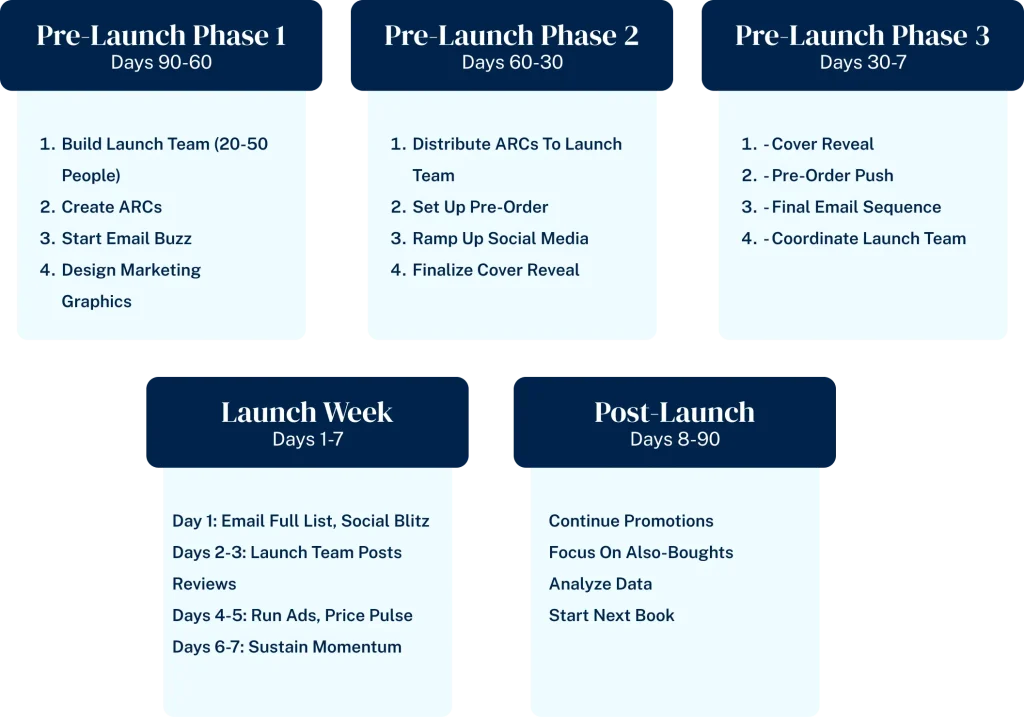
Phase 1
The Pre-Launch (90+ Days Before Launch)

The pre-launch phase is where the magic really happens. This is where you build your audience, assemble your team, and prime the pump for a successful launch. The work you do here will directly determine the success of your launch week.
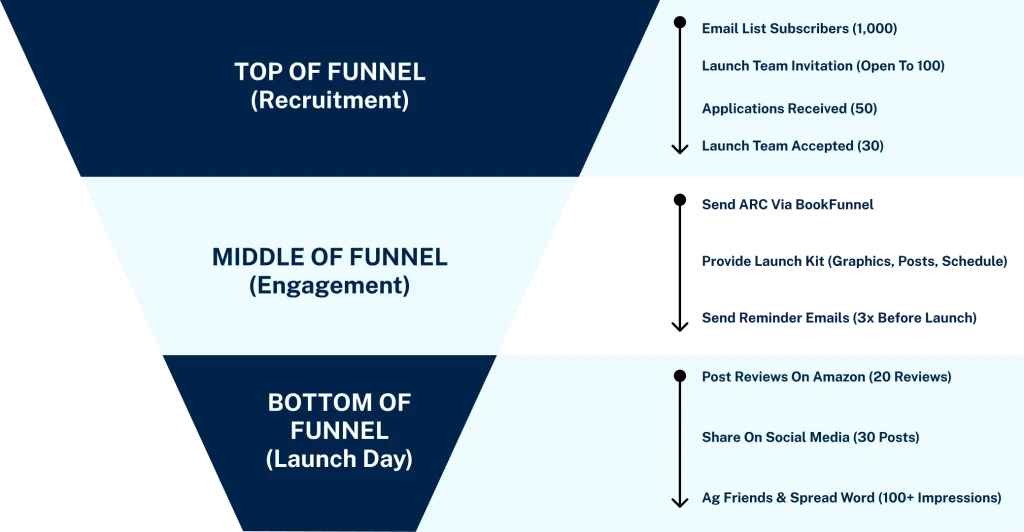
- Build Your Launch Team: Your launch team (or “street team”) is a group of your most dedicated fans who get an Advance Reader Copy (ARC) of your book and agree to help you promote it during launch week. Your goal should be to recruit at least 20-50 people. You can find them by asking your Email List subscribers, posting in your author Facebook group, or using services like Booksprout. Our guide “How to Build and Manage a High-Impact Launch Team” provides email templates and a step-by-step process.
- Create Your ARCs: An ARC is a near-final version of your book. You can create a digital ARC (as a PDF or EPUB file) and distribute it to your launch team using a secure service like BookFunnel or NetGalley. This prevents piracy and makes it easy for your team to read the book on their preferred device.
Pro tip:
Use BookFunnel to distribute your ARCs instead of emailing PDF files. BookFunnel is a secure platform that delivers your book directly to your launch team's e-readers and prevents piracy. It costs $20/year for unlimited books and unlimited readers, and it tracks who has downloaded your ARC so you can send targeted reminder emails. It's the industry standard for a reason.
- Start Your Email Buzz: Your email list is your single most powerful launch asset. Begin teasing your new book to your subscribers. Reveal the cover. Share snippets and behind-the-scenes details. Run a contest or a giveaway. The goal is to get them excited and emotionally invested in your book’s release. Our guide on “5 Essential Email Automations for Authors” can help you set up a pre-launch sequence.
- Set Up Your Pre-Order: Setting up a pre-order on Amazon KDP, Apple Books, and other platforms allows you to start accumulating sales before your book is even live. All pre-order sales are credited to your account on launch day, creating a massive spike in the sales charts that can help you hit a bestseller list. Our “Ultimate Pre-Order Strategy Guide” explains the pros and cons.
- Prepare Your Marketing Materials: Don’t wait until launch week to create your marketing graphics. Use a tool like Canva or BookBrush to design a suite of professional-looking graphics for social media, email newsletters, and ads. This includes “coming soon” graphics, cover reveals, quote graphics, and “available now” announcements.
book launch team recruitment funnel strategy.
Phase 2
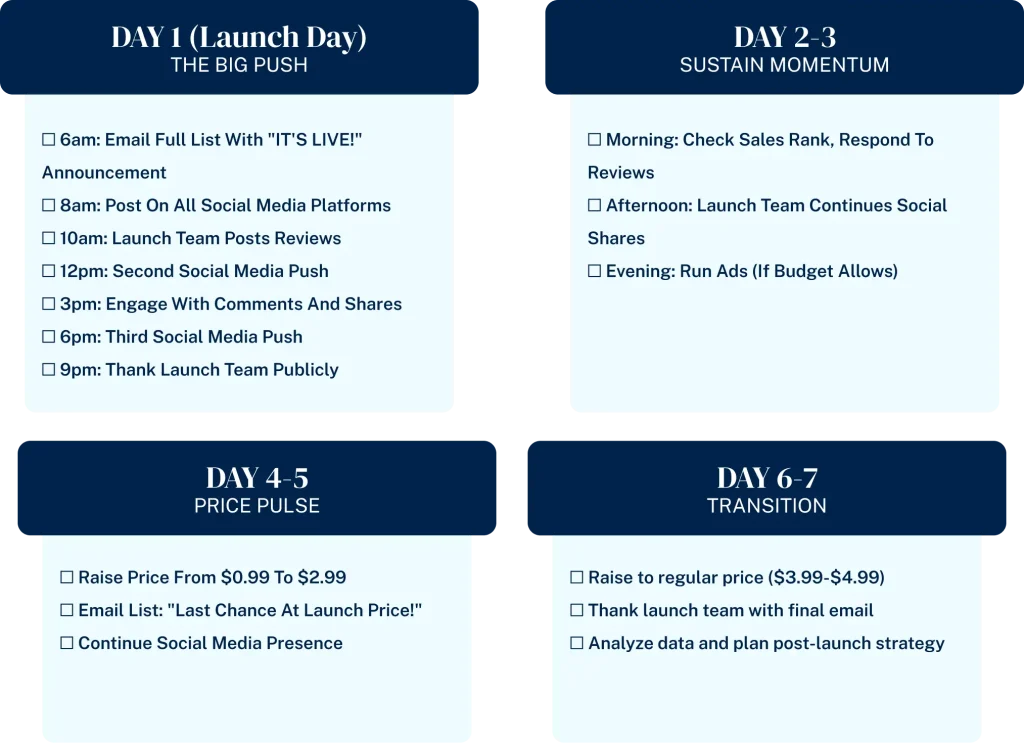
Launch Week (The 7-Day Blitz)
This is it. All your preparation leads up to this week. The goal of launch week is to drive as many sales as possible in a short period to trigger the algorithms on retail sites like Amazon.
- Day 1 (Launch Day): This is the most important day. Email your full list and announce that the book is live. Post relentlessly on all your social media channels. Ask your launch team to post their reviews and share your launch announcements. The goal is to get a flood of sales and reviews on the very first day.
- Coordinate Promotions: This is where a launch team is invaluable. Provide them with pre-written social media posts and graphics to make it easy for them to share. You can use a project management tool like Asana or even a simple Google Sheet to coordinate who is posting what and when.
- Run Launch-Week Ads: If you have the budget, launch week is the time to run ads. Amazon Ads and Facebook Ads can be highly effective at driving traffic to your book’s sales page. Start with a small daily budget and scale up what’s working. Our “Beginner’s Guide to Amazon Ads for Authors” can get you started.
- Price Pulsing: A popular strategy is to launch at a discount price (e.g., $0.99) for the first few days to drive sales, and then “pulse” the price up to its regular price ($3.99, $4.99, etc.) towards the end of the week. This creates urgency and rewards your early buyers.
book launch week daily checklist hour by hour schedule
Phase 3
The Post-Launch (The First 90 Days)

Your launch isn’t over after the first week. The goal now is to maintain momentum and transition into a long-term, sustainable marketing plan.
- Keep the Buzz Going: Don’t stop talking about your book. Continue to share reviews, post excerpts, and run promotions. The first 30-90 days are a critical window where Amazon’s algorithm is still paying close attention to your book.
- Focus on “Also-Boughts”: Amazon’s powerful recommendation engine works by looking at what customers also bought. Your goal is to get your book to appear in the “also-bought” section of other popular books in your genre. You can influence this by running Amazon Ads that target those specific books.
- Build Your Backlist: The most successful indie authors have a large backlist of books. The release of a new book will almost always lead to a spike in sales for your previous books. Start writing your next book! The best marketing for your last book is your next book.
- Analyze Your Data: Use the dashboards in Amazon KDP and other platforms to track your sales, page reads, and ad performance. What’s working? What isn’t? Use this data to refine your long-term marketing strategy. Our guide on “Using Data to Sell More Books” shows you what metrics to watch.
Pro tip:
The best marketing for your last book is your next book. Readers who love your first book will eagerly buy your second, third, and fourth. This is why successful indie authors publish 2-4 books per year. Focus 80% of your time on writing the next book and only 20% on marketing the current one. A growing backlist is the most powerful long-term marketing strategy you have.

Compare Top Publishing Tools Side-by-Side: Your Ultimate Author Toolkit

Being a successful self-published author means being the CEO of your own publishing company. And like any good CEO, you need a suite of powerful tools to help you do your job effectively.
From writing and formatting your manuscript to designing your cover and marketing your book, there is a tool for every step of the process. The right toolkit can save you hundreds of hours, produce a more professional product, and ultimately help you sell more books. But with so many options on the market, it’s hard to know which ones are worth the investment.
This section is your ultimate guide to the essential tools that six- and seven-figure indie authors use every day. We’re cutting through the noise to give you a side-by-side comparison of the best-in-class software and services for every stage of the publishing process.
We’ll compare the top Book Formatting Software, the best platforms for Cover Design, the essential tools for Keyword and Category Research, and the must-have services for Marketing and Distribution. This is a no-fluff, practical guide designed to help you build your author toolkit wisely, so you can invest in the tools that will actually make a difference to your bottom line.
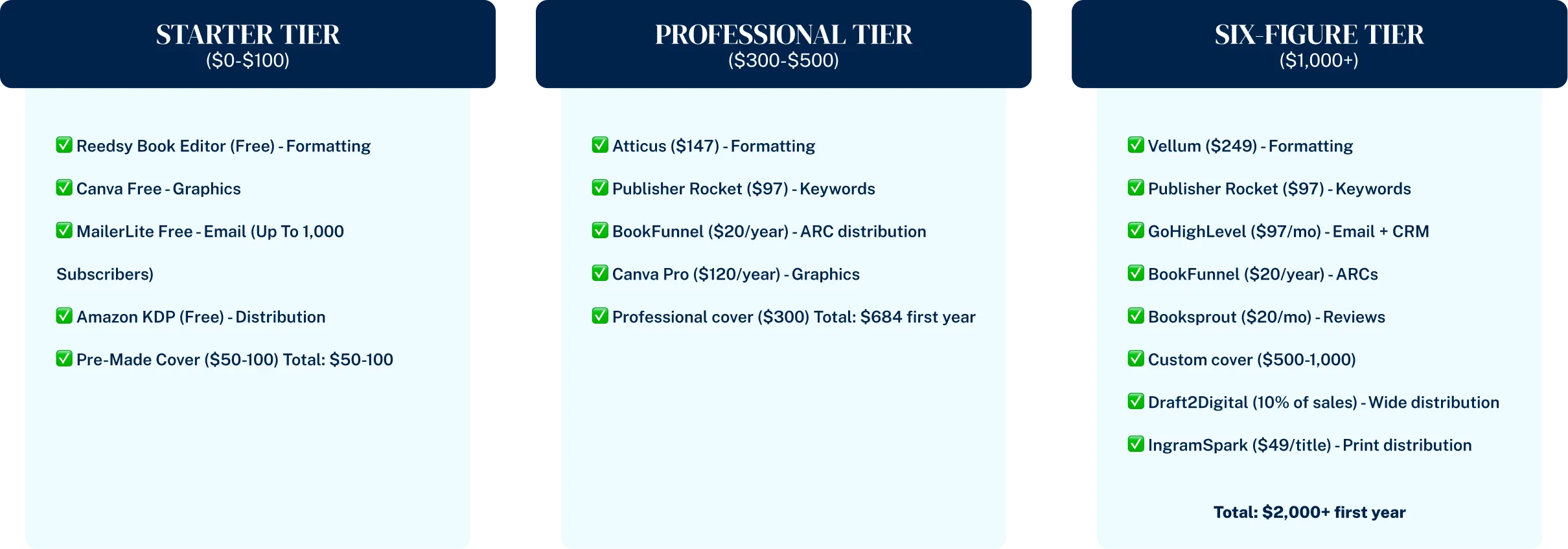
The Author’s Toolbox: A Side-by-Side Comparison
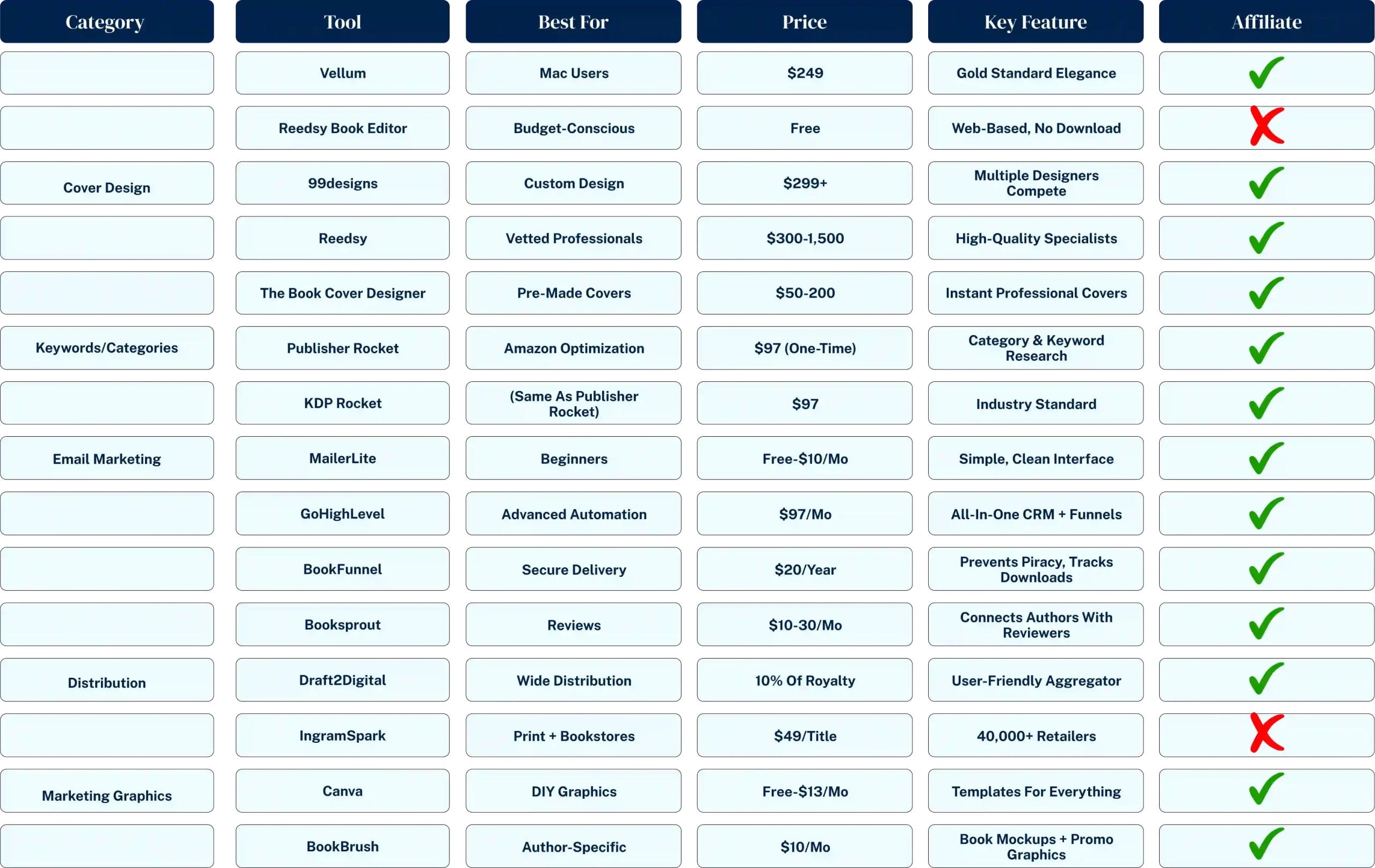
Pro tip:
Don't buy every tool at once. Start with the essentials (formatting software, Publisher Rocket, and a professional cover), then add tools as your income grows. Many successful authors reinvest their first $1,000 in book sales directly back into their author business by upgrading their toolkit. Treat your author career like a business, and invest strategically in tools that have a clear ROI.
author toolkit investment tiers budget professional six figure
Deep Dive: The Must-Have Tools
While every tool on this list is excellent, there are a few that we consider absolutely essential for a modern author career.
For Formatting
Atticus While Vellum has long been the king of formatting, its Mac-only limitation is a major drawback for many authors. Atticus has emerged as a true competitor that offers 95% of Vellum’s functionality, works on all platforms, and is constantly being updated with new features. It’s a powerful, one-time purchase that will handle the formatting for every book you ever write. Our Atticus vs. Vellum comparison goes into more detail.
For Research
Publisher Rocket You cannot be successful on Amazon without understanding keywords and categories. Publisher Rocket is the key that unlocks the Amazon algorithm. It takes the guesswork out of your research, allowing you to find profitable niches and the exact phrases readers are using to search for books like yours. It’s a one-time purchase that will pay for itself with your first book. Don’t publish without it.
For Distribution
Draft2Digital & IngramSpark If you want to build a long-term, resilient author career, you need to be available on more than just Amazon. Draft2Digital makes ebook distribution effortless, and IngramSpark is the only way to get your print book into the global distribution network that bookstores and libraries use. Using these two services in combination with Amazon KDP gives you a professional, global distribution footprint.
For Marketing
BookFunnel Building an email list is the most important marketing activity you can do. BookFunnel is the tool that makes it easy. It allows you to securely deliver a reader magnet (like a free novella) to new subscribers, and it’s the industry standard for distributing ARCs to your launch team. It’s an affordable, essential piece of your marketing infrastructure.
Pro tip:
Your email list is your most valuable asset as an author. It's the only marketing channel you truly own—Amazon can change its algorithm tomorrow, but your email list is yours forever. Even if you're 12 months away from publishing, start building your list today with a simple lead magnet. Use MailerLite (free up to 1,000 subscribers) and send a monthly newsletter with writing updates, book recommendations, or behind-the-scenes content. By launch day, you'll have a warm audience ready to buy.
author toolkit investment tiers budget professional six figure
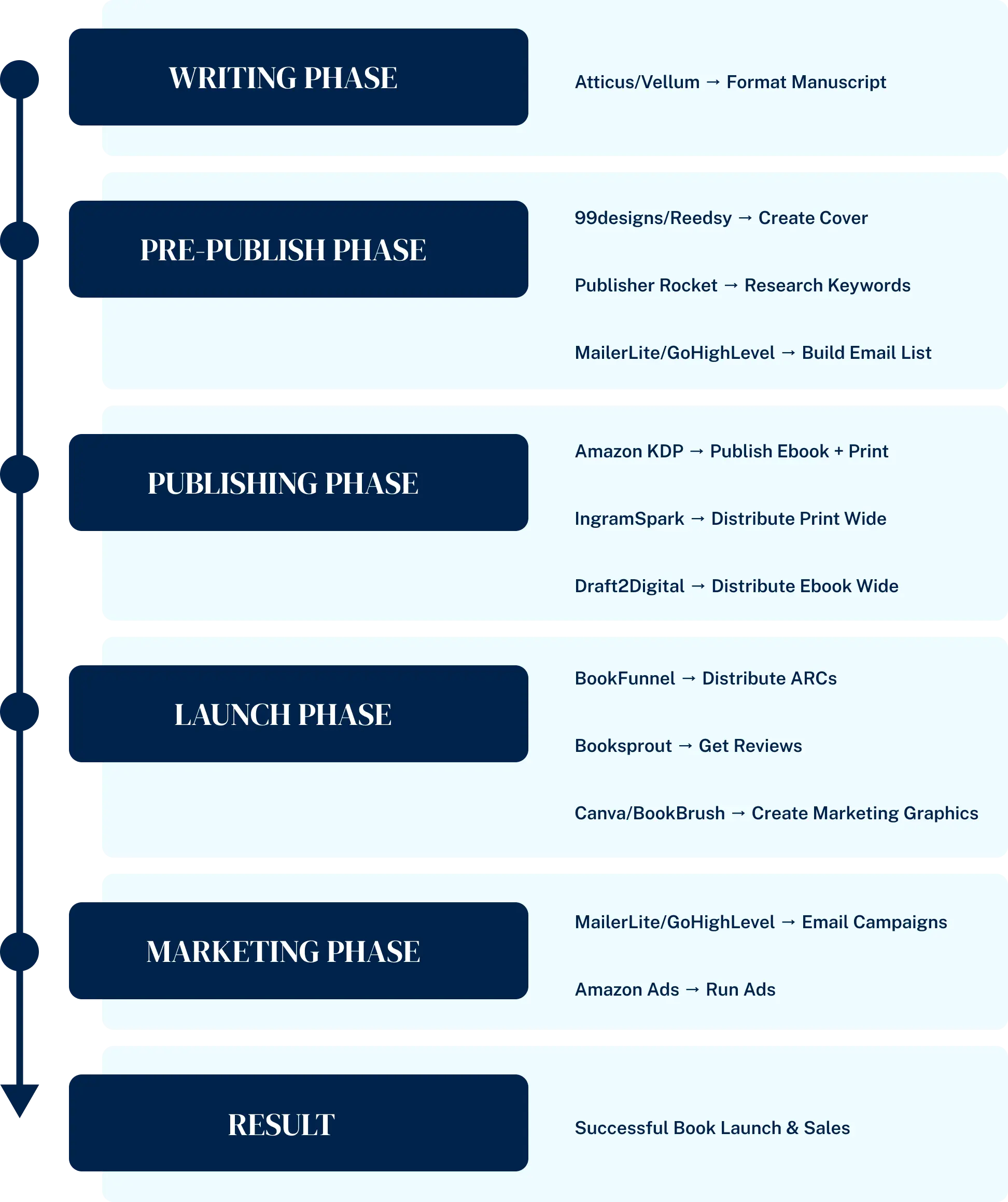
Building your author toolkit is an ongoing process. You don’t need to buy everything on this list on day one. Start with the essentials—a great formatting tool and Publisher Rocket—and then add to your toolkit as your career grows. By investing in the right tools, you are not just buying software; you are buying time, professionalism, and a better chance at success.
Everything was laid out in simple, actionable steps, and the linked guides went deep without overwhelming me.
When I typed ‘The End’ on my manuscript, I expected to feel relief — but what came next was pure confusion. I had no idea how to actually publish my book. Every article I found online gave different advice, and every ‘expert’ seemed to push a paid course or service. I didn’t know whether to self-publish, pitch agents, or even what half the jargon meant — ISBNs, metadata, distribution rights — it was all a mystery.
Then I found Authors Help Kit, and honestly, it changed everything. It felt like having a calm, experienced guide walk me through the chaos. Each section was laid out logically — first the big-picture roadmap so I could see the whole journey, then detailed step-by-step guides for each decision point. I finally understood why things mattered, not just what to do.
Two months later, my debut novel is live on Amazon, Apple Books, and Kobo — and I did it all myself, confidently. The Hub gave me not just knowledge, but peace of mind.
Marco R,.
Author