The Author’s #1 Asset
Every successful author will tell you the same thing: Your email list is your most valuable asset. It is the one place you own the relationship with your reader, bypassing the whims of Amazon, Facebook, and Google.
Choosing the right email service provider (ESP) is the most critical decision you will make after finishing your manuscript. AWeber and ConvertKit are two of the most popular choices in the author community, but they are built on fundamentally different philosophies: one is built for simplicity and reliability (AWeber), and the other is built for tagging and segmentation (ConvertKit).
Choosing the wrong one can cost you money, deliverability, and a massive headache when setting up your first book funnel.
The Quick Verdict
For the vast majority of authors, especially those new to email marketing or focused on simplicity, AWeber is the most reliable, cost-effective, and user-friendly choice. For the advanced "Authorpreneur" running complex courses and funnels, ConvertKit offers superior segmentation features.
Quick Verdict: At-a-Glance Comparison
Feature | AWeber | ConvertKit | Winner |
Pricing Model | List-Based (Simpler) | Subscriber-Based (Better for Segmentation) | ConvertKit |
Free Tier | Yes (up to 500 subscribers) | Yes (up to 1,000 subscribers) | ConvertKit |
Automation | Drag-and-drop, reliable | Visual, powerful, complex | ConvertKit |
Ease of Use | Extremely User-Friendly | Moderate Learning Curve | AWeber |
Author Focus | Simple list building, high deliverability | Advanced Tagging, Course Sales | ConvertKit |
Pricing and Author Budget: The List vs. Subscriber Debate
The way these two platforms charge you is the single most important factor for an author’s budget.
AWeber’s List-Based Pricing: Simple and Predictable
AWeber charges you based on the total number of subscribers across all your lists. If a subscriber is on two lists (e.g., “Fantasy Readers” and “Newsletter”), they are counted once.
- Free Plan: Up to 500 subscribers, all features included.
- Paid Plans: Start at $16.15/month for 501-2,500 subscribers.
- Advantage: Predictable and easy to understand.
ConvertKit’s Subscriber-Based Pricing: The Tagging Advantage
ConvertKit charges you based on the total number of unique subscribers. They operate on a single “master list” where you use tags and segments to organize people.
- Free Plan: Up to 1,000 subscribers, limited features (no automation).
- Paid Plans: Start at $9/month for 1,000 subscribers.
- Advantage: You can run incredibly complex funnels and target emails to a hyper-specific group (e.g., “Fantasy Readers who bought Book 1 but haven’t opened my last 3 emails”).
Winner: ConvertKit’s subscriber-based model is better for advanced segmentation, but AWeber’s list-based model is simpler and more cost-effective for a basic author newsletter.
Automation and Funnels: Setting Your Book Sales on Autopilot
Automation is the core of an author’s email strategy. This is how you deliver your reader magnet, welcome new subscribers, and sell your backlist books without lifting a finger.
ConvertKit’s Powerful Visual Automation
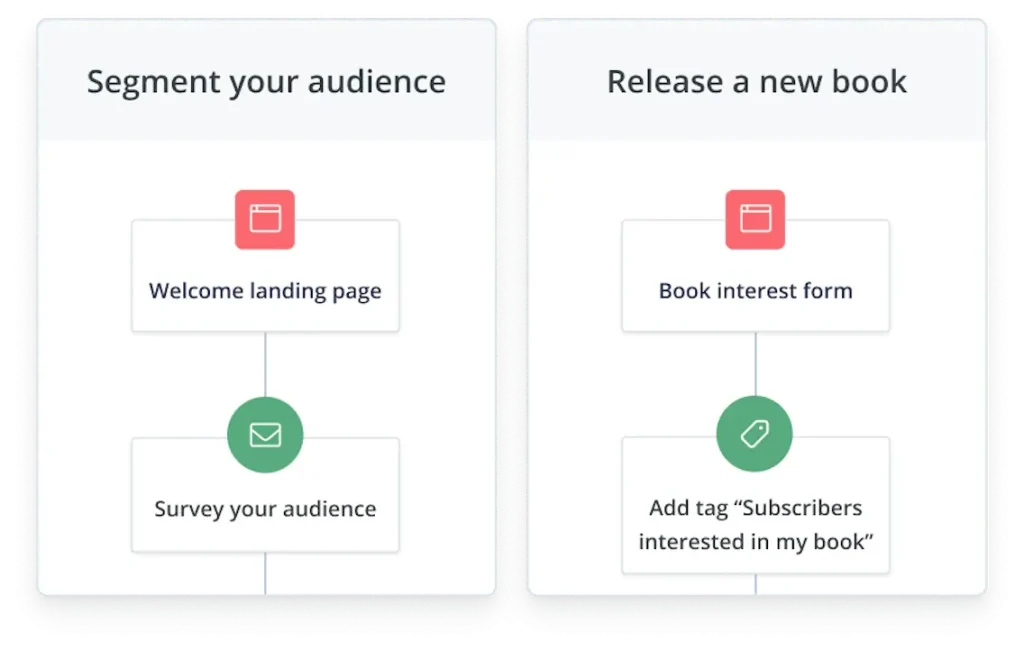
ConvertKit uses a visual automation builder that looks like a flowchart. You can easily set up complex rules: If subscriber clicks Link X, then tag them “Bought Book 1,” then remove them from the “Book 1 Sales” sequence.
- Pros: Extremely powerful, excellent for selling courses, running complex launches, and highly personalized funnels.
- Cons: Can be overwhelming for beginners. The learning curve is steeper.
AWeber’s Reliable, Simple Automation
AWeber’s automation is drag-and-drop and very straightforward. It’s designed to handle the 90% of tasks an author needs: welcome sequences, lead magnet delivery, and simple follow-up sales.
- Pros: Easy to set up in minutes, highly reliable, and their support team is excellent.
- Cons: Lacks the deep, multi-level logic of ConvertKit.
3. Landing Pages and Forms: Capturing the Reader
You need a simple, high-converting way to capture email addresses (your reader magnet).
ConvertKit’s Built-in Landing Pages
ConvertKit offers excellent, clean, and modern landing page templates built right into the platform. They are designed to convert and require no separate website integration.
- Pros: Looks professional, high conversion rate, no coding required.
- Cons: Limited design flexibility compared to a dedicated page builder.
AWeber’s Forms and Landing Pages
AWeber offers both forms and landing pages. Their forms are easy to embed on your website, and their landing page builder is robust, offering more design customization than ConvertKit.
- Pros: More design options, easy to integrate with any website.
- Cons: Some of the templates can look a bit dated if not customized.
4. Deliverability and Support: The Hidden Costs
Deliverability (getting your email into the inbox, not the spam folder) is non-negotiable.
Deliverability
Both AWeber and ConvertKit have excellent reputations for deliverability. They both actively monitor their servers to ensure your emails reach the primary inbox. This is a major advantage over cheaper, less-reputable services.
Customer Support
- AWeber: Known for having some of the best support in the industry, offering phone, chat, and email support.
- ConvertKit: Primarily relies on email and chat support, which is excellent but lacks the immediate phone option.
Final Verdict: Who Should You Choose?
The decision hinges on your current stage and technical comfort level.
Choose AWeber If…
- You are a new author or new to email marketing.
- You prioritize simplicity, reliability, and ease of use.
- You want excellent customer support (phone access).
- You want a predictable, list-based price that is easy to budget.
- Your Goal: Build a simple, robust newsletter and a basic welcome sequence.
Choose ConvertKit If…
- You are an advanced authorpreneur selling multiple courses, coaching, or products.
- You need complex segmentation and tagging (e.g., separating buyers from non-buyers).
- You are comfortable with a steeper learning curve for powerful automation.
- Your Goal: Run highly personalized, multi-stage sales funnels.